
by Petrit Latifi.
Another Albanian script from the 7th century BC is brought by Nikos Stilos, who proves that Albanian scripts are mostly found in antiquity. As the best expert on the alphabets of antiquity, Stilos brings, with an already known alphabet, a script from Phrygia (in present-day Turkey).

Photo 1: “This monument, erroneously called the “Tomb of Midas”, is located in the so-called “City of Midas”, Turkish “Midas Şehri”, which is about 50 kilometers northeast of Afyonkarahisar, in the present-day village of Yazilikaya in the Turkish province of Eskişehir, which together with Gordium are the most important Phrygian archaeological sites. I say it is wrongly called “Tomb of Midas” because the tomb of Midas, of which I also provide the following photo, is known to be located in Gordium.
A and B. Photograph from afar of the monument with a partial view of the village of Yazilikaya. B. Tomb of Midas at Gordion.
On this monument, as we see in the above illustration of it by F. M. C. Texier, there are two inscriptions, one on the upper part and the other on the right side of it, which, owing to the fact that the transcriptions known to me do not agree, I give to the other photograph of it, which is the best I know, which inscription I repeat and write clearly:
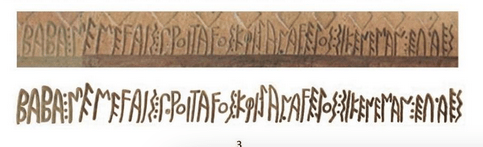
Translation: “Babaji, I will give you my word, I will give you my word.”
The Phrygians
The Phrygians were a population that spoke and wrote in Albanian. If the albanologists of Tirana accept Albanian scripts only in the Monastery alphabet and have set the limits of research (not to be exceeded) at the “baptism formula”, this does not apply to the albanologist and independent scientist Nikos Stilos, who promised me that one Saturday, not another, there will be posts of ancient Albanian scripts on A. Dalipaj’s Facebook page.
Stilos also sent me an Albanian inscription from Knossos in Crete, dating back to the tenth century BC. Contrary to those who teach students the Slavic lie that Albanian is the youngest language in Europe (only 1500 years old), Stilos reveals the great truth of the Albanian nation written in marble since antiquity.
Odysseus and the Pelasgian language

Photo 2: “Odysseus, when he captured a Phrygian, forced him to write a treasonous letter, which Priam supposedly sent to Palamedes. And after burying the gold in Palamedes’ tent, he threw the letter into the camp. Agamemnon, as soon as he read it and found the gold, handed it over to his comrades-in-arms to stone him as a traitor”
“Considering the information we find in Diodorus about the poem composed by Thymoitis, the grandson of Laomedon, who lived at the same time as Orpheus, the so-called “Phrygian poem”, that it was written in the “archaic language and letters”, and in other words in the Pelasgian language and letters, although we know very little about the Phrygian language, I will simply mention that one of the works of Phrygian literature, known throughout the world as “Myths of Aesop”, continues to be read today translated into dozens of languages.”
Without dealing here with what has been written about the Phrygian language, I will transfer here only what we find in Plato:
“Well, consider the following, if the word πυρ fire is barbarous, for it is not easy to connect it with the Greek language, and the Phrygians doubtless have the same word slightly altered, as they have ύδωρ (water), κύνας (dog), and many other words.”
Of these words, identifying the Phrygian language with the Arnaut language spoken today in Turkey, I will simply say that the “κύνας” called in ancient Greek by the Arnaouts is called ken (dog), with the explanation that the Attic dialect uses y instead of e”
Of the characteristic inscriptions of the early Phrygians in this article we will see only one written and more precisely engraved on the second of the ancient Phrygian monuments that I have given above, and for which I am also giving the other illustration, which was made in 1882 by F. M. C. Texier.”
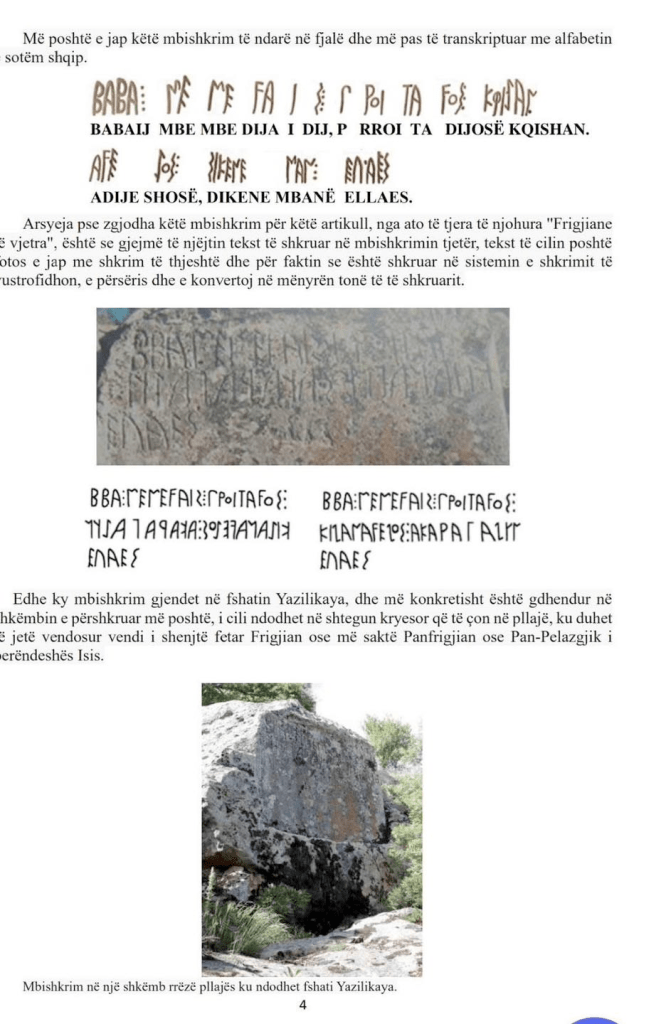
Photo 3: Below I give this inscription divided into words and then transcribed with today’s Albanian alphabet.
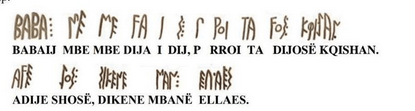
“BABA NE ME FAL&G ROI TA EOS KANAS
BABAIJ MBE MBE DIJA I DIJ, P RROI TA DIJOSË KQISHAN.”
FAREWELL SHOSE, KEEP THEM ELLAES.”
Translation: Babaji, I will give you my word, I will give you my word.”
The reason why I chose this inscription for this article, from the other known “Old Phrygian” ones, is that we find the same text written in the other inscription, text which below the Photo I give in simple writing and due to the fact that it is written in the Ustrophidhon writing system, I repeat it and convert it to our way of writing.
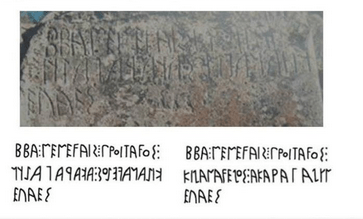
“BBA:MEMEFARECPOITAROS: ELAES
ΒΒΑΓΕMEFAR SPOLTFOS ΕΛΑΕΣ”
This inscription is also found in the village of Yazilikaya, and more specifically it is carved on the rock described below, which is located on the main path leading to the plateau, where the Phrygian or more precisely Pan-Phrygian or Pan-Pelasgian religious sanctuary of the goddess Isis must have been located.

Inscription on a rock at the foot of the plateau where the village of Yazilikaya is located.
Photo 4: Below I give both texts written one below the other, even with the color changed on the common words that do not agree. According to this comparison, we can say that these inscriptions were written in two different dialects and with alphabets that are not identical.

In these inscriptions of special interest I find the name of the church, written in the first inscription (KQISHAN) and in the second KMA (KISHAN). Name for which in G. von Hahn’s dictionary we have information that the church in the Tuscan dialect is called zjiöe (church), in Georgian xíře (church) and in Chamerishteljiöe (church).
Considering Plato’s writings that the Phrygians and the Greeks had many of the same words slightly changed, we can say that we have two of them in the above texts, the word 1 which the Greeks call ΕΚΚΛΗΣΙΑ and even write it with two K, and (SHOSË) and Greek ΣΩΘΕΙ.
Below I give the table that includes the letters of both inscriptions, where we can see very well the differences between these two alphabets.
Table of letters of two inscriptions
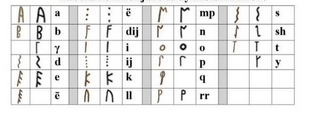
Considering the above about the origin of the Phrygians, namely that Xanthos Lydos regards them as Thracians and Herodotus as Macedonians, considering that the alphabet of the first inscription has two different E’s written and, I find it interesting that the so-called Bulgarian Glangolic alphabet, that this also has two E’s, written and €, of which, as we can see, one, and indeed the one used to write the long E, is also written with two internal horizontal lines.
Excerpt from the table of the Glagolitsa alphabet

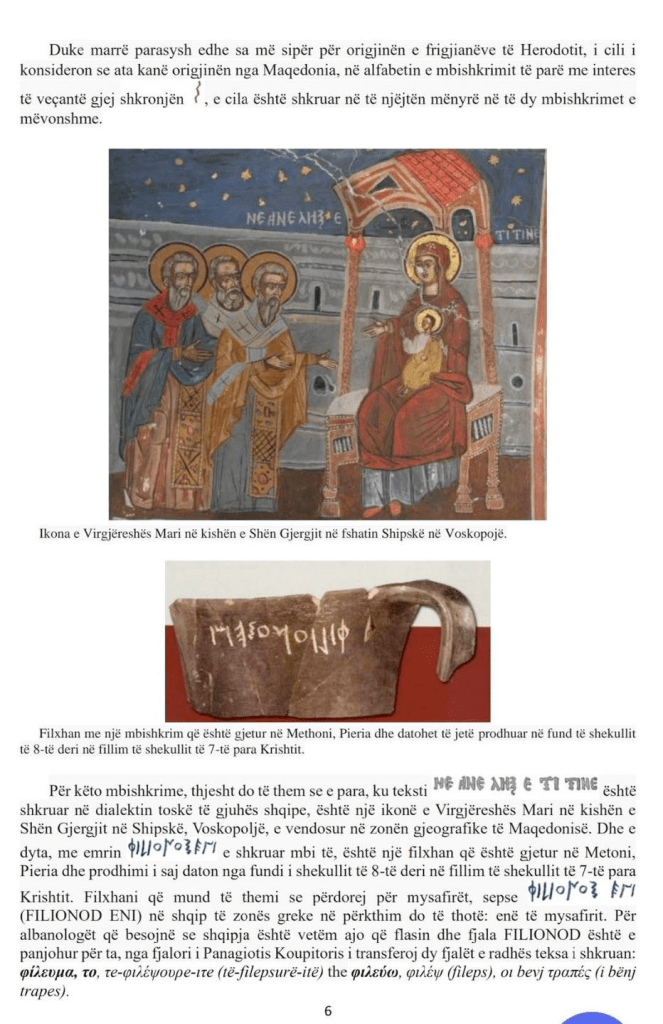
Photo 5: Considering the above about the origin of the Phrygians of Herodotus, who considers them to have originated from Macedonia, in the alphabet of the first inscription of interest I find the letter which is written in the same way in both later inscriptions.

The icon of the Virgin Mary in the church of Saint George in the village of Shipskë in Voskopoje.

Cup with an inscription found at Methoni, Pieria and dated to late 8th to early 7th century BC.
Regarding these inscriptions, I will simply say that the first one, where the text:

is written in the Tuscan dialect of the Albanian language, is an icon of the Virgin Mary in the church of Saint George in Shipska, Voskopolje, located in the geographical area of Macedonia. And the second, with the name:

inscribed on it, is a cup that was found in Metonia, Pieria and its manufacture dates from the late 8th to early 7th century BC. The cup that we can say was used for guests, because:

(FILIONOD ENI) in Albanian of the Greek area in translation means: vessel of the guest.
For albanologists who believe that Albanian is only what they speak and the word FILIONOD is unknown to them, I transfer the following two words from the dictionary of Panagiotis Koupitoris as he writes them:
φιλευμα, το, τε-φιλεπτέρε-ite (to-filepsure-it) the φιλεύω, φιλέψ (phileps), οι bevj τραπές (i trapes).
Translation: “to love, to, to-filepsure-it the to love, to love (phileps), the to bevj trapes (i trapes).”
References
Apollodorus Library, (trans. I.M. Hatzifotis), Georgiadis, Athens, c.h. Compendium III.
Plato, Cratylos or On the Correctness of Names, Cactus, Athens, 1994. 4104.
“Athys … – For him, instead of him, he is needed.” Grammatiki Graeci, Georg Olms Verlagsbuchhandlung, Hildesheim, 1965. Scholia Londinesia (AE) in artis Dionysianae, p. 464.
xjiöe-a, given xίσε-a, church. Johann Georg von Hahn, Albanian Studies, published by Friedrich Mauke, Jena, 1854. Reprint published by Dion Karavias, Athens, MCMLXXI, Volume III.
Carl Faulmann, The Book of Scripture, Containing the Characters and Alphabets of All Times and All Peoples of the World. Ëien, 1880. Printed and published by the Imperial-Royal Court and State Printing Office. P. 184.


 Balkan Academia