
Petrit Latifi
WAR OF KRAJA, 8 – 11 OCTOBER 1912. The text is taken from the book “1912-1913 Balkan Harbinde İşkodra müdafaası” by Abdurrahman Nafiz, Kiramettin, published in 1933, pp. 249-262.
“Montenegrins advance from the south of the lake, Battle of KrajëOn 6 – October (Hijri: 23 – September), the first Montenegrin troops arrived at our border with Krajë and set up a tent camp and the Muslim population on our side was notified by the governor of Krajë of Montenegro that they should not fire weapons at the Montenegrin soldiers and surrender, otherwise their property, children and homes would be destroyed and plundered.”
Montenegro closed its borders to Muslims and left them open to Christians.On 7 – October (Hijri: 24 – September) it was reported that the Montenegrins had begun to secure many ships and boats in Ulcinj to build a bridge on the Buna River. At noon today, cannon shots were heard from the area of Tivar. It was found that the Montenegrins had experience of attack.
The military troops of Shkodra knew shortly before the war that Montenegro was concentrated in Berane with one brigade, in Podgorica with two brigades and in Tivar with one brigade on the border of Kraja; Kraja and Anamalit, squeezed between the lake and the Buna river, are generally roadless areas. Only the busiest road of Gorica, with some repairs, was suitable for field artillery as far as Rizigaki (Rrezikaqe – Krythë).
The Montenegrins also brought their siege guns in this way after some repairs. The other roads consist of steep paths. The people of this region are almost entirely Muslim. There are Catholic Albanians only on the banks of the Buna. This border, from Lake Shkodra to Pulaj, along the Buna river, was protected by the Shkodra Border Brigade of 250 men.
Since the Muslim population in that area had been expelled, anyone who took up arms would reinforce the nearby border post. On 8 October (25 September), the day Montenegro declared war on the Ottoman government, Montenegrin forces crossed the border. They occupied the border posts of Klesna and Rrezikaqe.
They completely burned down the Muslim village of Shas on the shore of Lake Shas. The people fled. Advancing (from the village of Klesna – Shas) with three battalions, the advanced enemy units reached the line (Goriča – Selitë) on the evening of 9 October (26 September). There was no breakthrough from the north towards Kraje. They hit the village of Pulaj with artillery from the direction of Shenkollit on the Buna River. On 9 October (26 September) the enemy burned down the Muslim villages of Bojk, Kalimad, Milla, Rashtisha Kosik and Selitë (Sukobine).
It was seen that he brought his soldiers, who had boarded boats to conquer the Kraje region, from the lake on the evening of October 9 (September 26) and returned them to the Karadag border and from there he advanced. About 24 Londons could be counted that day. On the evening of October 9 (September 26) in Shkodër, the Muslim population of the villages of Arbeneş, Ostros i Madh, Ostros i Vogël and Zogaj of the Kraje district took refuge.
On October 10 (September 27) the enemy stood on the line (Gorica – Selitë). He burned only the Muslim villages in the Kraje region and advanced to the line (Zogaj-Selita). On the bank of the Buna from Fraskanjeli to Pulaj there was gunfire and artillery fire between the people who supported us, the border troops, the gendarmes and the Montenegrins.
On October 11 (September 28), the first major battle (the Battle of Kraje) took place. With the declaration of war, the Montenegrins crossed the border and approached the western front of Shkodra, creating a frightening situation. A force from the general reserve of the fortress was sent to prevent this attack in the Trabosh region, where the fortifications had not yet been completed to face the enemy from the front.
This company, sent under the command of Major Sadeddin Bey, commander of the 70th Infantry Regiment, included: The 24th Rifle Battalion, 2 battalions of the 70th Infantry Regiment, 1 battalion of the 71st Infantry Regiment, a machine gun company of the 70th Infantry Regiment (3 rifles), a platoon from the machine gun company of the 71st Infantry Regiment (2 rifles), and a rapid-fire mountain battery (5 guns).
This company set off from the eastern bank of the Buna towards Muriqan at 20:00 (half past two) on the evening of 9/10 – October 1912 (26/27 – September – 328). Since the decks of the Boyana River bridge were not yet completed, the company spent the night on the opposite bank in boats. The weather tonight was partly cloudy and very sunny. Although the path to be followed was irregular, it was not muddy.
The soldiers had all their equipment (bag, water bottle, portable tent, bag with ammunition and bread, portable fortification equipment). Each infantryman had 150 cartridges on him. Each soldier carried 30 cartridges in combat weights. There was a two-day supply of food in Efrat. In large quantities, for each soldier, fractures and roasted meat were purchased for three days and for the animals only barley was purchased for three days.
After crossing to the western bank of the river, the platoon commander gave the following verbal order (Map – 7, 8, 9): Buna Bridge in the West via Muriqanit Road10 – October – 1912 (26/27 – September – 328) EWednesday 0:50 / Thursday 7:15 “1- The enemy is on the Kravarit-Gorica line, our fortress units are in Fesattepe. 2 – The platoon will follow the Muriqan road and will go up to Muriqan to attack the enemy on this line.
The sniper battalion is on guard. The order of march is as follows: 2nd Battalion of the 70th Infantry Regiment Mountain B.I of the 70th Infantry Regiment. Team of the 71st Infantry Regiment Mt Two companies from the 1st battalion of the 71st Infantry Regiment Rapid fire mountain battery Two companies from the 1st battalion of the 71st Infantry Regiment.
The battalion will soon advance along the road (Shkodra – Muriqân). The section will follow the ash-filled pistachio from 800 meters. It will scout both sides with the guidance of the people (Guides) assigned to it. The reconnaissance wing that will go to the right flank will be the officers’ reconnaissance wing. This officers’ reconnaissance team will also guard the platoon wing.
The march will start at five o’clock (eleven thirty). By this time the contingents will organize themselves. During the movement, they will take their places in the marching columns and cover their distance. The first break will be at five thirty (twelve o’clock) and will last ten minutes, and then there will be a ten-minute break every hour on the hour.4 – The heavy weights section will march 2 kilometers from the compound.
The Muhaxhirs will stay in the Muriqân neighborhood (Hamidiye Muhacir village) and await orders.5 – I am on guard at the guardhouse”. Continuing the march, the platoon stopped on the Kodrac ridge. The enemy appeared in and around the village of Goriçë, on the Krajes mountain range at 750 and around. It was seen that the Montenegrins were descending the mountain in groups and were burning the Muslim neighborhoods of Vallas and Kravar.
At 11:40 on October 10 (6:10 on September 27) the platoon commander gave the following verbal order to the commander of the 2nd battalion of the 70th regiment: “Go to the ridge west of the Upper Oblik and south of Vallas with the two cannons that I will give to your battalion. Stop the enemy advancing in the direction of Vallas with artillery fire. If necessary, you can fight with infantry too!”
The battalion holding the ordered ridges opened fire on the enemy appearing on the Kraje mountain range and at its foot and favorable effects were observed. The enemy artillery responded from the eastern slopes of the 750-meter-high hill. Several enemy forces arrived from the direction of Vallas to burn the Muslim villages. The battalion continued to fire artillery intermittently until evening.
There was no infantry fire. Today, our ships on the lake fired from time to time with artillery at the enemy appearing on the ridges between the mountains between Zogaj and Kraje. The detachment on the Kodraç ridge also fired on several enemy units that appeared within range of their weapons in the northwest direction. Today the platoon’s task was to understand the enemy situation.
In the evening, the battalion sent south of Vallas and other units moved east of the Lower Oblika and spent the night of 10/11 October (27/28 September) in the tent camp they pitched east of the Lower Oblika and near the Buna River. The roads from the west were equipped with posts. The detachment set out from the Aşağı Oblika camp on the road between Çizgitepe and Semertepe at 08:00 on 11 October (2:30 pm on 28 September).
The heavy weights were left in the camp. During this march, an infantry company was marched from the hills on the right and left to protect the flanks. The detachment stopped at line 111. At this time it was understood that the enemy was located on the 750-meter-high hill in the Krajes range and on its northeastern ridges. At eleven o’clock (17:30) the platoon commander gave this order verbally:
The second battalion of the regiment had a single cannon and the Mt mountain will take its team and supporting its right wing on Fesattepe and the fortress forces, it will climb to the eastern point of the 514-meter hill pass of Mount Tarabosh. From there, it will attack the enemy frontally.
The entire section will march under my command in the direction of (Vallas – Vilgar) to the southern and southwestern ends of Mount Krajes. If the second battalion encounters any difficulties, it will be helped immediately.” Before the majority of the group reached Valas, the second battalion began to climb Mount Babattan. The second battalion arrived at the ordered point of the pass at 12:30 (7 o’clock).
200 Albanian volunteers sent from the Fesattepe support point advanced towards the 658-meter-high hill from the Tarabosh line. The second battalion placed its guns and machine guns on the high ridge at 451 and advanced towards 514, with two companies in the first line and two companies in the second line. At 1 o’clock in the afternoon (7 minutes and 30) sporadic infantry fire began.
Then, the fire between the two sides intensified with fire with a artillery and machine guns. In the meantime, the bulk of the people had arrived between the villages of Valas and Dramos. He had positioned his artillery. The enemy, who was seen advancing against the 2nd Battalion, opened fire from a distance of 2800 meters. At first, the 2nd Battalion estimated the enemy in front of him at 4 battalions.
He asked for another cannon from the bulk. The 2nd Battalion occupied the hill at height 514 and took up positions at 514 against the incoming artillery. At this time, two enemy mountain guns opened fire on the 2nd Battalion from the north of 513. After the two guns under the command of the 2nd Battalion turned their fire towards him, the enemy artillery ceased firing and after a while changed position.
He moved up to 513 and took up position to the east of him. This time, the bulk of the artillery was noticed. A firefight broke out between the two. The 1st Battalion of the 71st Regiment mostly advanced from Valasköy towards Babatköy. The platoon commander followed the 1st Battalion of the 71st Regiment with 2 companies of the sniper battalion, a machine gun company and a mountain gun.
He left the 4th Company of the sniper battalion with 2 mountain guns east of Valasköy. The 1st Battalion of the 71st Regiment, which moved west of Babatköy, was involved in battle with the enemy who came from the front and left flank. Here two machine guns were placed between the battle lines. The 2nd Battalion on the right wing led the infantry forward after his artillery, which arrived later, took up position at 514.
He moved his two machine guns to the right behind the gun at 514. These machine guns began to fire on the enemy infantry advancing in several lines from 461 meters away. It was seen to have a very good effect on the enemy reinforcements, especially at 700 meters. Faced with our infantry, which had advanced to within 300 meters of the enemy, the Montenegrin front lines began to retreat piecemeal.
But in the meantime enemy reinforcements were seen arriving. Our infantry remained in place. It immediately began to consolidate the ground it had gained. After the reinforcements arrived, the Montenegrins launched an attack with the close assistance of their machine guns. The majority of the detachment went west of Babatköy under the ridge.
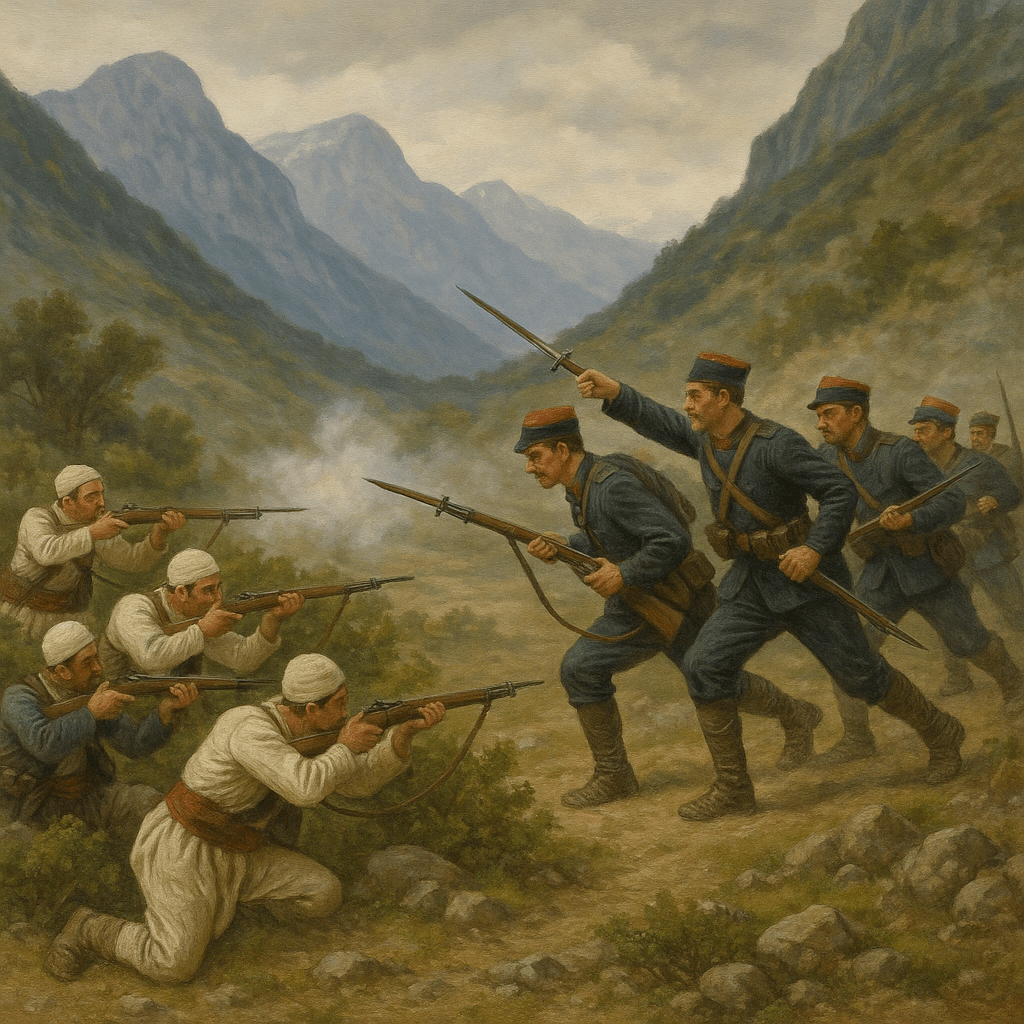
Since the bulk of the detachment was below the ridge, west of Babatköy, the 2nd battalion had to withstand this powerful attack alone. A bloody bayonet fight began with the Montenegrins who had entered the ranks of our fighters. It was almost fifteen minutes thirty (ten o’clock) when hand-to-hand combat began. The commander of the machine gun squad, who had so far performed very well, became anxious to save the rifles from the confusion created by the enemy’s entry into our fighters and the terrible state of the battle.
The new officer in command of the team took his machine guns and returned. (in the photo) Lieutenant Behçet Efendi from Sinop, from the 2nd battalion of the 70th regiment, who was martyred in the battle of Krania. The lake fleet was taking part in this battle on the shores of Zogaj. The field guns on the lake ferry and the motorboats opened fire on the enemy advancing from the south of Zogaj at 13:30 (8:00).
This fire continued to the group and 120 shells and cartridges were fired. However, today a strong wind blew and there were many waves on the lake. In general, the shells fired by the fleet had high breaking points. When the fight began on the right, at a distance of 1200 meters there was a firefight between the enemy machine guns located east of the 461st on the left and our machine guns west of Babat.
The two guns east of Valasköy were cleared by enemy artillery at sixteen (ten-thirty). 2000: From a distance of 2100 meters, he returned fire on the enemy infantry that was seen advancing to the west of 514. Seeing that the 2nd battalion and the Montenegrins were coming face to face and that the Albanian volunteers were turning from the right, the commander of Sadeddin Bey’s detachment sent reinforcements from Babat’s 1st company to the 2nd battalion and advanced the troops west of Babat to the enemy’s right.
He also joined the 2nd battalion. Sadeddin Bey gave the following order to the 1st company of the mole battalion:< The 1st company will help the 2nd battalion, the direction is the hill ahead on the right (514) March! I’m coming too » .When the sniper company reached the hill with its section in front, the enemy repeated his attack with the reinforcements he had advanced. The fire was very heavy.
The 2nd Battalion had fallen back to the east of 514. Sadeddin Bey, who was walking at the head of the forward team of the sniper company, encountered the enemy’s advanced units from 100 meters away, when he reached the west of point 514. Sadeddin Bey had placed the team next to him to fix bayonets. They rushed forward together. Meanwhile the other two teams of the 1st sniper company were climbing the the hill to go to the ridge.
Mumailejh participated in this hand-to-hand fight with his weapon and even picking up stones from the ground and throwing them. This part of the enemy, which was there, was destroyed. However, Sadeddin Bey was also seriously wounded in the right side of the chest by a bullet fired from a very close distance. The leading team that carried out this attack positioned itself where it was against the enemy who was advancing in a dense line behind each other at 10:15 and began to fire.
Meanwhile, the other parts of the company that had arrived positioned themselves 30-40 meters behind them, among the rocks that were suitable for firing on each other and immediately engaged in fire fighting. This fire, directed against the enemy who was advancing in several dense lines close to each other, was giving a great effect and was creating deep gaps between the enemy lines.
The enemy was advancing rapidly and attacking fiercely, despite the casualties he was suffering and without the need for fire protection. He was attacking with the intensity of serious training and education. Continuing to fire with great confidence and calmness, as a result of the serious training and education of the Caspian, the company was knocking down the enemy lines that were constantly coming one after the other.
This fire, which continued for half an hour and destroyed many enemy lines at 150 meters, broke the determination of the Montenegrins to attack. The enemy lines and reserves behind were forced to stand still at a distance of 400 meters. While this fight was going on fiercely, Sadeddin Bey, lying wounded and watching the battle, gave this order to Lieutenant Tiranlı Mithat Efendi (1), who commanded the first sniper company in this battle: “Stay strong here! Later in front of the big cannon![2] Send me down! »
Sadeddin Bey died on the way on a stretcher. The enemy force tried to advance on the right of the company from the Zogay direction. Their advances were also stopped by the company’s fire. Upon hearing the news that Sadettin Bey, on the western flank of Babatköy which was advancing, had been shot, he fell into a futile hesitation and remained where he was.
On the right of the second battalion in 514, an enemy battalion was advancing from the lake side. Then, despite the fire of our fleet in the open sea, the enemy landed troops in several large boats along the coast of Zogai. He reinforced this battalion. He advanced his infantry from this front and advanced his first lines to 200 meters. This enemy, who attacked every time he received reinforcements, was falling to the ground under the fire of our infantry who did not move like iron.
After half past sixteen (after eleven), an hour before sunset, while the battle was still fierce, the ammunition of the gun at 514 m. This cannon could not be used at the most critical time. The artillerymen entered with their rifles the line of infantry shooters. Further, the cannon on the crest of track 451 had previously also fallen silent. The officer commanding this gun thought it necessary to guard his gun from the forward and backward movements of the hunters of both sides so that they would not run into each other, so at seventeen o’clock (half past eleven) he loaded the gun and turned back, following the steep and steep line of Trabosh.
On the way, the mule was frightened and the cannon overturned, leaving the cannon, the sled, the wheels and two loads of ammunition lying on the road at different distances. The famous Ester fell from the cliff and died.[1] Now, the Chief of Staff, Mithat Bey.[2] There was a tree in front 700:800 meters away and approximately 461 meters away. The 2nd Battalion of the 70th Regiment, which has been very active until recently, (photo) Captain Filibeli İsmail Hakkı Bey, commander of the 2nd Battalion of the 70th Infantry RegimentOur howitzer position on regular terrain of 12 centimeters.
After half an hour this fire also stopped. The sniper of the 1st company remained on hill 514. . The courage shown by the Montenegrins in today’s battle was great. They were not worried about the losses they suffered. Relying on the power of their superior forces, they attacked and advanced each time with more force. The masses of gigantic-bodied people, pushed by the Montenegrin standard-bearers who held an open flag in one hand and a long knife with a large handle in the other, walked in several rows one after the other without stopping or resting.
Such sacrifice and effort yielded no results in the face of the unwavering determination and steadfastness of our troops, trained with thorough preparation and education. Especially the skill of our men in shooting and the faith in their weapons, made the courage of the Montenegrins cost them dearly. The 2nd Battalion of the 70th Regiment went to support the Fesattepe point, following the Tarabosh line from hill 451 to the height.
At about twenty-two thirty (five) at night, the sniper of the first company moved in the same direction upon receiving the order. MateThe rials of the overturned cannon came across the road and gathered them together in the moonlight. They were all taken by the detachment sent the next morning. The fourth sniper company with two cannons east of the village of Valas came to Zuos via the village of Muriqan after they could not find the way during the night.
They stayed near the Buna River. The other troops returned to their camps of the previous night in the lower Oblika. At eighteen o’clock (half past midnight) when darkness fell, the enemy left many firearms and ammunition on the battlefield. He could not even bury his victims. The chain line was withdrawn to the West, following the balance. The 2nd Battalion of the 70th Regiment.
The companies of the battalion fighting on the right flank returned, bringing with them many Montenegrin rifles and bayonets. The 1st sniper company, which remained alone on the battlefield for five hours after the enemy retreated, thoroughly surveyed the battlefield before its movement. It left nothing but martyrs. Each soldier of the company brought with him, in addition to his rifle, a Montenegrin rifle, several knives and Montenegrin flags.
The division arrived at the Fesattepe point an hour after midnight. The commander of the 2nd Battalion of the 70th Regiment initially reported that the enemy forces participating in today’s battle were four infantry battalions and, as a result, estimated the enemy casualties at over 800.
In the battle that continued fiercely for six hours, the 2nd Battalion of the 70th Regiment used 37308 shells and the Machine Gun Company of the 70th Regiment (with 3 rifles) used 4117 cartridges. The five-gun mountain battery fired 223 rounds, 19 from different positions. According to this calculation, each soldier from the second battalion, which carried most of the battle, fired 80 rounds, each soldier from the second battalion, which carried most of the battle, fired 80 rounds.
Each machine gun fired 1375 rounds, and each cannon fired 48 bullets. When the news of the martyrdom of Sadeddin Bey was received from Shkodra, Lieutenant Colonel Abdurrahman Nafiz Bey was appointed to command the company. The main part of the detachment, stationed the night before, was found on the banks of the Boyana River, on the lower bank of the Oblik.
He gathered the company (except for those who went to Fesattepe) in Zuos. The skeleton of the defensive position chosen to cover the area between the Buna River and the Fesattepe support point was created today with the help of this detachment. Swiss Lieutenant Egli, who was in the Montenegrin army in the Balkan War, describes this movement based on information he received from the Montenegrins as follows:
The southern group under the command of Martinovic began the movement with two wings. The 1st and 3rd brigades moved via Bardan Katerkoli, the 2nd brigade moved along the lake. They reached the line (Skje – Selika Gorica) on 10 – 1. October 1912 (27 – September – 328). The columns for the attack on the enemy positions in Trabosh were formed as follows and took the following directions of attack:
2nd Brigade (5 infantry battalions and 1 mountain battery) from Skjeja on the northern side of Trabosh, 1st Brigade (6 battalions, 1 mountain battery) from Selita on the southern side of Tarabosh, 3rd Brigade (4 battalions, 1 mountain battery) from Goriča on the southern side of Tarabosh, two companies Vikanë and Eshas.
The brigade was ordered to cross from the Belay bridge to the left bank of the Buna to secure the right flank and protect it. 2. Liva 11 1. October 1912 (September 28 – 328) also advanced from its own territory. But they were repelled by 3 Turkish battalions (Battle of Kraje). In the following days, these forces were able to gradually gain enough ground to position heavy artillery on the rear hills.
In this battle, our forces stood in three separate groups, at point 514, west of the village of Babat and east of Valas. These forces could not gather around 514. The entire weight of the battle fell on a battalion and a sniper company that arrived later. The brave and determined commander of the 2nd battalion of the 70th regiment, Captain İsmail Hakkı Bey [1], did not leave his battalion until the end, although wounded in the left hip.
He used his battalion very well and showed great determination and courage against an enemy 6-7 times stronger, more stubborn and braver than him. After the martyrdom of Sadeddin Bey, among the battalions that remained on their own, there was no commander who could understand the situation and use these units accordingly.[ 1 ] Filibeli İsmail Hakkı Bey was wounded in the stomach by a bullet during the battle of the village of Müsellim.
It was good that he commanded his battalion in the battle of Zadrima. He had recently been the commander of the Fesat Hill Reinforcement Point. He was a Major in the Great War, and his leg was wounded by a cannonball during the Arıburnu offensive in Çanakkale. He was in Istanbul for retirement. He died soon. No battalion commander. He did not see in himself such a right and authority. If this had been done, the Montenegrin army, powerless against one of our battalions, would have been completely destroyed long before dark.
This example shows very well that in training and exercises it must be assumed and accepted that the commander is shot and to teach every unit, large or small, to work in this situation and obtain certain results. Proven in the battle of Krajë, the commander of the 70th Infantry Regiment, Major Serezli Sadeddin Bey, who was Chief of Staff of the Shkodra Independent Corps, was in fact a person who participated in many bandit raids in Rumelia and Albania and was a factor in important successes.
Sadeddin Bey was a very hardworking, stubborn, brave, courageous and experienced commander. The deceased had a determination and will of steel. In the most dangerous times, he would miraculously instill calm and confidence in his followers. The martyrdom of Sadeddin Bey was a great loss for Shkodra. On the day the Battle of Kraje took place, there was only the support point of the Fesat hill in Trabosh. Even this was not complete.
All forces were occupied with fortifications. Due to the resistance and losses they suffered in the Battle of Kraje, the Montenegrins were left far from their initial position. In fact, five days after the Battle of Kraje, on October 16 (October 3), a reconnaissance team of ours that set off from Fesattepe followed the polygon line and went to the 514-meter hill where the battle took place and collected ammunition for the Montenegrin rifles and brought them.
The enemy was able to fire the first cannon at the Trabosh positions only 11 days after the Battle of Kraje. The time gained was useful for the fortification to be created with maximum activity. In the Battle of Kraje, the actions of the artillery and machine gunner officers and the medical team were extraordinary. This situation clearly illustrates the need for different classes and organizations to unite to fight together.
Some young officers were still in the process of maturing and becoming competent in their duties. After the Battle of Kraje, the Corps Commander Hasan Rıza Bey gathered them together. He spoke publicly about the services of those who were worthy of appreciation. He also explained the actions of others in very bitter language. He stated in categorical terms that if this were repeated they would pay the penalty in blood.
However, such situations were never seen in later battles. (map:) 11 – October – 1912 (28 – September – 1328) Battle of Krajes Number of units present and their casualties Units casualties Number of officers Private name and number of officers Wounded private martyrs Total wounded martyrs Missing general staff of platoons 1 21 1 11 2 24 Rifle Battalion 12th Battalion 5272nd 2nd Infantry Regiment 8 448 1 121939 2 60 62 13 1st Battalion of the 71st Infantry Regiment 12 345 1 1 70 Mt. Company 3 70
Total casualties Percentage of casualties Remarks The regiment had no. Next to the commander was a volunteer soldier with the regimental ensign. The messengers received from the continent are not included in this calculation. The casualties are from the first company, which reinforced the second battalion of the 70th regiment with 2.4 and 13.1, which made 0.2.
The other divisions did not enter the fighting. Lieutenant Behçet Efendi from the 2nd Company fell a martyr. The battalion commander was slightly wounded in the shoulder. Lieutenant Abdullah Efendi is a martyr. Those who fell a martyr, but who proved to be a martyr, are determined.”

Traboş (Tarabosh) after the Battle of Kraje.
Reference
(The text is taken from the book “1912-1913 Balkan Harbinde İşkodra müdafaası” by Abdurrahman Nafiz, Kiramettin, published in 1933, pp. 249-262)


 Balkan Academia