
Petrit Latifi
Illyrian tumuli are prehistoric tombstones built of stone and earthen material. The word tumulus is of Latin origin meaning small hill. Popular names are: piles, piles of stones, grave mounds and mounds. With their content, tumuli show cultural unity over a wide area. In Europe , it is the area from Thrace to the English Channel , which was inhabited by Thracians , Illyrians and Celts , the Dnieper and Kuban area, where the Scythians once lived , up to the Altai Mountains in Asia (kurgan tombs).
At the turn of the 3rd and 2nd millennium, new masses of the population penetrated from the Eurasian steppe area, into the Danube region and then throughout Europe. They brought their language, way of life, religion and customs. They destroyed the very foundations of the old Neolithic communities.

Illyrian mound in the Glasinac area
The real invasion of nomadic shepherds from the Danube , which archaeology recognizes as the Lasinja, Baden, Kostolac and Vučedol cultures, continued in the areas south of the Sava .
The end of this entire troubled period was marked by the coexistence of various Neolithic and remnant layers and their cultures in the substrate, which Benac called the Para-Illyrians . The spirit of the new time that has arisen is best illustrated by a type of Early Bronze Age monument widespread in the territory of present-day Croatia , Bosnia and Herzegovina, Montenegro, Albania and Kosovo, namely burial mounds ( tumuli ).
Based on the remains of material culture found in them, the mounds were built together with fortifications, from the Middle or Late Bronze Age (from around 1600 BC) until the end of the Iron Age , i.e. until Roman domination .
The most recent radiocarbon analyses of mounds and simple pit graves at Shtoj, Rakiča and Apolloni in the southern Adriatic , including several reliable radiocarbon dates from the local framework, confirmed the emergence of “pseudo-steppe” elements arriving via Eastern Balkan cultures, and the beginning of the Adriatic Bronze Age in the first centuries of the third millennium BC.
The appearance of mounds, princely tombs and violin idols is a clear reflection of important cultural innovations that mark a definite break with the old Neolithic tradition and that make the southern Adriatic area and above all the coastal area of today’s Montenegro, Kosovo and northern Albania , the initial nucleus of the development of the Bronze Age in the wider area of the eastern coast and in its Mediterranean interior.
Mounds are a new phenomenon that was unknown to Neolithic communities and represented a new area of religion – the cult of the dead.
Archaeological sites
On the Glasinac plateau, the municipality of Sokollac, along with several hundred hill forts, thousands of burial mounds were discovered, the research of which began in 1880. 1234 burial mounds were investigated, of which 250 were empty. The largest number of mounds dates back to the period of the 7th – 5th centuries. During the years 1974/75. the research was renewed to obtain anthropological data. It was found that in the Glasinac area there are about 2000 mounds.
In the vicinity of Priboj and Užice , several necropolises under the mounds were discovered, which in terms of burial methods and accessories in the graves completely coincide with those in the Mati-Drilon and Glasinac regions and undoubtedly belong to the same group. Such a large number of mounds and mounds, together with movable finds (weapons, ceramics, jewelry, imported bronze vessels) are scientifically associated with the Autarijati tribe and this period is called the Mati – Drilon Culture . .
In Croatia , a well-known locality is Budinjak in the Žumberačko Mountains, where over 140 burial mounds were found, among which the so-called. Princely Mound, which is 2 meters high, 3.5 meters deep and 20 meters wide. On the Turkish slope near the village of Vranovine e Velika in Topusko, the mound is within the settlement. On the slopes of Papuk in Slavonia, not far from Slavonska Požega, there is a group of at least 20 burial mounds (among them the “Knežev grob” mound).
According to the objects found so far, this archaeological site, known as Kaptol and located in the forest, belongs to the Early Iron Age or the prehistoric Hallstatt period, around 800-400 BC. Stone tombs of a rectangular shape were found here. On the bank of the Mrežnica River near Karlovac is a hillfort with mounds, which is supposed to have been built by members of the Japoda (or possibly Kolapijana) tribe, no later than around 800 BC.
Description
They were created by piling earth and stones, or both together, over the deceased, most often lying on the surface of the earth, and less often in a stone tomb or in a tomb. As a rule, the bases are circular (sometimes elliptical), originally most likely conical and most often preserved in the form of a higher or lower calotte.
Their diameter is from several meters to 40 meters, and the height is up to 7 meters. The construction of the mound is based on a peripheral circular stone ring that had a cultic and practical protective function. Usually the stone ring was filled with a layer of gravel. Usually each burial had its own ring, with a constructive and cultic character.
Tumuli are family tombs. In the middle, usually specially equipped, is the main and oldest tomb, with the deceased lying on his back. Other secondary tombs were placed in circles around the periphery of the already formed mound, with one or more individuals, symbolizing by their position the relationship to the first buried. After the burial, the pit was regularly filled and covered with stones. The Illyrians did not bury all their dead in tumuli. In some cases, the dead were buried in the open, in the so-called flat cemeteries (necropolises).
In the middle of the Iron Age, which lasted two centuries, the phenomenon of cremation of the deceased appeared in Mat, Drilon and Glasinac. Remains of burnt wood, burnt earth and burnt bones were found. A cremation pit was found in Novi Pazar . In Atenica, an entire sacrificial structure with a cult and ritual character was found. The ashes were not placed in an urn, but were scattered on the mound to sanctify the space.
The erection of a mound marked the visible place where the remains of the deceased were buried. During burials in mounds, certain types of rituals were performed, which can be inferred from the objects found, e.g. food, drinks and vessels used during rituals that were left on the mounds or broken. This phenomenon speaks of a certain understanding of the afterlife. It is interesting that even today the population of Eastern Herzegovina encounters the phenomenon of breaking vessels during burials.
In the population of these regions it was difficult to stop the practice of burial in mounds, so most medieval necropolises were built on mounds or near them. Therefore, there are old churches on the tops of some burial mounds in medieval cemeteries. It seems that on the sites of pagan shrines new shrines were built – temples and paleochristian churches. Along with the numerous churches, which were also erected on burial mounds.
Illyrian princely tombs
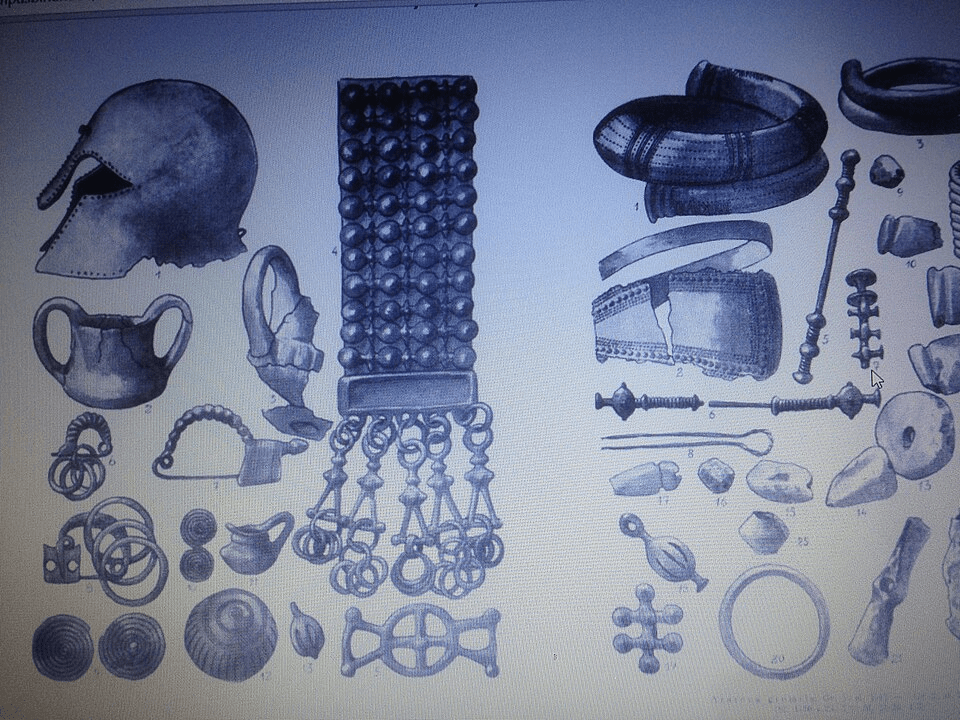
Finds from the Arara mound
In the Illyrian area , in the first two centuries of the 1st millennium BC, a significant use of iron began, mainly in the production of weapons, which led to the transformation of the military and then political structure of the clan community. . The first consequence was social differentiation (the creation of a class society) and the division into clan aristocracy and the remaining members who were more numerous. The best evidence for this process is provided by the princely tombs created during the 7th and 6th centuries. The common characteristic of princely tombs is:
Monumentality of burial, mainly under large burial mounds
Rectangular tombs with wooden or stone construction
An abundance of precious, expensive tombs made of precious materials, mainly gold
Many Greco-Latin imports, mainly bronze and ceramic vessels
Burial of the deceased with chariots, horse equipment, along with many personal accessories, jewelry, and weapons that the deceased could use in the afterlife.

Illyrian royal tombs in the village of Selca e Poshtme – Tomb no. 3
The Illyrian Tombs of Selcë e Poshtme are located near the city of Pogradec in Albania in the village of Selcë e Poshtme. On the right bank of the Shkumbin River, at an altitude of 1040 m above sea level, lie the remains of the ancient city of Pelion and its associated necropolis. The Roman Via Egnatia leading to Thessaloniki passed here. Although there are traces of human activity in the Neolithic, the settlement proper dates back to the Iron Age (proto-urban Illyrian) to the Illyrian urban period (5th-2nd centuries BC), and reached its height under the settlement of the Illyrian tribe of Enkelej in the later Iron Age.
The settlement was also occupied in the Roman period as evidenced by traces of a municipal building. From the 4th to the 1st centuries BC the city was the royal residence of the Illyrian kings and therefore, perhaps, also an important political and economic center. In 1996, Albania included the royal tombs of Lower Selca in the UNESCO World Heritage List.

Tumular necropolis in Llashtica
In general, in the tombs of the Illyrian princes, representatives of families who could be military, secular and spiritual leaders in the mentioned period were buried. The cult of the heroized deceased implies separation from other relatives or members of society, especially from the place and size of the tomb. A warrior equipped in this way, he stood by his relatives, as protection and help in the decisive struggle for survival, becoming over time a supernatural being – a demigod.
In some places, toponyms such as “Prince’s Tomb” or “Prince’s Coast” have been preserved, which refer to the place where the tomb is located (or was). The most famous are the tombs in Mat, Drilon and Glasinac with princely tombs : The tomb in Ilijak, Talin, Čitluci, Osovo, Arareva gromila. Other princely necropolises are also notable: at Pilatovici near Užice for its architecture, Atenica for its funeral rituals, and Novi Pazar for its wealth of gold, silver, and imported Greek objects.
After the stratification of the clans, in the Mati – Drilon – Glasinac area there were “internal wars” between the clans, which ended with the creation of a political entity, a tribal alliance, historically known as the Kingdom of Illyria and its vassals the Kingdom of Dardania and the Kingdom of the Autariats , which turned against neighboring communities.
References
^ “Aleksandar Jašarević – Socio-economic and symbolic role of imported metal vessels from Glasinac, ANUBiH, Yearbook 43, 2014” (PDF) . Archived from the original (PDF) on 19 March 2020. Retrieved 23 July 2022 .
^ “Aleksandar Palavestra: PRINCELY GRAVES OF THE EARLY IRON AGE IN THE CENTRAL BALKANS” . Balkanological Institute, SANU, 1984 . Retrieved 9. 2. 2016 .
^ “Blagoje Govedarica: Glasinac and Glasinac culture – V. Glasinac princes” (PDF) . Faculty of Philosophy Sarajevo – Freie Univerzitat Berlin . Archived from the original (PDF) on 8 June 2019 . Retrieved 9 February 2016 .
^ “Fanula Papazoglu, -Central Balkan Tribes in the Pre-Roman Era. Tribali, Autariati, Dardanci, Scordisci and Mesi” . ACADEMY OF SCIENCES AND ARTS OF BOSNIA AND HERZEGOVINA – WORKS BOOK XXX, CENTER FOR BALKANOLOGICAL STUDIES Book l. SARAJEVO, 1969 . Published on 9. 2. 2016 .
^ “Salmedin Mesihović: Historija Autarijata” (PDF) . Filozofski fakultet Sarajevo, 2014. Archived from the original (PDF) on 21 March 2016. Retrieved 9 February 2016 .


 Balkan Academia