
Petrit Latifi
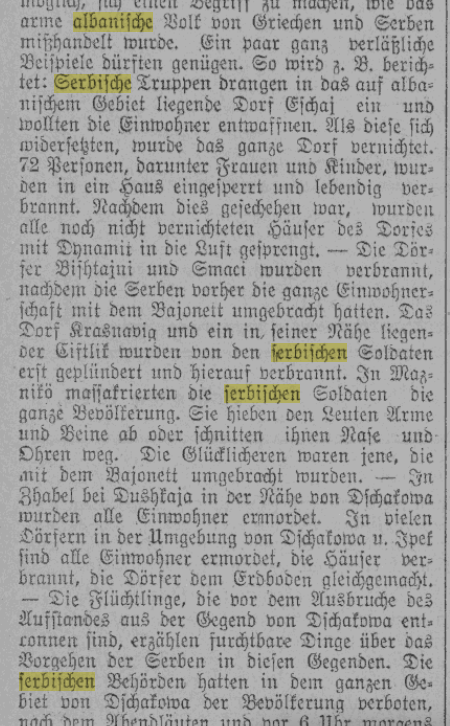
In 1913, the Alpenländer-Bote reported on Serbian atocities in the Albanian villages of Lleshaj, Bishtan, Smaçi, Krasniq, Mazniku, Ciftlik, Shabel and Dushkajë.
“It is virtually impossible to imagine how the poor Albanian Balt was mistreated by Greeks and Serbs. A few very reliable examples should suffice. For example, it is reported: Serbian troops invaded the village of Eschai, located on Albanian territory, and attempted to disarm the inhabitants. When they resisted, the entire village was annihilated. 72 people, including women and children, were locked in a house and burned alive.”
Bisthan, Smaçi, Krasniq, Mazniku and Ciftlik
“After this happened, all the houses in the village that had not yet been destroyed were blown up with dynamite. The villages of Bishtajni and Smaci were burned after the Serbs had bayoneted the entire population. The village of Krasnavia and a nearby village of Ciftlik were first plundered by the Serbian soldiers and then burned.”
Serbs would cut the arms, the legs, ears and navels of Albanians
“In Mazniku, the Serbian soldiers massacred the entire population. They cut off people’s arms and legs, or cut off their ears and navels. The more merciful were those who were killed with pajonets. In Shabel near Dushkaja, near Dschakowa, all the inhabitants were enraged. In many villages around Dichakova and Ipek, all the inhabitants were murdered, the houses burned, and the villages razed to the ground.”
Serbs murdered two Albanian farmers working and placed their heads at the pazar of Gjakova
“The refugees who escaped from the Dichakova area before the outbreak of the uprising tell terrible stories about the actions of the Serbs in these regions. The Serbian authorities had forbidden the population throughout the entire Djakova area to leave their homes after the evening bell and before 6 a.m. Anyone who violated this order was shot. Even children paid with their lives for the protection of this order. Anyone suspected of pro-Albanian sentiments was killed without question. Two old farmers, arrested in their fields while working, were beheaded. Their bloody heads were placed in the Djakova bazaar as a warning.”
Reference


 Balkan Academia