
Petrit Latifi
Uc Turku: a story of patriotism, untold until today. “You could only find such men in ancient Greece”. Reading the book “The Last of the Kelmendi Chieftains”, dedicated to Uc Turku, on the occasion of the 100th anniversary of the border discussion in Vermosh.
These days, the book “The Last of the Kelmendi Chieftains”, dedicated to the life and patriotic activity of Uc Turku on the 100th anniversary of the border discussion and establishment in Vermosh, written by co-authors Gjovalin Gjeloshi and Gjergj Shyti, two men who proudly proclaim to the world that they are sons of Kelmendi of Malesia e Madhe.
Who was Uc Turku?
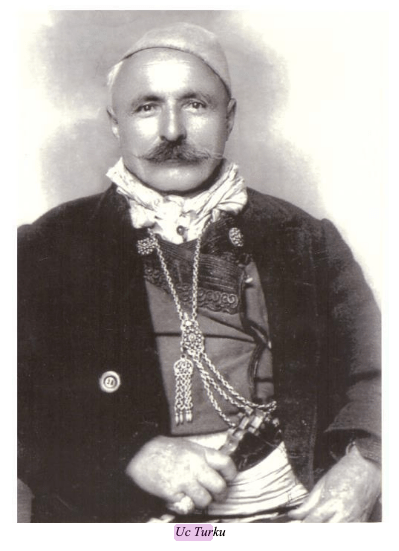
I have only “known” him from his portrait (photo by Marubi) that catches the eye as soon as you step foot in the lobby of Pal Shabi’s “tower”, next to the “Martin Shabi” library, which was created and enriched over the years by: Dr. of Sciences Gjovalini with his wife Vera, a mathematics teacher in one of the high schools in the city of Lezha, established in didactic, pedagogical and sociological profiles, and two sons: Martini, Master in Natural Sciences in Tirana, and Donaldi, an aspirant for the Master’s degree at one of the universities in Vienna.
But the authors of the book answer the question: Uc Turku, son of Turk Shabi. He was born in 1860 and grew up in Selce, Kelmendi, in the neighborhood of the Hasanaj tribe. He would inherit from his father the highest virtues of the “mountain citizenry”: manhood and wisdom, bravery, knowledge and skill as a regular and family leader, but also the ability to perform the duties of Vojvoda (military leader), a title and trust inherited from their predecessors, Ali Rama and Shaban Ali.
Turk Shabi was the first Voivode of the 900 houses of Kelmendi, a participant in the League of Prizren and the “leader of the League forces” for Kelmendi, as such assessed by Gjergj Fishta in “Lahuta e Malcië” (Kanga 23) / “…every boy like every bull/The shadow is already scarred by a man like Turk Shabi with three hearts/Uc Turku also walked in those footsteps manfully and bravely.
His first test as a military leader was the “War of Kindness” where 25 Kelmendi men defeated a surprise attack by a regular Montenegrin military unit. The eighteen-year-old boy, positioned near a tree, fought and encouraged his friends who defeated the provocative neighbors. Uci was wounded in that battle and could not bend his left leg for the rest of his life.
The popular poet in the verses dedicated to the War of Goodness addresses:
/ You Uc Turku, what are you saying?
Don’t worry, nephew, for me
I have not been killed, but I am buried
A few bullets a month will bring me /
And he led the Kelmendi people a whole life, in different historical and social times and circumstances, as a regional leader, military, social and political leader, but also as the head of the great Hasanaj tribe. Uc Turku, in the Austrian census of 1918 that was carried out on the population of Albania, was valued and defined as “Ober Vojvoda”, which meant “Voivode above the other voivodes”.
He held and wisely carried out the legal duty entrusted to him as a member of the Xhibal (Official Court of the Mountains) and defended the Arbër lands and the dignity of the co-provincers and the Greater Highlands.
The authors, through notes with elements of reportage or description, “invite” and “lead” readers to “climb” the Albanian Alps, in whose heart lies Kelmendi, historically included in the territory between the banks of two rivers: the Cem of Selce and the Vukli, to “go out” to Vermosh and:
-Learn that Uc Turku and his tribe are among the former first inhabitants of Vermosh, which, like Vukli, belongs to the historical province of Kelmendi and in 1909 would become the capital of Selce
– Visit their guesthouses, today traces, and to honor Turk Shabi by standing a minute in silence in front of his grave his;
– To meet early and current residents, who, like the entire Greater Highlands, speak with pride and gratitude about Uc Turku and Prek Čal for the contribution they made to the defense of the Vermosh region from annexation by Montenegro in two periods, in 1913-1914 and 1922- 1924,…
– Learn that both, Uci with wisdom and Preka with bravery, proved calm and determined before the International Commission of the Great Powers, sent to Vermosh to determine the borders with Montenegro.
The missionary commissioners who went to Kelmend and Vermosh to investigate the Albanian and Montenegrin border lines, in their memoirs, valued Uc Turku and Prek Čal for their manliness, bravery and wisdom, who, with facts, arguments and fair reasoning, managed to convince them the representatives of European governments for fair and reliable decision-making.
Even the younger generations tell their friends and visitors that the Kelmendi Mountains “speak” of the wisdom of Uc Turku and the bravery of Prek Cali, who told the senior officers of Europe: look at the cemetery of Vermoshi with the crosses of Catholic Christians and take a piece of bread in your hand and ask the children: what is this? Their answer: bread.
This word, in our Albanian language; while beyond the borders of Albania, children and adults will give an answer in their own language. The European envoys kept notes on these and many other facts, arguments which were very convincing, because they could not overthrow the representatives of the Serbo-Croatian-Slovenian kingdom. Thanks to these two men, Vermoshi with the mountains remained in Albania, where it had a natural place.
The pages of this book trace and describe the course of Uc Turk’s life with the attributes of the leader of Kelmend and as the leader, leader and administrator of the Shabi tribe on Mount Kolaj, where many families from the Albanian Alps had descended and settled.
The “Kelmendi” of Sub-Shkodra extends over a vast territory between the Drin River that separates Zadrima and Lezhë and the Adriatic Sea on the coast from Velipoja to “Rana s’Hedhun” in Shëngjin and south to the Rekaj Hills. For more than two centuries, this region was the settlement of the Upper Shkodra Highlands for a pastoral and sedentary life that lasted 6-7 months.
There, below the “Maja s’Zezë”, on a beautiful meadow, is the “Shoj” neighborhood, where even today the homes of the Uc Turku family are located, which, until the end of the 1930s, consisted of approximately 60 people: men, women, daughters and daughters-in-law. In a tower that resembles a real castle, well preserved and maintained even today, there is the “Oda e Uci”, a large room with a fireplace, paved with tiles and carpets, a reception and party room where men gathered.
Uc Turku, even after 1925, until he passed away on
September 21, 1937, would be known and treated as one of the five regional leaders, part of the government administration and, as the leader of Kelmendi, in Xhibal he represented Selce, Vukli, Nikçi and Bogen. Uc Turku has been passed down through generations even through verses:
/….A man of intellect and patriotism//Among the Kelmedans, his first home//Honor to the homeland’s symbols//You, the voivode of Kelemend’s homeland// Here is our mountain range //Honor is there, all of Albania//For Uc Turku and his tribe//Who gave their lives for the border/.
And, on the eastern side of Mount Kolaj, travelers rest at “Guri i Uçit”, a resort of his.
The scientific aspect of the book is intertwined with history and publicistic and literary skill. The authors, in order to motivate the data, facts and assessments that have become the object of reflection, bring well-verified source references from 86 authors, such as Father Zef Valentini, Edit Durham, Kristo Frashëri, Mehdi Frashëri, Gjergj Fishta, Kahreman Ulqini, Fulvio Kordinjano, Milan Shuflaj, Selami Pulaha, Nathalie Clayer, Robert Elsie, Andre Ordion, Romeo Gurakuqi, Petrit Imami etc.
With this aim, they have been invited to demonstrate their knowledge, heard from their predecessors, such as the current residents of Vermoshi Nikoll Vilajeti, Nik Peraj, 78-year-old Dodë Tinaj, Nikë Doni, Gjovalin Dodë Pllumi, Zef Gjergj Vushaj. Dedë Fran Coku and many others whose opinions have been published. The 96-year-old witness stands out here, Prek Mirash Duli, who was 16-17 years old when Uc Turku died.
The authors’ correctness and sense of responsibility towards their readers is also evidenced by the clarification and argumentation of their statements, such as the case of the evolution of Muslim names and surnames Hasanaj, Ali Rama, son of Shaban Ali (Shabi), son of Turk Shabi, son of Uc Turku and… The truth is that these names and surnames hid Christian names, but there were also some like “Old Shaba, who, (according to Father Domenico Pazzi), when he was young, had the misfortune to deny his religion and become a Muslim.
He remained more than 60 years burdened with the unpopular sect, but helped by the mercy of God, in old age he had returned to the Christian religion”. (See “The Last of the Kelmendi Leaders”, p. 164) The well-known and historically proven real assessments of the personality of Uc Turk argue for truthfulness and accuracy as scientific criteria for public communication.
We refer to some high-ranking political and military actors of the time. Let us recall some of them. Mehdi Frashëri, in his memoirs, describes: “Uc Turku, voivode of Kelmend, an old man with clear understanding and patriotism”. (“Kujtime”: 1913-1933, Tirana OMSCA – 1”, 2005); Andre Ordion, a French missionary in the Balkans, writes:
“…In Vermosh I always saw the leaders of the Kelmend tribe, Uc Turku and Prek Cal, with whom I had established a true friendship, they were very patriots, both of them defended their property and that of the tribe with an unprecedented severity, giving convincing arguments that had made me think for a long time… (Andre Ordion “A French officer in the Balkans”, V. 1, “Papirus”); Colonel Grannet said about Uc Turku:
“You could have found such quiet and wise men only in ancient Greece”; while Baron Franz Nopça in “Travels through the Balkans” noted that “Uc Turku had a great influence on other leaders”.
We come to the conclusion of these notes: The book is a comprehensive observation and reflection of many national historical events in the early times of and before the years of Uc Turk’s patriotic activity. History of the life of the distinguished patriot, who was born and lived in our mountains, one of the bright minds, a warrior with a rifle and a wise man for the defense of the Arbër territories in the Albanian Alps, above Shkodra and the plains below Shkodra, extending to the confluence of the Buna River into the Adriatic Sea.
The complex structure, universal in content, has given the co-authors free rein to reflect on the historical, geographical, social, but also political levels with a dynamic expression of thoughts about realities even in a figurative way.
We appreciate the methodology that the authors have chosen to provide as much information as possible, although the text is extremely loaded with reticence, returning to past events and breaking them down to detail and detail; as well as with etymology and toponymy, although they complement the knowledge of the work and give it an encyclopedic character.
Gjovalini and Gjergji, with their linguistic, literary and cultural formation and with a rich research and publishing experience (Gjovalini, journalist, publicist and literary, author of 7 books, as well as Gjergji, a qualified linguist, teacher and literature, author of 4 publicistic and literary books) have worked hand in hand, researching a rich literature and have managed to write a work that goes beyond the limits of a monograph.
Reference

 Balkan Academia