
Petrit Latifi
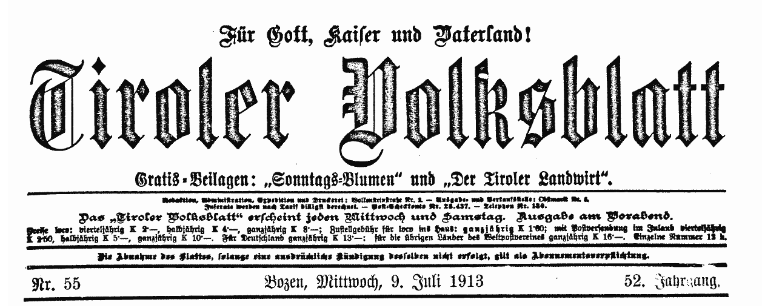
In 1913, the Volksblatt published an article by Dr. D. Klementi writing that Sjenica, Berane, Novi Pazar and other Albanian inhabited regions, now invaded by Serbia, were the heart and center of Albania. These territories were necessary for the economical survival of the Albanian nation.
Cited:
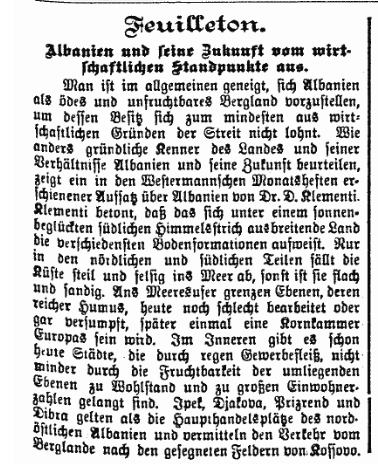
“Albania and its future from an economic point of view.
One is generally inclined to imagine Albania as a desolate and barren mountainous region, whose ownership is not worth fighting over, at least for economic reasons. How differently thorough experts on the country and its conditions assess Albania and its future is shown by an article on Albania by Dr. D. Klementi published in the Westermann Monthly.
Klementi emphasizes that the country, stretching under a sun-blessed southern climate, exhibits a wide variety of soil formations. Only in the northern and southern parts does the coast drop steeply and rockily into the sea; otherwise it is flat and sandy.
Plains border the seashore, whose rich humus, today poorly cultivated or even swamped, will one day become a granary of Europe In the interior, there are already cities that have achieved prosperity and large populations through lively trade and the fertility of the surrounding plains.
Pejë, Gjakova, Prizren, and Dibra are considered the main trading centers of northeastern Albania and mediate traffic from the mountains to the blessed fields of Kosovo.
The Sanxhak is equally fertile. Tall forests, excellent pastures, and well-tended fields distinguish this area pleasantly from the bare barrenness of the northern Albanian Alps. The main town of the southern Sandzak was previously Berane, at whose weekly markets the herds of the mountains gathered to barter with the farmers of the plains. Other wealthy Albanian cities include Sjenica, Novi Pazar, Mitrovica, and Prishtina.
Despite their short distance from the former Serbian border, they were almost entirely inhabited by Albanians. The Uesküb-Mitroviza railway, which was to be extended to the Bosnian border in 1909 as the Sandžak Railway, represented the mountain peoples’ only connection with the outside world.
We can thus see that the heart and lungs of Albania lie on the coast and in Kosovo. What lies between Kosovo and the coast is mostly barren land, whose treasures are still buried beneath hard rock and can only be exploited by an industrially powerful state. But these are prospects that are probably still in the distant future for the Mirditë, Malesori, Hoti, Kelmendi, Nikaj, Shala, and all the other mountain tribes.
What Albania needs first of all are borders that will guarantee the economic survival of its people, who exclusively engage in cattle breeding and agriculture. The mountain herders live off the grain of the plains, and these, in turn, get their livestock from the Alps.
Thus, one part of the country is dependent on the other. But to separate Shkodër, the rich cities, and the fertile plains of northern Albania from Albania would be like cutting off the arms and legs of a healthy person.”
Reference

 Balkan Academia