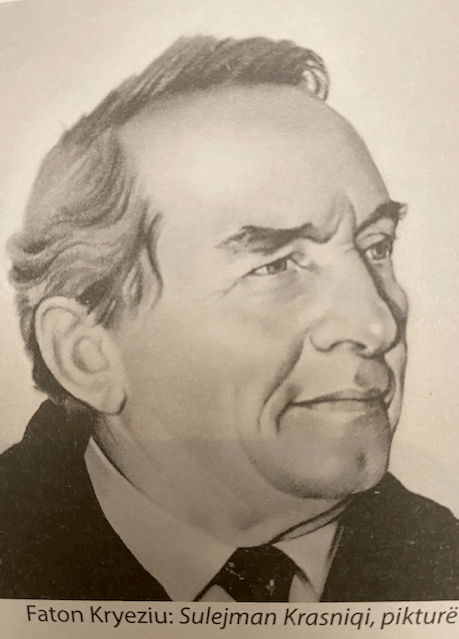

By Sulejman Krasniqi. Translation Petrit Latifi
A detailed history of what they “the Serbs” have “spiritualized”.
In October 2004, the book-diary “Kosova” by the Serbian academic Dobrica Cosic was published. Although the book had a circulation of 30 thousand copies, it was sold out in Serbia within ten days. In the epilogue of the diary “Kosova”, the long-suffering father of the nation, as the Serbs call him, Dobrica Cosic sheds lukewarm tears of cunning as the heir to his class of Serbian academics: “Will Kosovo be my last concern in life? Will I die fighting for some Serbian rights, for medieval culture, for the values of our spiritual identity in Kosovo?…”
Throughout the indoctrinating content of the diary, woven with Byzantine cunning, readers turn a blind eye and cloud their anger with humiliations and insults against Albanians, unworthy of an academic and former president of a great state, such as Yugoslavia. In the diary “Kosova” he writes: “Kosova, Nazi ghetto, “Zoo”, Kosovars – murderers, Horde of terrorists” … Qosiç develops many options for resolving the status of Kosovo.
On January 3, 1993, he meets in Geneva, Switzerland, with two international diplomats, Cyrus Vance and Lord Owen. He presents to them one of the options for a permanent resolution of the Serbian-Albanian issues based on the territorial division of Kosovo and the determination of new borders, in which the “historical rights” of the Serbs would be preserved and the right of the Albanian people to national unification with their mother country would be ensured.
Anti-Albanian books in Serbia in the 1980s
Even if I am wrong, the author of the newspaper “Kosova”, who in 1974 rose up against the Yugoslav Constitution only because it granted some rights to the Albanians of Kosovo, was expelled from the Communist Party. In the early 1980s, bookstores throughout Serbia were filled with anti-Albanian books written and published by the Serbian Academy of Sciences with authors: Qosiç, Batakovic, Bogdanovic, Djuretic and others.
In the fall of 1981, under the leadership of Dobrica Qosiç, many Serbian activists wrote a petition against the 1974 constitution. In 1989, under the auspices of the Serbian Academy of Sciences, a report was compiled with slander against the Albanians of Kosovo.
So Dobrica Qosiçi now appears to us as the first senior Serbian politician who, in the “famous historical compromise”, proposes, in addition to the cantonization of Kosovo, with Truffle-like generosity, also accepts the unification of Albanians with the mother country, aiming for a possible compromise, very diabolical, for greedy and chauvinistic interests.
Lord Owen, after listening to him, says to the academic: “Your proposal, Mr. Qosiç, is very foxy. With the division of Kosovo, you are also dividing Macedonia…”. Qosiç tries to dodge: “We have no territorial claims to Macedonia. I am only committed to resolving the Serbian-Albanian issue”.
Qosiçi, as cunning and diplomatic in dialogue as he is, is equally arrogant and talkative. He allows himself to call the American diplomat Richard Horlbrook “a vulgar type and a primitive cowboy”, calls Gelbart “ignorant”, and describes Petritsch as a “professional Serbo-monger”.
Academician Qosic is exchanging options like a wolf. In the famous “historical compromise”, he seeks to unite the Albanian ethnic group into a separate state. Later, he issues orders: “The Serbs of Kosovo should not participate in the parliamentary elections of the Albanians in October of this year 2004.
Their participation should be conditioned by the acceptance of the Serbian government’s plan for territorial autonomy…”. On May 15, 1999, he writes:
“Kosovo is the cradle of Serbian statehood, the Serbian spiritual and religious core. Religious and cultural-artistic monuments of the Serbian Middle Ages are located in Kosovo. In Kosovo, around Serbian monasteries and ethnic enclaves, Serbian ethnic states should be formed. The Serbian parts north of Mitrovica should be annexed to Serbia. The southern parts of Kosovo, where the Albanian majority lives, should be annexed to Albania…”.
They don’t even mention that the Serbian Orthodox churches were built on the foundations of the Albanian Catholic churches in Kosovo.
It is not at all true that Kosovo is the cradle of Serbian statehood. The Albanian state was created in Prizren, Kosovo, this is based on historical facts, and not on myths and church tales as Serbian academics preach about Kosovo. “Our (Serbian) officials,” writes Qosiçi, “should, in international contacts, emphasize the following topics: – We should win over several members of the Security Council and as many Western governments as possible. We should spiritualize the most influential Western media (such as “Spiegel” in Germany, “New York Times” and “Washington Post” in the USA, etc.) – We should establish a Serbian lobby in America, Great Britain, Germany, etc. ”
This message reminded me of Vladan Đorđević, (Prime Minister of Serbia), who in the first decade of the 20th century wrote the book “Albania and the Great Powers” in several world languages, where he portrays Albanians as wild beasts with tails. It reminded me of the Serbian doctor and professor, Jovan Cvijić, who in his multi-volume work “Osnove za geografiju i geolo giju Makedonia i Stara Serbije“, (Belgrade, 1911,) on page 1164 writes:
“Recently in these regions (Kosovo and the Dukagjin Plain) the peasants were dispossessed. This happened during the liberation wars and the Serbian-Turkish wars. Consequently, the agallars, who are generally Turks in Kosovo, could rarely protect them from the evil-doing Albanians…“.
Jovan Cvijiqi in the aforementioned book, pages 1264-1265, writes: “Before the arrival of the Muhaxhers (in Kosovo) the people spoke mainly Turkish and Serbian, less Albanian. Since the arrival of the Muhaxhers, the Albanian language has become dominant. ” So the expelled, the Muhaxhers, from the Sandzak of Niš, according to Cvijić, have taught Albanian to the Kosovars.
Serbian academics adhere to Ilija Garašanin (Minister of the Interior of Serbia) who, as early as 1844, wrote the book “Naçërtania” (Project), where he legitimized Serbian territorial claims over Kosovo, referring to the medieval empire of Stefan Dušan. According to “Naçërtania”, in 1846, a map of Kosovo was falsified in Belgrade, marking it as “Stara Serbia”. “Naçërtania” planned the invasion of our homeland and the exit of Serbia to the Adriatic of Albania. Serbian academics: Jovan Cvijić, Vladan Đorđević and Nikola Pašić wrote to the Great Powers, especially the Entente: “Serbia is the only country isolated from all sides.
The Serbian people live like in prison. The Serbs are insistently demanding that Serbia be given a port in Albania. Serbia needs an exit to the Adriatic, whether by grace or not…”. On December 24, 1876, the Conference of Ambassadors of the Great Powers convened for the demands of the South Slavs. The conference held its proceedings in London.
Krasniqi: Obranovic attacked 620 Albanian villages of the Sanxhak of Nish and expelled 350 000 Albanians
There, autonomy was granted to all Balkan countries. Russia insisted that autonomy not be granted to Albania since the Albanians were not a separate nation. Immediately after the Conference of Ambassadors, the Serbian army of Knjaz Obranović attacked 620 pure Albanian villages of the Sandžak of Nish by surprise and expelled 350 thousand Albanians with horrific massacres.
(Those expelled, exhausted and bloody, found refuge in Kosovo. And that day and today they are called muhaxheri, whom academician Cvijici mentions in his multi-volume book. He calls them newcomers, not expelled.)
Bilal Shimshiri in the book “Rumeliden Greqleri”: 35 000 Albanians were murdered in 1878 and cost around 40 billion dollars
History Bilal Shimshiri’s book “Rumeliden Greqleri“ I-II, Istanbul; contains weighty documents proving that in 1876-1877, 350,000 Albanians were barbarized and expelled from the Sandzak of Nish with massacres. 35,000 were brutally murdered during the expulsion by the Serbs. The looting in the Albanian Sandzak of Niš amounts to 40 billion dollars.
“Every killed Albanian is a patriotic merit for the Serbian soldier” – Knjaz Obranović
The massacres and expulsion of Albanians from the Sandzak of Nish became a coveted tradition for future Serbian politicians, who tried it in later years. Finally, in 1998-1999, Knjaz Obranović, when preparing the Serbian army for the massacre in the Albanian areas of the Sandzak of Nish, published the slogan: “Every killed Albanian is a patriotic merit for the Serbian soldier.”
Dobrica Qosic: Albanians are a “terrorist horde”
The President of Serbia, Slobodan Milošević, at the turn of the 21st century, ordered the Serbian state terrorists for the massacre in Kosovo: “Only dead Albanians are good for Serbia…” Academician Dobrica Qosiçi in the journal “Kosova” calls Albanians murderers and a “terrorist horde”. How can Albanians be like that, when they have never set foot on a single inch of foreign land and for centuries have not known bloody usurpations like the Serbs in Kosovo.
To show that the Serbian people have seen the quarrel of their Serbian academics, I would like to highlight just one example here: In December 2004, the Serbian historian Slavenko Terzic appeared at the Hague court in defense of the criminal and satrap Slobodan Milosevic. Terzic categorically denied the massacres against Albanians in Kosovo.
The Hague prosecutor recalled the testimonies of generals Wesley Clark and Klaus Naumann, to whom Milosevic had said in 1998: “I will round up and kill all Albanians, just as was done in 1945/46 by Aleksandar Rankovic”. Slavenko Terziqi denied: “This statement is false. At the end of World War II, not a single Albanian was executed in Kosovo.” At that time, 70,000 Albanians were documented to have been massacred.
Academician Dobrica Cosic, to motivate the famous “Historical Compromise,” writes: “Since Albanians do not agree to live with Serbia…” How did the terrorists who turned Kosovo into a mass grave, transformed it into a sea of blood, agree??? It seems that Serbian academics are not even aware of the shadow of their own victims. The best sons of Kosovo are accused of slandering Belgrade.
In the first half of 2003, the republican Minister of (im)Justice, the Serb Vladan Batic, and the head of the UDB, Aleksandar Vasiljevic, were threatened with sending more than 400 Albanians to The Hague. Even Belgrade’s “daughter-in-law”, Carla del Ponte, threatens Albanians with the Hague Tribunal. (Endless Albanianophobes…) That there is a secret camp in the heights of Kopaonik in Kosovo, where secret police specialists from Belgrade work, was learned at the Hague Tribunal.
In that camp, former Serbian UDB spies are trained and processed to become witnesses in the Hague Trial against members of the KLA, the sons of Kosovo.
Before compiling the “Historical Compromise”, Dobrica Qosic had to remind his Serbian colleagues of the damage they had caused to the Albanians: In 1844, Ilia Garashanin wrote NAÇËRTANIA (The Project), in which he planned the invasion of Albania and the exit of Serbia to the Albanian Adriatic. In 1876-1877, Knjaz Obranović exterminated and uprooted the Albanians of the Sandžak of Nish (620 pure Albanian villages).
Cetnik attacks and Serbian terrorism against Albanian villages in 1901-1905
In 1901, Crna Ruka was created – a Serbian terrorist organization against Albania and Albanians. In 1902, the main council of the Chetniks was formed in Belgrade, led by the Minister of War of Serbia, Milovan Pavlović. Under his leadership, the ground was prepared for the invasion of Albanian lands. In 1904-1905, the general Serbian Chetnik action against Albanian Kosovo began.
Serbian terrorist organization Narodna Odbrana in 1908
In 1908, the Narodna Odrbana was created, a terrorist organization with the major task of creating detachments and throwing them across the border of Serbia. The head of the “Narodna Odbrana” was Boža Janković, who in 1912 was appointed commander of the Third Serbian Army, which fought for the invasion of Albania during the First Balkan War. In 1908, the clandestine organization “Ottoman Serbs” was created in the territory of Kosovo. Its head was Bogdan Radenković.
Vardar newspaper and Belgrade papers presented Albanians as murderers
1913:1921: Albanians were forced to dig their own graves
The newspaper of the Ottoman Serbs was “Vardar”. That newspaper, as well as the press in Belgrade, presented the Albanians as murderers, savages and beasts. In 1913-1921, the Serbian occupying army forced Albanians, en masse, to dig graves and buried them alive.
1943: Serbian colonisation attempt
In 1943, the elaborate of academician Vasa Čubrillović was published, which predicted the military extermination of the Albanian people of Kosovo. Kosovo would be populated with Serbian settlers. In 1945-1946, the OZN, the mother of the Serbian UDB, killed 70 thousand Albanians without trial.
In the 1998-1999 war, Slobodan Milošević’s Serbs killed thousands of Albanians, expelled tens of thousands, opened hundreds of mass graves where they buried the living and the dead; they loaded the Albanian corpses into refrigerated trucks and dumped them far away, in Batajnica, deep in Serbia. Does world history know such macabreness? What “phantasmagoric compromise” does Dobrica Qosić seek?
Reference
Sulejman Krasniqi, in the “Shekulli”, 21/01/2005.

 Balkan Academia