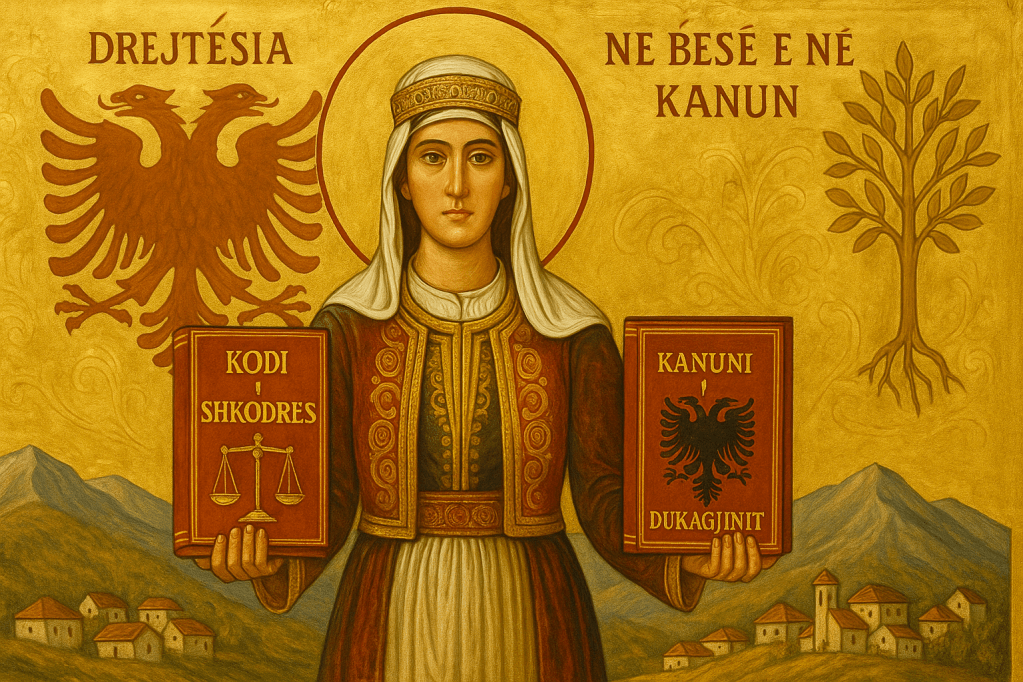

by Ndriçim Kulla. Translation Petrit Latifi.
Even in terms of shared property within the family, women had a favored status, while within the family, women and men had the same rights over shared property. If a man and a woman after marriage wanted to live separately from their paternal families, everything they earned was to be considered equal: half belonged to the husband and half to the wife. This also applied to damages (“Statutes of Skodra”, chap. 166).
When it came to working outside the home, women were less favored than men. As everywhere in medieval Europe, men’s work was considered more valuable than women’s work. Likewise, women were considered inferior in court proceedings. They were not allowed to offer any guarantees, and in this respect they were no different from servants, the poor, criminals or other groups who were marginalized for one reason or another.
Even in terms of responsibility for children, the father had much more authority than the mother, since he could testify for any child, boy or girl, while the mother only for boys, but not for girls (“Statutes of Shkodra”, chap. 135).
Regarding the age of assuming social responsibility, the system functioned as everywhere in Europe. In terms of writing skills, girls could testify in writing earlier than boys. While boys were not allowed to write a will before the age of 14, girls could write one as early as the age of 12, (“Statutes of Shkodra”, chap. 160) an age corresponding to that of marriage according to canon law.
A woman’s responsibilities also began early in her life, and double standards were used to measure her responsibilities against those of her husband, especially with regard to sexuality. It was the woman’s responsibility to be careful and to guard against dangers outside the home. In cases of rape, the only case where a woman was fully believed and protected by the law was when the rape was committed by a cleric.
If a married woman complained that she had been raped by a cleric, she was believed even without witnesses, and the cleric had to pay a tax (“Statutes of Skodra”, chap. 200).
The concepts of shame and honor are not directly mentioned in the statutes, but if we consider the Code of Lekë Dukagjini, the sexuality of the woman was certainly under the control of the heads of the family, while the sexuality of the man was not controlled by anyone.
Reference

 Balkan Academia