
Authored by Aurenc Bebja from the website “Dars (Klos), Mat – Albania”. Translation Petrit Latifi

Photo: Young Albanian Keu Rexhep Bey Jella, sent to show Serbian atrocities and oppression. — Source: The New York Times Magazine, June 15, 1919, page n°15
“The New York Times Magazine” published, among other things, on June 15, 1919, on pages n°13 and 15, the interview of its special correspondent at the Peace Conference with Rexhep Bey Jella, which, Aurenc Bebja, through his blog “Dars (Klos), Mat – Albania”, has brought to the Albanian public:
“Serbian Victories of Peace. Peaceful Penetration Behind the Smoke Screen of the Fiume Imbroglio by Merton Emerson,
The correspondent at the Peace Conference has just returned from an investigative tour of the Adriatic countries.“
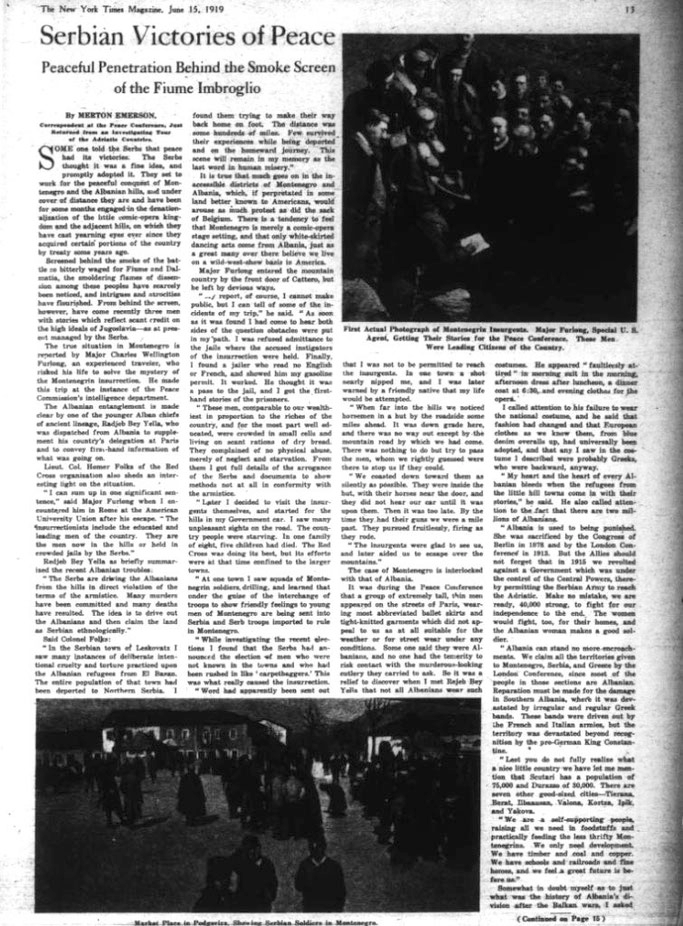
Source: The New York Times Magazine, June 15, 1919, page n°13
Cited from the article:
“Someone told the Serbs that peace had its victories. The Serbs thought it a good idea and immediately adopted it. They began to work for the peaceful conquest of Montenegro and the Albanian hills, and under cover of distance they have been engaged for some months in the denationalization of the little comic-operatic kingdom and the adjoining hills, on which they have cast their ardent eyes ever since they gained parts of the country by treaty a few years before.
After the smoke of the bitterly fought battle for Fiume and Dalmatia, the smoldering flames of discord between these peoples have scarcely been noticed, and intrigues and atrocities have flourished. However, behind the screen have recently appeared three men whose stories do not lend credence to the high ideals of Yugoslavia – as it is at present managed by the Serbs.
The real situation in Montenegro is reported by Major Charles Wellington Furlong, an experienced traveler, who risked his life to solve the mystery of the Montenegrin uprising. He made this journey at the instance of the intelligence department of the Peace Commission.
The Albanian confusion has been made clear by one of the younger Albanian leaders of ancient descent, Rexhep Bey Jella, who was sent from Albania to supplement his country’s delegation to Paris and to convey first-hand information about what was happening.
Lieutenant Colonel Homer Folks of the Red Cross also throws interesting light on the situation.
“I can sum it up in one meaningful sentence,” said Major Furlong (Charles Wellington Furlong) when I met him in Rome, in the American University Union, after his escape. “Among the insurgents are the educated and most influential people in the country. They are the ones who are at present in the hills or being held in overcrowded Serb prisons.”
SERBIAN ATROCITIES
Rexhep Bey Jella summarized the recent Albanian unrest succinctly:
“The Serbs are driving the Albanians out of the hills in direct violation of the terms of the armistice. Many murders have been committed and many deaths have resulted. The idea is to drive the Albanians out and then claim the land as ethnologically Serbian.”
TORTURE OF ALBANIANS OF LESKOVAC
Colonel Folks said:
“In the Serbian town of Leskovatz I saw many instances of cruelty and deliberate torture inflicted on Albanian refugees from Elbasan. The entire population of that town had been driven into Northern Serbia. I found them trying to return home on foot. The distance was several hundred kilometers. Few survived their experiences during the drive and the journey home. This scene will remain in my memory as the last word in human misery.”
It is true that many things happen in the inaccessible districts of Montenegro and Albania which, if they were carried out in any country more familiar to Americans, would excite as much protest as the plundering of Belgium. We are apt to regard Montenegro as a mere setting for a comic opera, and that only the dancing in white frocks comes from Albania, just as many people there believe that we live in America based on a Wild West play.
Major Furlong entered the mountainous country through the Kotor gate, but left by secondary roads.
“My report; I cannot, of course, make it public, but I can relate some of the incidents of my journey,” he said. “As soon as it was discovered, I had come to hear both sides of the question that obstacles had been put in my way. I was refused entry to the prisons where the accused instigators of the uprising were held. Finally, I found a prison guard who could read neither English nor French and showed him my license. It worked. He thought it was a pass to the prison and so I got first-hand stories from the prisoners.
These men, comparable to our richest in terms of the wealth of the country, and for the most part well educated, were crowded into small cells and lived on meager rations of dry bread. They did not complain of any physical violence, only of neglect and hunger. From them I got all the details of the arrogance of the Serbs and documents demonstrating methods not at all in accordance with the ceasefire.
Later I decided to visit the insurgents myself and set off for the hills in my car of the government. I saw many unpleasant scenes on the street. LiveThe country was starving. Five children in a family of eight had died. The Red Cross was doing its best, but its efforts were limited at that time to the larger towns.
In one town I saw squads of Montenegrin soldiers training and learned that, under the guise of an exchange of troops to show friendly feelings towards the Montenegrin youth, Serbian troops were being imported to rule Montenegro.
During my investigations into the last elections, I discovered that the Serbs had announced the election of people who were unknown in the towns and who had been rushed in as ‘carpets.’ This is what really caused the uprising.
Word had apparently been sent out that I would not be allowed to contact the insurgents. In one town a shot almost hit me and I was later warned by a friendly native that an attempt would be made to kill me.
Far up in the hills we noticed some horsemen in a roadside hut a few miles away. Here was a descent and there was no way out except by the mountain road by which we had come. There was nothing to do but try to get past the horsemen, who we correctly thought were there to stop us if they could.
We rode towards them as quietly as possible. They were inside the hut, with their horses by the door, and did not hear our car until it was upon them. By the time they took up their weapons we were already a mile and a half away. They pursued us in vain, firing as they rode.
The rebels were glad to see us and later helped us escape from the mountains.”
The question of Montenegro is related to that of Albania.
“It was during the Peace Conference that a group of extremely tall and thin men appeared on the streets of Paris, dressed in short frocks and tight knitwear, which did not seem at all suitable for the weather or for street wear under any circumstances.
Some said they were Albanians, and no one dared to risk contact with these murderous-looking people. It was therefore a relief to discover, when I met Rexhep Bey Jella, that not all Albanians wear such suits. He appeared “immaculately dressed” in his morning suit in the morning, his afternoon suit after lunch, a tuxedo at 6:30 p.m., and his evening clothes for the Opera.
I drew attention to his failure to wear the national costume, and he said that fashions had changed and that European clothing as we know it, from blue overalls jeans and high, were universally adopted and that whatever I saw in the costume I described were probably Greeks, who were backward anyway.
“My heart and the heart of every Albanian bleeds when refugees from the small hill towns come with their stories,” he said. He also drew attention to the fact that there are two million Albanians.”
“Albania is used to being punished. She was sacrificed by the Congress of Berlin in 1878 and by the London Conference in 1913. But the Allies must not forget that in 1915, we rebelled against a government that was under the control of the Central Powers, allowing the Serbian army to reach the Adriatic. Make no mistake, we are ready, 40,000 strong, to fight for our independence to the end. Even women would fight for their homes and the Albanian woman is a good soldier.
Albania can no longer afford any further infringement. We claim all the territories given to Montenegro, Serbia and Greece by the London Conference, as the majority of the people in those sections are Albanians. Compensation must be given for the damage in Southern Albania, where it was devastated by Greek irregular and regular bands. These bands were driven out by the French and Italian armies, but the territory was destroyed beyond recognition by the pro-German King Constantine.
In order that you may fully understand what a small and beautiful country we are, let me mention that Shkodra has a population of 75,000 and Durrës has a population of 30,000. There are seven other cities of good size: Tirana, Berat, Elbasan, Vlora, Korça, Peja and Gjakova.
We are a self-sufficient people, gathering all we need in food and practically feeding the less thrifty Montenegrins. We only need development. We have timber, coal and copper. We have schools, railways and beautiful houses and we feel that a splendid future lies before us.”
Somewhat in doubt as to what was the history of the partition of Albania after the Balkan Wars, I asked questions and Rexhep Bey gave me the following plan which had been prepared by the National Party as an official statement:
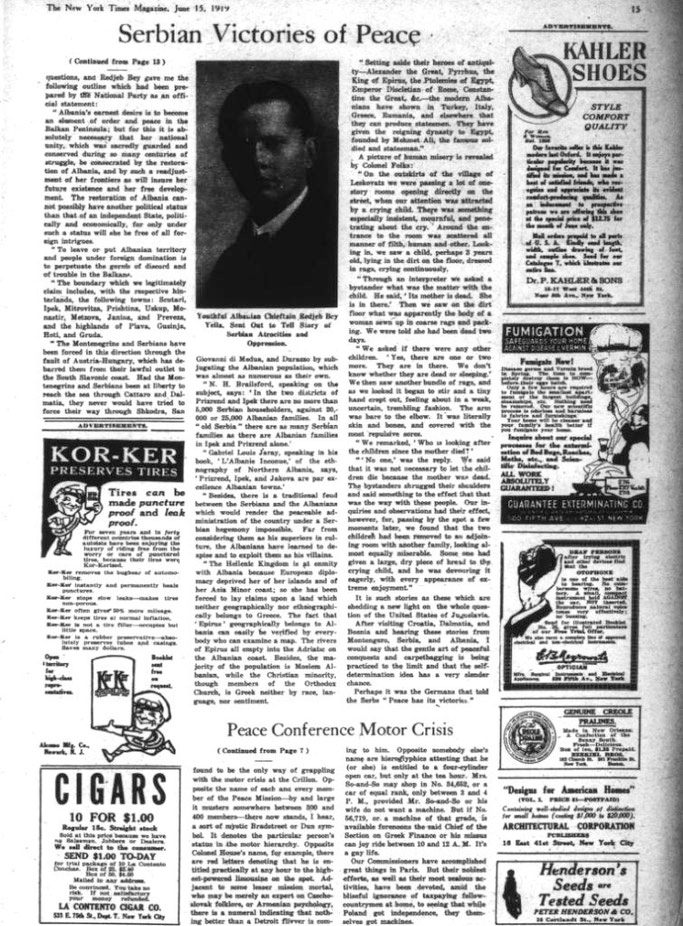
Source: The New York Times Magazine, June 15, 1919, page n°15
“The sincere desire of Albania is to become an element of order and peace in the Balkan Peninsula; but for this it is absolutely necessary that her national unity, which was preserved t and was sacredly defended during so many centuries of wars, to be sanctified by the restoration of Albania, and by such readjustment of its borders as would ensure its future existence and its free development. The restoration of Albania cannot have any other political status than that of an independent state, politically and economically, for only in such a status will it be free from all foreign intrigues.
Leaving or placing the Albanian territory and people under foreign domination constitutes the perpetuation of the seeds of discord and unrest in the Balkans.
The border which we legitimately claim includes, with the respective surroundings, the following cities: Shkodra, Peja, Mitrovica, Pristina, Skopje, Manastir, Metzova, Janina and Preveza, and the highlands of Plav, Guci, Hoti and Gruda.
The Montenegrins and Serbs have been forced in this direction through the fault of Austria-Hungary, which has forbidden them their lawful exit to the southern Slavic coast. If the Montenegrins and Serbs had had the freedom to reach the sea through Kotor and Dalmatia, they would never have attempted to force their way through Shkodra, Shëngjin and Durrës and subdue the Albanian population, which was almost as large as their own.
Pizren and Peja
N. H. Brailsford, speaking on this subject, says: “In the two districts of Prizren and Peja there are not more than 5,000 Serbian families, as against 20,000 or 25,000 Albanian families. In the whole of “old Serbia” there are as many Serbian families as there are Albanian families in Peja and Prizren alone.”
“Prizren, Peja and Gjakova are Albanian cities par excellence,” says Gabriel Louis Jaray, speaking in his book “L’Albanie inconue,” about the ethnography of Northern Albania.
In addition, there is a traditional feud between Serbs and Albanians that would make the peaceful administration of the country under Serbian hegemony impossible. Far from considering them as cultural superiors, the Albanians are accustomed to despise and exploit them as evildoers.
Epirus being Albanian
The Hellenic Kingdom is at enmity with Albania because European diplomacy deprived it of its islands and its coasts of Asia Minor; thus it is forced to lay claim to a land that neither geographically nor ethnographically belongs to Greece.
The fact that ‘Epirus’ geographically belongs to Albania can be easily verified by anyone who can examine a map. The rivers of Epirus all flow into the Adriatic on the Albanian coast. In addition, the majority of the population are Muslim Albanians, while the Christian minority, although members of the Orthodox Church, is not Greek either by race, language or sentiment.
Leaving aside their heroes of antiquity — Alexander the Great, Pyrrhus, the King of Epirus, the Ptolemies of Egypt, the Emperor Diocletian of Rome, Constantine the Great, etc. — the modern Albanians have shown in Turkey, Italy, Greece, Romania, and elsewhere that they can produce statesmen. They have given Egypt the royal dynasty, founded by Mehmet Ali; the famous soldier and statesman.”
A picture of human misery is revealed by Colonel Folks:
“On the outskirts of the village of Leskovatz we were passing many one-story rooms (parts) overlooking the road, when a crying child attracted our attention. There was something particularly persistent, distressing, and piercing about the cry. All manner of filth, human and otherwise, was strewn about the entrance to the room. Looking in, we saw a child, perhaps three years old, lying on the ground, dressed in rags, crying incessantly.
Through an interpreter we asked a passerby what was wrong with the child. He said, “His mother is dead. She is there.” Then we saw on the dirt floor what appeared to be the body of a woman, sewn up in large rags and wrapped. We were told that she had been dead for two days.
We asked if there were any other children. “Yes, there are one or two more. They are in there. We don’t know whether they are dead or sleeping.” Then we saw another bundle of rags, and as we looked, it began to stir, and a small hand came out, feeling weak, uncertain, trembling. The arm was bare to the elbow. It was literally skin and bones, and covered with the most hideous wounds.
We asked, “Who has been taking care of the children since the mother died?”
“Nobody,” was the answer. We said that it was not necessary to let the children die because the mother was dead. The passers-by shrugged their shoulders and said something about how this happened to these people. Our searches and observations had their effect, however, for, passing by the scene a few moments later, we discovered that the two children had been taken to a room next door to another family, looking almost equally miserable. Someone had given the crying child a large, dry piece of bread, and he was eagerly devouring it, with an air of extreme pleasure.”
It is such stories that are throwing aa new light on the whole question of the United States of Yugoslavia.
After visiting Croatia, Dalmatia and Bosnia and after hearing these stories from Montenegro, Serbia and Albania, I would say that the gentle art of peaceful conquests and carpets is being practiced to the limit and that the idea of self-determination has very little chance.
Perhaps it was the Germans who told the Serbs: “Peace has its victories.”
Reference

 Balkan Academia