
Author: Fahri Xharra. Translation: Petrit Latifi
“This article discusses the so called “Stone Oaths”. The appearance of stone as a symbol of faith is also for proving innocence and in decisions of certain village communities. In the dokesor law of our highlands it is stated: “The oath with a “stone” towards the canoe is among the most important and honorable oaths known to the Albanian of the Highlands”. (KLD, 1933, p.60).
In the dokes of the highlands, the stone as a sign of faith in the oath is given an extraordinary value, as a very early oath cult; in terms of divine active force, it turns out to be much stronger than the Gospel and the Quran. Of course, we are always talking about the old mindsets of the people of the Albanian highlands.
How is it possible that the Romans laid an oath by stones?
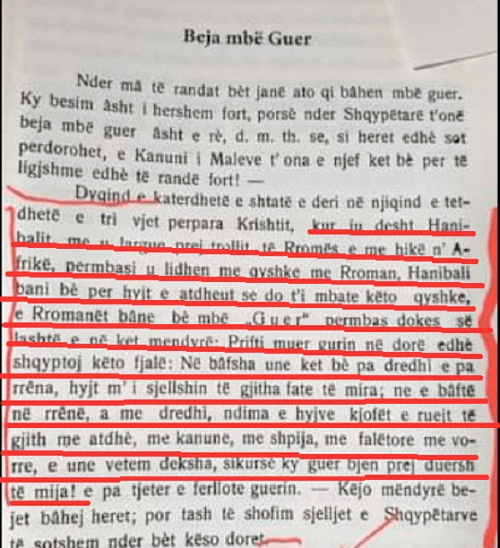
Oath on the stone, “the Romans and Hannibal”. From author Sh. Gjeqovi , “Hylli i Drites” in 1936.
“The stone on my side in the oath was held firmly and firmly. They said that the beja lied to me, with a stone on the side in that life is worth half the world. Two people were fighting (arguing) for a place (for ownership of a piece of land). They said: “he is my name and he (the other) is my name”. One would say to the other: “Take the stone with your arm! If you take it with a stone, it’s yours”.
With a stone in your hand, the other person takes the field under your house. With a stone in your hand, the other person takes the boy. It was stronger than a bey with 24 men. The other person could take you with a stone in your hand: land, a well, the water of the well or the one where the people drank.
When they wanted to separate (completely separate) someone from the society because of the abominations they had committed, they made a covenant, and swore with the stone as if they had passed it through their hands. It was said: I have stoned so-and-so through his hands for death and for darzēm”. The bey with a stone in your hand or in your hand was very “heavy”, more “heavy” than any other way of bey. The “heaviest” was with the lightning stone. Before this bey, with a stone, everyone retreated, submitted, obeyed. He was very afraid of her.
In my book “Roma filiste shqip” (“Lena” Prishtina 2019) I have clearly and irrefutably explained that the Roman Empire was the offspring of the Etruscans and Illyrians of the Apennine Peninsula, which is often called Italy (page 119, ibid.)
Italy is not an ethnonym. Neither did the Roman Empire represent and does not represent any ethnonym. Q In the above question of how it was possible for the Romans to swear on stone, it is easy to explain because they spoke the Albanian language of their time.
That the Romans swore on stone is written in a long work by Shtjefën Gjeqov published in “Hylli i Dritës”, 1936.
Stone and lump of earth
Stone and lump of earth were used as a vow to divide and redefine forgotten borders between two families or villages, especially for forests, meadows, pastures. To make this redivision, an elder who knew the old borders and who had been spoken about by even older elders who had died long ago was generally appointed as a judge. It was believed that this elder knew them and that he would restore them with justice.
Before the elder redefining the borders began to act, hostages were released (symbolic signs indicating that the interested parties on both sides would agree with the determination of the borders by the marked elder). The old man, accompanied by representatives of two neighborhoods, two villages or two villages, would take a stone and a handful of earth (a lump of earth or a handful of earth) and put it on his shoulder, holding it in his hand.
Before leaving, he would swear to the two groups as follows: “By this stone and weight and earth, with which I burdened myself, because I felt from the beginning, the places of the borders have been as if I will now declare them; and as long as my mind and soul can remember, I will not be attached to any neighborhood!”. He would also swear thus: “By this weight, here and here was the ancient border and here I am also establishing it, and I would have taken it in that life even if I were lying!”.
If any of the parties object, he adds: “For this reason, if we were to be together in that life, this is the old sign of the ancient border, as my grandfather told me… when I was a little boy (a child of 10-15 years old) I used to fight with them, and he took it in that life because it is here, and I still take it at his word.” The old man leads the others with stones and on his shoulder.
From place to place the old man stops, marks the border with his foot, and there the others plant a tree or a sign. During the establishment of the border, the old man always keeps his hand on it, bringing it straight. After the establishment of the border is finished, the old man says: “He who played with this stone, may he be a shepherd in that life!”. In this way, the old man and the others continue to establish all the borders in the places previously determined.
According to popular belief: “The old man who carries a stone and a stick – which are the symbols of his soul – if he does not speak correctly and even if he passes it by the door of the house, things will not stop, his soul will go there for better or worse.”
References
Mitologjia ndër shqiptarë / MarkTirta. – Tiranë: Shkenca, 2004.
Sh.Gjeçovi, “Guri i kufinit”, “Hylli i Dritës”, 1936.
Original article

 Balkan Academia