
Petrit Latifi
In a 1920s article from the newspaper “Alpenland” we can read of Serbian and Yugoslav rape and abuse of German women in territories awarded to Yugoslavia in 1919 after the Peace of Saint-Germain. The title is “From the Borderlands: Brutality Behind the Lines”, from Graz, September 8, 1920.
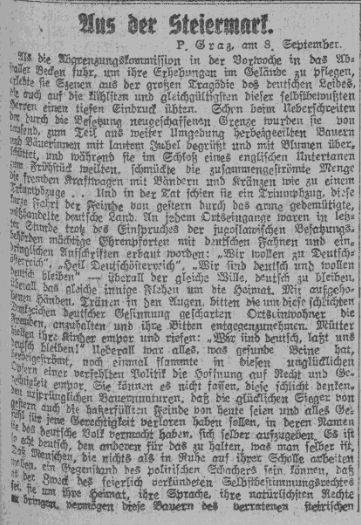
“During a recent visit to the southern territories by the Reconstruction Commission, harrowing testimonies emerged, painting a grim picture of life under Yugoslav occupation. As the commission passed into the newly redrawn border regions, once part of German Austria but now under Yugoslav control, they were met with both desperate hope and overwhelming grief.
Among the most disturbing revelations were the systematic abuses committed by Serbian soldiers against the civilian population—particularly against women. Entire communities had gathered to bear witness, not merely with slogans and flowers, but with evidence of trauma still fresh on their bodies and faces.
At Freudenau Castle, the Viennese industrialist Meinl had offered shelter and care for women who had suffered under the occupation. Here, the commission was confronted with women who had been beaten, bloodied, and left unconscious—victims of targeted aggression carried out by Yugoslav troops. These women, some barely able to speak, stood as living testimony to what the local population saw as the “barbarism of the southern occupiers.”
The women had not come to beg for pity. They came to plead for justice, to demand that the commission witness not just the political consequences of redrawn borders, but the human cost of violence carried out in the name of national expansion. The stories they told were not isolated. Rather, they formed a pattern—one of systematic humiliation, bodily assault, and attempts at forced subjugation.
One of the commission’s members, the Japanese officer Major Naganmochi, was so moved by what he saw and heard that he publicly expressed his deep emotional disturbance—perhaps the only gesture of compassion from the outside world that the women had yet received.
These acts of violence, the locals insisted, were not accidents of war. They were not excesses in the chaos of conflict. They were deliberate, calculated moves meant to break the German-speaking population’s spirit, to erase their cultural identity, and to punish them for a war they did not start.
Despite the brave faces and heartfelt cries—“We are Germans, let us remain loyal!”, “Do not abandon us!”—there was a palpable sense of abandonment. The victors of yesterday, now the rulers of today, had become the enforcers of repression. And the so-called right of self-determination, once so proudly proclaimed by the Entente, had been reduced to a slogan with no substance in these remote valleys.
For the women of Lower Styria, the war did not end in 1918. It continues in the form of occupation, silence, and the lingering wounds of violence. Their suffering, long ignored by the powers that be, now lies in plain view.”
Reference

 Balkan Academia