

Petrit Latifi
In 1932, the “Alpenzeitung” published an article about Serbian atrocities and massacres being committed against Croatian civilians in the region of Lika.
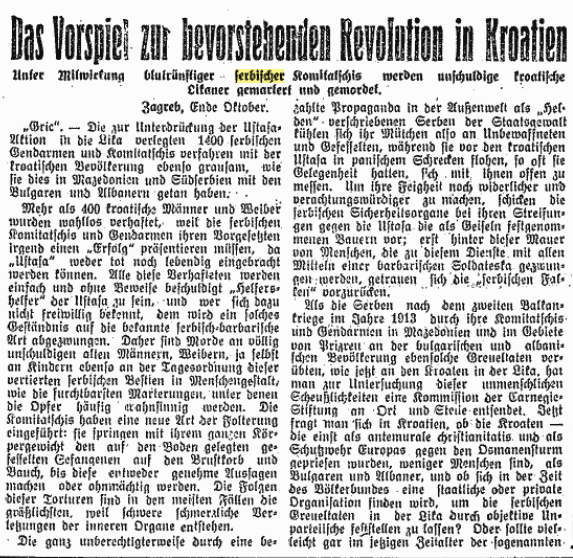
Cited:
“The Prelude to the Impending Revolution in Croatia. With the participation of blood-thirsty Serbian komitadjis, innocent Croatians from Lika are being tortured and murdered. Zagreb, end of October.
“Gric.” – The 1,400 Serbian gendarmes and komitadjis deployed to Lika to suppress the Ustasa action are treating the Croatian population just as cruelly as they treated the Bulgarians and Albanians in Macedonia and southern Serbia.
More than 400 Croatian men and women were indiscriminately arrested because the Serbian komitadjis and gendarmes had to present some kind of “success” to their superiors, since the “Ustasa” could not be brought to justice, dead or alive. All of these detainees are simply and without evidence accused of being “accomplices” of the Ustasa, and anyone who does not confess voluntarily is forced to make such a confession in the well-known Serbian barbaric manner.
Therefore, the murders of completely innocent old men, women, and even children are just as much a part of the daily routine of these bestial Serbian beasts in human form as the most horrific tortures, which often leave the victims unconscious. The Komitadjis have introduced a new form of torture: they jump with their full body weight onto the chest and stomach of bound prisoners laid on the ground until they either make favorable statements or faint.
The consequences of these tortures are, in most cases, the most gruesome, resulting in severe, painful injuries to the internal organs. The Serbs, who are quite unjustifiably presented as “heroes” by paid propaganda in the outside world, are being sworn to the state power. They thus vented their anger on unarmed and bound people, while fleeing in panic from the Croatian Ustasa whenever they had the opportunity to confront them openly.
To make their cowardice even more disgusting and despicable, the Serbian security forces sent the peasants they had taken hostage to lead them in their raids against the Ustasa. Only behind this wall of people, who are forced into this service by all means of a barbaric soldiery, do the “Serbian traps” dare to advance.
When the Serbs, after the Second Balkan War in 1913, through their komitadjis and gendarmes, committed atrocities against the Bulgarian and Albanian populations in Macedonia and in the Prizren region, just as they had committed against the Croats in Lika, a commission from the Carnegie Foundation was dispatched to the scene to investigate these inhumane atrocities.
Now, people in Croatia are asking themselves whether the Croats, once praised as an antiquated Christian state and as Europe’s defense against the Ottoman onslaught, are less human than Bulgarians and Albanians, and whether, in the era of the League of Nations, a state or private organization will be found to Serbian atrocities in Lika should be determined by objective and impartial experts?”
Reference

 Balkan Academia