

Petrit Latifi
In 1903, the paper “Bozner Nachrichten” published an article about the history of the Albanian people with an interesting analysis.
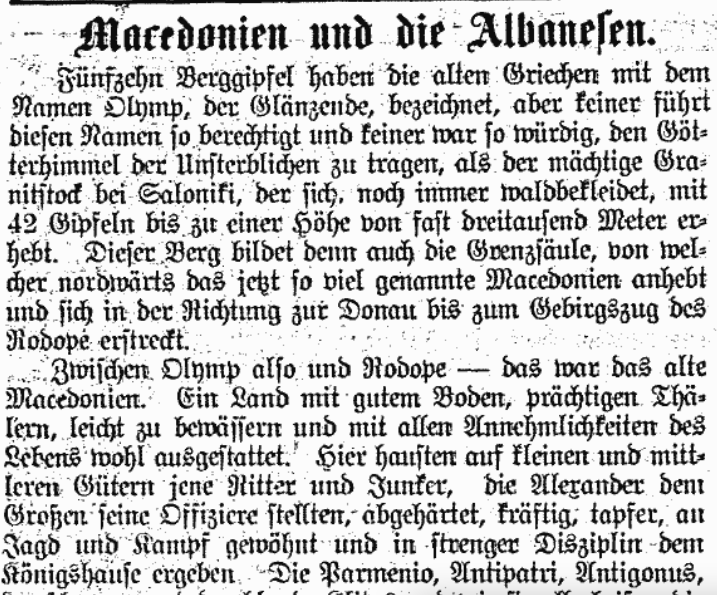
Cited:
“The Albanians (Arnauts) are an ancient people, older probably than the Hellenes themselves, whose prehistory is connected with Albania, since in the latter country lay the oldest sanctuary and oracle of the Greeks, Dodona with its oak grove, furthermore the dark river Acheron, but no less the Elysian Fields.
Thus, the entrance to the underworld and paradise! What more could one want? In this nest of valleys and mountain ranges, protected by its geographical location and its nature, Albania stands as a stronghold, which has been frustrated or bypassed by all the countless invasions of the Frigian peoples who flooded the Balkan Peninsula. Greeks, Romans, Goths, Heruli, Slavs, Byzantines, Avars, Maghars, and Turks—nothing has shaken the Albanians.
Tough, introverted, domineering, accustomed to playing for their lives, a soldierly people of the highest order, the Albanians are reminiscent in many respects of the ancient Germanic tribes, of the berserkers of the north. With them they share audacity, boundless ambition, a love of war, and the mercenary spirit.
Countless men-at-arms and fortune hunters emerged from this tribe; One-third heroes, two-thirds scoundrels,” they fought in the armies of Megan the Great and Pyrrhus, delivering their sons to the Romans, later to the Arabs and Turks, for whose rule they formed a strong pillar. Lord Byron calls Albania the “rugged nurse of savage men,” and never was a title better deserved than this!
Alexander the Great himself, Pyrrhus, Skanderbeg, who is said to have slain two thousand enemies with his own hand—his helmet is in our Court Museum—were Albanian forerunners. Yet they are not as heavy-headed as so many brave northerners. A letter from Skanderbeg has survived in which Skanderbeg attempts to prove that the Arnauts do not deserve the epithets bestowed upon them by the Italians, but that he and his countrymen are the descendants of noble ancestors.
When would a Swiss mercenary ever have invoked the Cheruscan Hermann or the paladins of Charlemagne? It is thanks to this firmness of inner consciousness that the Albanians, too, have faithfully preserved their national identity for a long time beyond their borders, as, for example, the settlements they sent to the gates of Athens, to Calabria, and Sicily. In Austria, there are also Hungarians near Zara in Dalmatia and (as “Clementines”) in the area around Semlin. The rural population of the Kingdom of Greece is said to be one-third Albanian.
The modern appearance of the Albanians already betrays the old Strieger race. In this, they are very different from their neighbors, the Bulgarians, Serbs, Wallachians, and the Greeks proper. For the most part, the people are tall and well-built, with long necks and high chests.
Their facial features proclaim boldness and the pride of men who have never been enslaved. They thoroughly display the characteristics of the Indo-European race. Their women are not inferior to the men in beautiful and expressive build. The stature and gait of these Arnautian Amazons have something stately and commanding, which is supported by their picturesque clothing.
If one compares the Arnautian type with other types, it most resembles the Caucasians on the one hand and the Tyroleans on the other, whereby the similarity also lies in the fact that among Arnauts and Tyroleans are both dark-haired and black-eyed, as well as blond and blue-eyed individuals, appear.
The most beautiful blond hair is said to be found among the women of the southern Arnauts (Tuscans, the actual descendants of the Epirotes). If one remembers that the Ostrogoths lived in these regions for a long time before they crossed over to Italy, these blond and blue-eyed appearances are easily explained.
In this strong warrior race, which occupies western Macedonia, the Bulgarians have now found a tough, difficult-to-overcome opponent. The tribal hatred was sharpened by the Peace of St. Stephen, which sought to assign the main towns of Monastir, Ochrida, and Dibra, which belonged to the Albanians, to the Bulgarians.
The Turkish government has its hands full keeping the two opponents apart Settling this dispute is far more difficult than the overthrow of the princedom of Bulgaria by the Turks would be. Only a reasonable separation of the enemies, the introduction of local self-government, and impartial supervision by the princely authorities controlled by Europeans can help here, and even this can only happen gradually, with the danger of relapses always foreseeable.
On the whole, the latest Austro-Russian reform is certainly on the right track. The name “Macedonia,” however, is false and misleading. The country so called is not a unit and will not become one in the foreseeable future. If incorporated into Bulgaria, it would be the source of constant fighting between the Bulgarians and the Greeks, Serbs, and especially the Arnauts. Between them, the Turks still constitute the most qualified element of the ruling power.”
Reference


 Balkan Academia