
Petrit Latifi
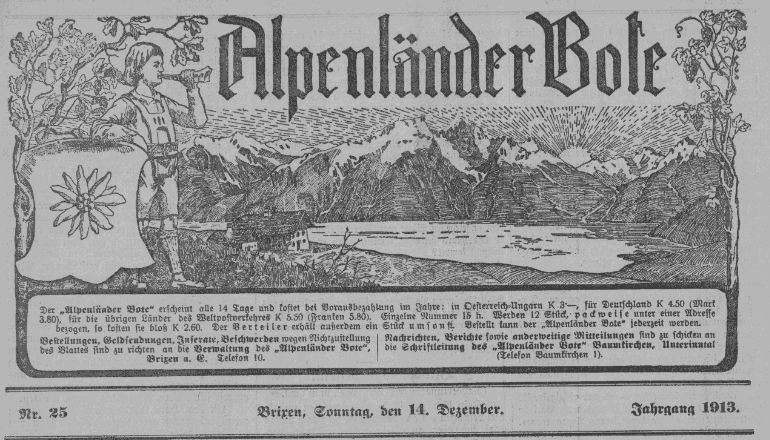
In 1913, a priest published an article in the paper “Alpenländer-Bote” testifying about Serbian atrocities against Albanians and Catholics in Serb-invaded territories in 1913. He also explained the anti-catholic sentiment in Serbia.

“How Serbia treats Catholics.
A priest living in the Balkans recounts: In the inaccessible gorges near Ferizaj visible from above in the rock face to the passing hiker, still lie the remains of countless bodies thrown into the depths by Serbian soldiers. The unfortunate ones were Albanians.
The numerous village ruins near Uskub and in the Metohija are still blackened with smoke, the rooms of which once housed an industrious Albanian population. Shrines of the decimated Catholic population still stand devastated and desecrated. And already, a new war of annihilation is being waged against the Albanians, who were tormented for so long, until they laid down their heads and demanded humane border conditions.
We fear that once again, not only the Albanians but also the Catholics will be affected. Europe is blind and deaf, otherwise it would know first hand what crimes are being committed here against civilization, against nationalism, against freedom of conscience, and it could not be so hardened in its heart as to permit this disgrace of our age
But I want to tell it like it is, to explain it like it is. Above all, it should be remembered that in Serbia itself there have been about 6,000 Catholics, the vast majority of whom live in Belgrade and are made up of foreigners. The second group of Catholics is located in Nish. Just as well known as this fact is that the Catholics in Belgrade have never been able to build their own church, although they number more than 3,000.
In Nish there is a small church, the only Catholic one in the entire previous kingdom, which is still in the The church was built during the Turkish rule by Monsignor Dario Buccarelli, Archbishop of Usküb. Since Nish came under Serbian rule, it was no longer possible to add a single new stone to the church; the Serbian government forbade any expansion, no matter how necessary.
In 1890, the Serbian See agreed to the establishment of a separate diocese with its seat in Belgrade; thanks to the intolerance of the authorities, the project has remained on paper to this day; the commitments made at that time remain unfulfilled to this day.
Four years ago, a Catholic priest went to Pirot in the Archdiocese of Uesküb to visit an acquaintance. His arrival in Pirot was noticed by the police and immediately aroused suspicion. After being summoned to the Serbian police station three times, he had to leave the place as quickly as possible the next day if he valued his life.
With the exception of the Russians, with whom I never came into personal contact, I have not found a people in Europe more intolerant of Catholicism than the Serbs. And not only the masses are permeated by this hatred. It happens every day that one hears very high-ranking figures express themselves about Catholicism in such a way that one is in doubt as to what predominates, ignorance or fanaticism. This hatred seems innate to them and grows with age, but is held as sacred as the most venerable tradition.
Anyone who has not spent a long time in Serbia has difficulty imagining the conditions; without having lived among this people, it is impossible to form a correct idea of this intolerance. It may seem unbelievable, but not even the Turks went that far in their hatred. For five years I lived among Turks as a priest, but they did not do as much to me as the Serbs did in the last five months.
The first thing one is asked, even by educated people, is always and infallibly: What religion do you belong to? If they hear that one is a Catholic, they turn around and leave the person being asked standing there as if he were afflicted with a contagious disease, and those who do only that are the most tolerant. This, in general terms, is the Serbian spirit in its attitude toward Catholicism
The racial hatred between the Serbs and Albanians is indelible. Serbia only wants a free hand against the Albanians, especially against the Catholics among them. 30,000 of them were killed in this war; only 8,000 fell in battle; the rest were massacred. 3,000 children and old people were massacred without any fault of their own, simply because they were Albanians; I myself helped bury many of these dead.
Even today, in those regions, death threatens the person who commits the crime by openly communicating with his priest, and we ourselves are already being threatened to adopt the Oriental rite instead of the las teiniihen, to refrain from preaching in the language of the people, that is, the Albanian language, and to use Serbian instead
Now the Serbian bastailions are marching again through the Albanian villages, towards the Albanian border. What will be left until they return and there is finally peace?”
Reference

 Balkan Academia