
Written by Lulzim Osmanaj. Translation Petrit Latifi
ILIR UNAZOR inscription from the DALAMACIAN NECRO-POLIS
In previous research, a ring inscription from the necropolis of the Dalmatian Castle (Albania) was considered an Illyrian inscription (see, for example, Hans KRAHE. The Language of the Illyrians. Part One: Sources, Wiesbaden, 1955, p. 12).
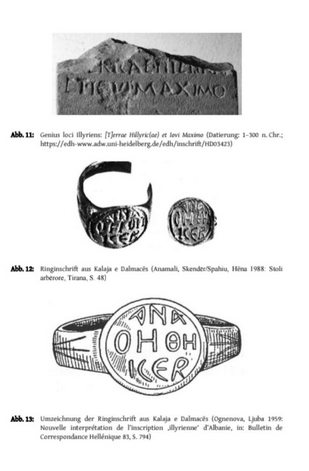
Sacred to Mother Oëthe
The name of the supposed goddess Oëthe, which could not be found anywhere else, was compared to the Goth, aipei ‘mother’, and was assumed to be associated with the Greek word hierós ‘holy’. Joachim Matzinger (Vienna) Munich 30.11.2016. According to OGNENOVA
However, the Bulgarian scholar L. OGNENOVA managed to show that it is in fact a Greek-Byzantine Christian inscription of the middle period, which should be read correctly as: ‘Lord, help (Anna)’, which belongs to the context of other similar Byzantine Christian inscriptions with rings.
Ljuba OGNENOVA. ‘Nouvelle interprétation de l’inscription “illyrienne” d’Albanie’. In: Bulletin de Correspondance Hellénique 83, 1959, S. 794-799, Eqrem ÇABE). “Ringinschriften aus Nordalbanien”. In: Lingua Posnaniensis 9, 1963, S. 98-102, [40] EICHNER 2004, S. 92.
The glosses, which in antiquity were described as Illyrian, are treated in detail by [] EICHNER, 2004, p. 93-94, drawing attention to the difficulties of their interpretation (Hesych: Deua-dai(with conjecture) Sat(ur)oi, scholia to the Odyssey: rhinós = achlýs, the glosses sabaium/sabaia e. type of beer and sybina ‘spear’ are uncertain in Latin authors).
Among the Oinotrians in Lower Italy, rhinós meant clouds, hence the word. Albanian re (vs. rê) ‘cloud’.
Onomastics:
What remains of Illyrian are the evidence of anthropo- and toponymy, from which an attempt should be made to determine at least the basic features of the phonological system of Illyrian.

Linguistic characteristics of Illyrian.
Marginal evidence prevents any penetration into the grammatical/morphological system of Illyrian. Regarding the development of the Illyrian phonological system from Proto-Indo-European, contradictions and ambiguities also arise that have not yet been resolved.


 Balkan Academia