
Written by Prele Milani. Translation Petrit Latifi
A MEMORY OF GRANDFATHER, IN FRONT OF A PHOTO OF HIM (Essay)
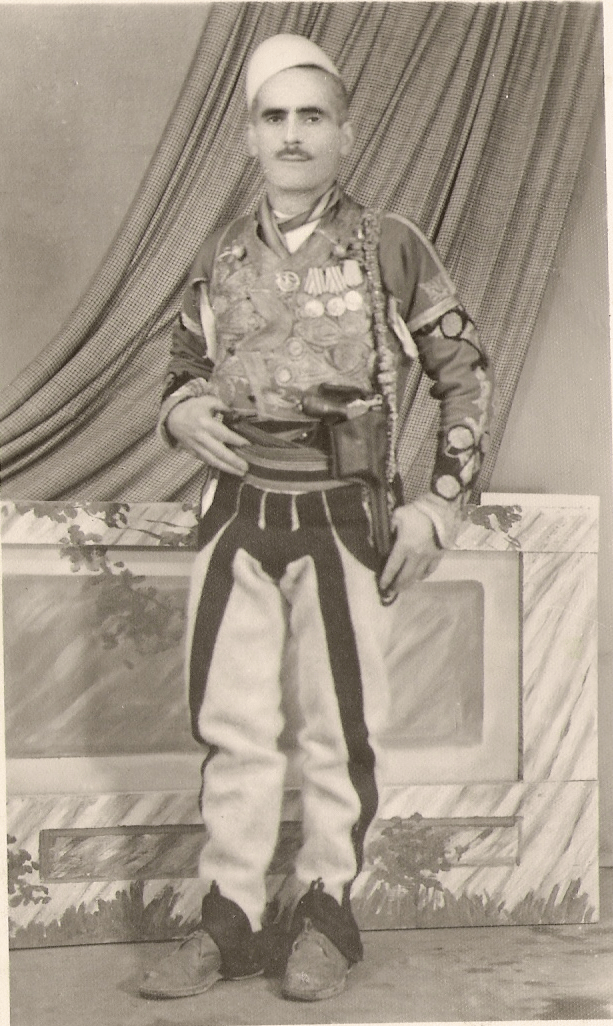
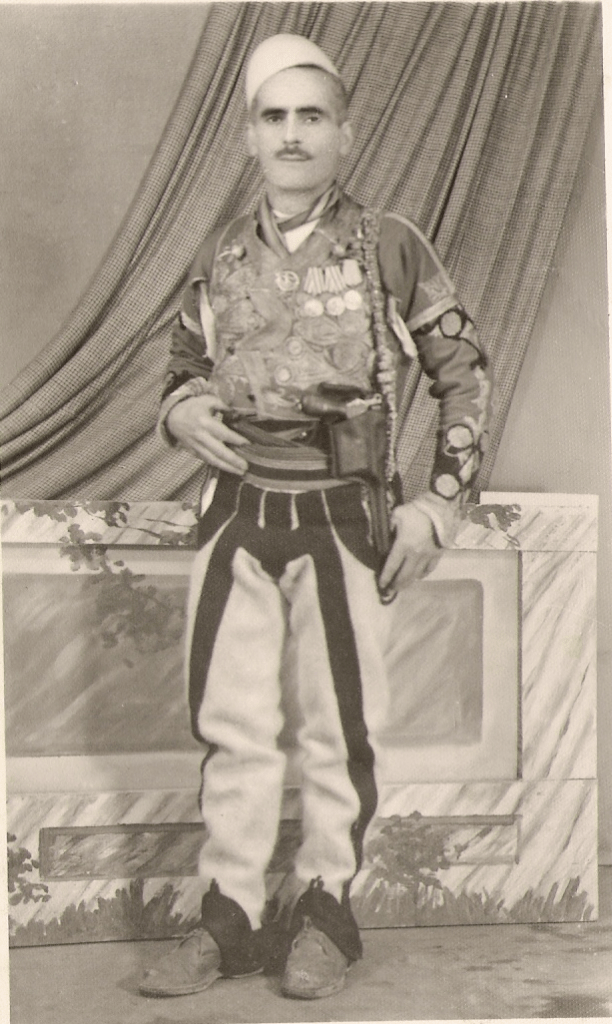
Dressed in the brightest robe of tradition, adorned with medals that are not only made of metal, but of blood, sacrifice and spoken words, he represents the rare breed of the mountaineer – the one who has the wisdom of an old man, the strength of a man and the pride of a tribe, all in one body.
He was a wise man, with a gaze that pierced not from severity, but from depth – that he had seen much, had lived long, had understood deeply, had been silent more than he had spoken. He had traveled and knew the land of the Albanians by heart; he knew the strength of the mountain and the laziness of the city, where his gait resembled that of an old knight who never accepted humiliation, nor bowed to the fashion of lies.
On his body there were wounds of honor, in his soul he carried pain that he never showed, and in his heart there was room for all those who were defenseless – the little ones, the poor, the widows, the voiceless children. He protected them with the same determination with which the Albanian protects the little ones in the nest of the hawk.
He was not only a man of the house, but also a standard-bearer of the faith. He inherited it from his father, Mark Milani – a man who ended up on the rope, not for guilt, but for honor. Because faith is both word, and blood, and sacrifice. Even when his friend, Zef Dela, fell and broke his back, he did not leave him.
He took him on his shoulder, carried him as far as he could, and when all the roads were closed – because honor knows no limits of possibility – he did not bow down. Like his father, this man lived his life with justice and without compromise.
This man of ice, with a proud forehead and a gaze that swept through the assembly like a righteous word, was one of those who are not born often. A man with a great soul and a heart as pure as the water of the stone of his mountains. He was a great worker – his day began before the sun and ended only when the night fell darkly on the hills.
His work was not only for the land, but also for the word, for justice and for honor. Humble in everyday life, but a brilliant orator in every assembly, in every region, in every chamber or office where the word and the right called him. He knew the language of the country and honor, but he also knew how to speak in the language of the law, the city, and the government. And when he spoke, there was no one who did not listen to him – not because of his voice, but because of the truth that came out of his mouth.
A man silent about untruths, but outspoken about the right. Incompatible with liars, hypocrites, fools and moral fools. He smashed the truth in their faces like a mountain stone – and with his courage he made a noise even when others were silent.
He did not live to rise above others, but to be a pillar for them. He was a wise, just, strict grandfather with an inherited nobility that does not dissolve. A man who did not leave behind great wealth, but a name that is indelible and worth more than millions.
I grew up in his lap as the most precious jewel of his life. I dare not say that I resemble that amber man – not because it was my grandfather who loved me more than life itself – but I say it with all sincerity: if I had not grown up with him, I would not be who I am today.
He probably raised me better than all my peers, but if I were given life again, I would never wish for a millionaire grandfather without the virtues of Bal Mark. Ah, if the clock were turned back, I would keep many more notes from that auto-experience that was him.
NOSTALGIA OF COSTUME
The suit that my grandfather wore was a treasure of Albanian cultural heritage – a garment of a high level, a rare sight that today is no longer found either in the coffers of homes or on the shelves of museums. Because it is nothing but clothing – it is identity itself.
It is the rich costume of Dukagjini, with elements that testify to high ethnographic class: carefully embroidered tirq, in black and white colors, in accordance with the principles of simplicity and pride. Xhamadani with rich sleeves, with typical Arbëro geometric ornaments, where the bright and strong colors are preserved – with a subtle sensitivity for symmetry and masculine charm.
This xhamadani is nothing but a sign of honor – it is immortalization. Because on it are hung memories, struggles, faith and the sweat of a lifetime. And on top, the white plis – the final seal of a masculine identity that cannot be challenged.
This costume was not worn to show off. He was eager to show the world that the Albanian does not only have a rifle and a word – but also the art of heritage that keeps him alive, even when the years and time try to erase his memory.


 Balkan Academia