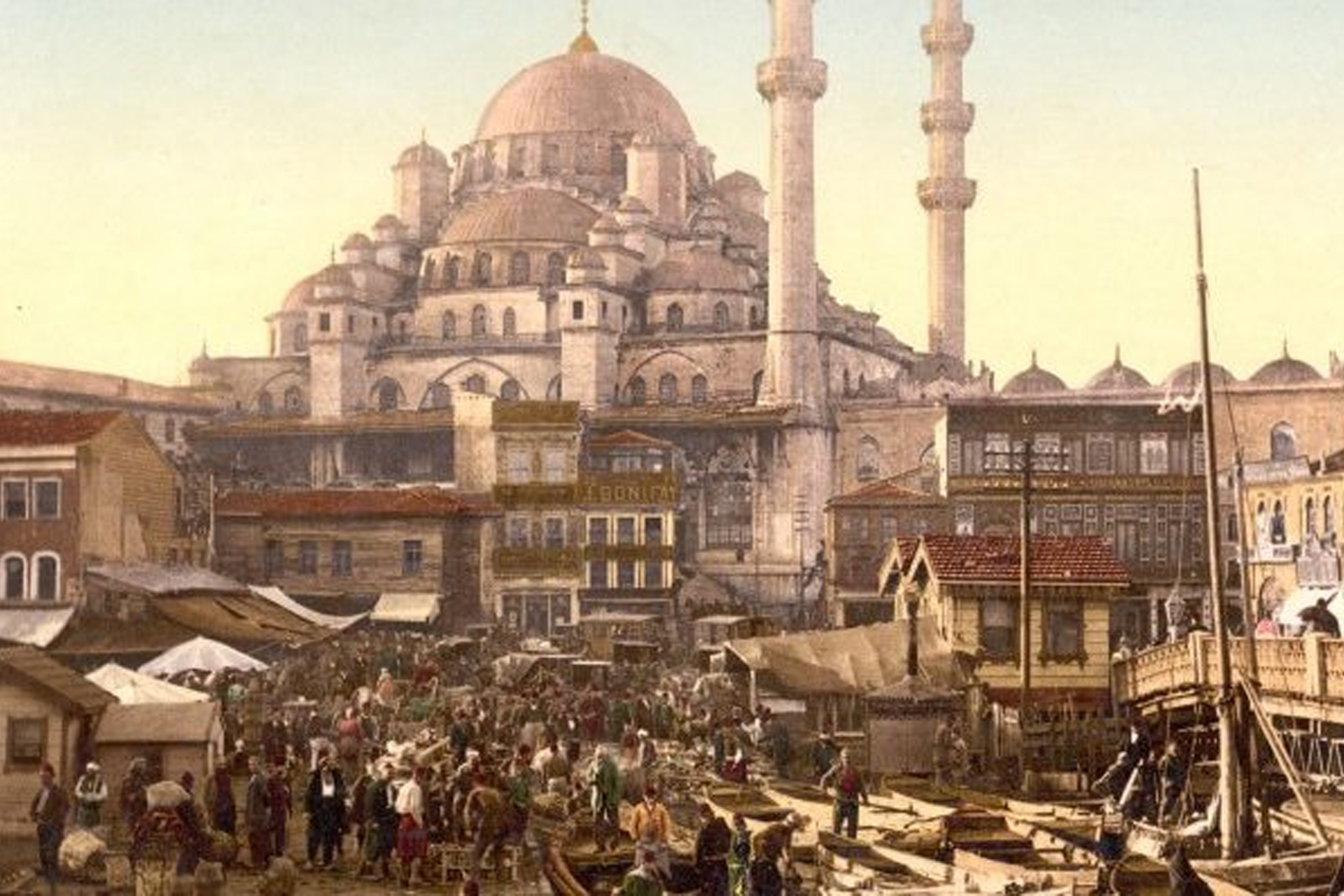

Petrit Latifi. Cover taken from Nistori.com
The Ottomans were descendants of the Oghuz Turks. They migrated as a tribe from Central Asia and settled in Anatolia at the end of the 11th century, after the heavy military defeat that the Seljuk Turks inflicted on the Byzantine Empire (1071), from which they took most of the possessions they had in Asia Minor.
The Oghuz Turks entered history when their leader Ertugrul received as a reward from the Seljuk sultan a small possession on the banks of the Sangaria (Sakaria) River. Meanwhile, the Seljuk state disintegrated into many small principalities after the military defeat inflicted on it by the Mongols (1243).
Ertugrul’s son, Osman I (1290-1323), expanded his paternal dominion and turned it into an independent state called the Ottoman Emirate, which became the nucleus of the Ottoman Empire. In 1299, Osman I assumed the title of sultan and his subjects were called Ottoman Turks. His army consisted of petty feudal lords called spahis (sipahs – knights), who were obliged to participate in war as knights whenever called upon by their superior commanders.
In 1317, Osman I entrusted his son, Orhan, with the duty of commander of the army. Sultan Orhan (1323-1362) in 1326 conquered Bursa and made it the capital. He expanded the borders of his state, created an alliance with the Byzantine Empire, and married the daughter of Emperor John VI Kantakouzenos.
Historical sources, and therefore modern historians, have some chronological differences for the first years of the Ottoman conquests in the Balkans. In 1347, 1349 and 1352, the troops of Sultan Orhan landed in the Balkans to fight alongside the sultan’s father-in-law against the Serbs, Bulgarians and internal political opponents of John VI. Under these circumstances, in 1352 the Ottomans established their first possession in Europe, taking the Cimpes castle near the city of Gallipoli and, two years later (1354), they conquered this city along with the Dardanelles region and beyond.
Sultan Orhan strengthened the internal organization of the Ottoman Empire. He minted a separate currency for his state and around 1330 created the elite standing army, the Janissary corps (janissary – young soldier). In addition to the spahis and janissaries, the Ottoman Empire also had military units of akanjin (akan – attack), which were cavalrymen, who were usually assembled when undertaking campaigns of conquest.
Orhan’s son, Sultan Murad I (1362-1389), brought entire regions of the Balkans under his rule. In the mid-60s, he conquered Adrianople, which he made the capital of the Empire and renamed Edirne. Its conquest greatly influenced the expansion of Ottoman conquests in Thrace. The path to massive Ottoman conquests in the Balkans was opened by the victory of 1371 near the Maritsa River, where Ottoman troops inflicted a military disaster on the Slavic rulers, the brothers Volkashin and Uglesha Mrnjavčević, who were also supported by Alexander of Vlora.
After the Battle of Maritsa, the Byzantine emperors and many other Balkan rulers became vassals of the Ottoman Empire. As vassals, they began to pay annual tribute and, together with their troops, took part in battles alongside the Ottoman armies whenever called upon by Sultan Murad I and his successors. The highest leaders of the Greek and Slavic churches, who had secured a number of privileges from the sultans, were also allies of the Ottoman sultans in the Balkans.
The transfer of the capital from Asia (Bursa) to Europe (Adrianople – Edirne) and the creation for the first time here and not in Anatolia of the beylerbeylik (Eyalet of Rumelia), prove that already at the time of Sultan Murad I, the Balkans were taking on more weight in the life of the Ottoman Empire than Anatolia. In the middle of the century. The Ottoman sultans managed to collect more soldiers and tax revenues from Rumelia (the European part of the Ottoman Empire) than from Anatolia.
During the following years and decades, the focus of the political and military activity of Sultan Murad I and his successors was the expansion of the borders of the Ottoman Empire towards the Balkans and other regions of Europe.
The first Ottoman invasions of Albania
The attacks of the Ottoman armies to conquer Albanian territories began in the mid-1480s. Led by the Beylerbey of Rumelia, Timurtash Pasha, in 1385 the Ottoman armies, after taking Sofia, entered Albania and occupied the cities of Shtip, Përlep, Manastir and Kostur. In Western and Ottoman documents of the 14th century. XIV-XV for the cities of Skopje, Manastir, Kostur, Ioannina etc., as well as for Fushe-Dardanina it is expressly noted that they were “in Albania” or “in the Albanian lands”.
In August 1385 Balsha II wrote to the Republic of Venice that his possessions were under daily attacks by the Ottoman armies and that they had caused great confusion in his subjects. When Balsha II was engaged in conflict with the Bosnian king, Tvrtko (1376-1391), over the issue of possession of Kotor, a powerful Ottoman army, commanded by Timurtash Pasha, in September 1385 quickly entered the depths of Albanian lands. Balsha II, together with a group of nobles led by him, quickly mobilized part of the army and came out in front of the Ottomans on the field of Savra (near Lushnja).
In the battle of Savra, which took place on September 18, 1385, the Albanian military forces were defeated and Balsha II himself was killed. The victory in the battle enabled the Ottoman army to conquer Berat, Kruja, etc., which it temporarily held, until it released them to their previous owners. Their incursions also extended to Upper Albania as far as Lezha, as well as to Lower Albania. In 1386, the Ottomans conquered Niš and a year later Thessaloniki, which they temporarily held until 1403.
For several well-known noble families, such as the Balšajs, the Muzakajs, etc., the Battle of Savra marked their fall under Ottoman vassalage, which was initially weak and sometimes formal. Not long after the defeat they suffered on the field of Savra, the Balšajs resumed an independent policy. In 1388, Gjergji II Balša, alongside the military forces of the rulers of Rasa and Bosnia, participated in the battle that took place in Beliqë (Bosnia) and his forces played an important role in defeating the Ottoman armies, commanded by L`alla Shahini. This victory prompted Karl Topina and the Muzakajs to sever their ties of vassalage to the Ottomans.
The intensification of the attacks of the Ottoman armies and the rapid expansion of their conquests in the Balkans made the Balkan rulers put aside their quarrels and conflicts and think and plan joint military actions to protect their possessions. In 1387 a broad Balkan coalition was created, while in 1388 the sultan concentrated numerous forces in Plovdiv to continue the conquests in the Central Balkans.
The Serbian prince of Rasha, Lazar Hrebelanović, took the initiative and invited the other Balkan rulers to join their forces to stop the Ottoman march. His call was answered by some of the Albanian rulers, such as George II Balsha, ruler of Shkodra, Theodore II Muzaka, lord of Berat and Myzeqe, Dimitar Jonima, lord of the territories along the Lezhë-Prizren trade route, Andrea Gropa, lord of Ohrid and the regions around it, rulers of Lower Albania, etc.
They were joined by other Balkan rulers, such as the Romanian voivode Mircea, the Croatian ban Ivan Horvat, King Tvertko I of Bosnia, the ruler of Kosovo Vuk Mladenovic, usually known by the surname Brankovici (Vuk Brankovici), etc. His family possessions were in the northern part of Drenica and Fushë-Dardanija. After Vuka’s death in October 1398, political life in his possessions was decentralized.
Albanian troops had an important weight in the forces of the Balkan coalition. The Ottoman chronicles, which describe this event, emphasize the large size of the army of George II Balsha and consider him one of the three main rulers of the anti-Ottoman coalition, along with Prince Lazar and Voivode Vlatko Vuković, commander of the army of King Tvrtko I of Bosnia.
In June 1389, the armies of the Balkan coalition united at Fushe-Dardani (Fushë-Kosovo). At the beginning of the battle, V. Branković withdrew his troops from the coalition. On June 15, the Balkans fought a bloody battle with the Ottoman forces commanded by Sultan Murad I. After some initial successes of the coalition armies, the victory in this battle ultimately favored the Ottomans, but with heavy human losses on both sides.
During the battle, the warrior Milosh Kopili killed Sultan Murat I. In retaliation, the Ottomans killed the prisoners of war, including Prince Lazar and Milosh Kopili. In this battle, Teodor I Muzaka was killed, as well as many of his comrades and other Albanians. The Battle of Fushë-Dardanija and the heroic act of Milosh Kopili left a strong impression on the Albanians of Kosovo, who immortalized them in folk songs.
The defeat of the Balkan coalition in the Battle of Fushë-Dardanija in 1389 had serious consequences for the peoples of the Balkan Peninsula. It put an end to the creation of broad Balkan coalitions against the Ottoman invaders and paved the way for the successor sultan, Bayezid I (1389-1402), known as the Lightning (Yëlldëm), to new conquests in the Balkans.
The Ottoman conquerors turned the ruler of Kosovo, Vukë Branković, into their vassal, whom they forced to surrender Skopje, and then Zvečan (a castle near Mitrovica), etc. in early 1392. With the capture of Skopje, the Ottomans strengthened their power in the eastern part of Central Albania (present-day Macedonia), especially in the lowland regions of the Vardar River, which one of the most prosperous in the Balkans.
The very favorable geographical position of Skopje, where the shortest routes connecting the capital of the Ottoman Empire with all Albanian lands and with other regions of the Balkans intersected, encouraged the Ottoman sultans to make it a very powerful military base, declaring it Pasha Sanxhak, i.e. the residence of the Beylerbey of Rumelia.
Meanwhile, the Ottomans had tried to expand their conquests in Central Albania. As early as 1385, they had taken the important city of Kostur from the Muzakajs, and around 1394 they took Ohrid from the Gropajs, which they could not hold for long. This lakeside city had a powerful fortress and a very favorable position for controlling fishing in the lake and in the numerous bays of the Drin River in Struga, where the dried fish prepared there was traded in large quantities.
To gain control of the lake region and weaken the presence of Albanian nobles there, the Ottomans established their administration in Ohrid and demolished the other three castles, Struga, Pogradec and Starovo, which guarded the lake and the roads near it.
In the absence of an Albanian national church, which would have had a significant impact on preserving the religious unity of the Albanians, a significant part of the nobility and other classes living in Skopje, Manastir and other cities in the eastern regions began to massively embrace Islamism.
By the end of the 60s of the 15th century, over 60% of the inhabitants of Skopje and Manastir were Muslims. Meanwhile, the process of Islamization did not spread to the Slavs, who had their own national church. In the Ottoman cadastral registers of the 16th century, XV almost no spahi has the qualification of being Serbian or Slavic, unlike many others who bear the surname Albanian (Arnaut).
After consolidating Ottoman power in the eastern regions of Central Albania, the Ottoman troops launched attacks towards the western and coastal regions, as well as Upper and Lower Albania, attacks that continued without interruption from 1385 to 1402 to resume after a decade. After taking Zvecan, in 1393 the Ottomans managed to temporarily occupy Shkodra, Ulcinj, Deja and Kruja, which they held until 1395.
At the end of the XIV century they temporarily took Ioannina and occupied the provinces of Korça and Përmet. The expansion of Ottoman conquests in Albania was temporarily halted after the Battle of Ankara, fought on 20 June 1402, where the Ottoman troops suffered a heavy defeat and Sultan Bayezid I (1389-1402) was captured by the victorious Mongol armies led by Timur.
After this battle, for a decade, the political life of the Ottoman Empire was engulfed in fierce conflicts between Bayezid I’s three sons for the succession to the throne, conflicts that ended with the rise to power of Mehmed I (1413-1421). The new sultan reactivated the policy of conquest also towards the Balkans and Albania.
Before Sultan Mehmed I came to power, in 1412 the Ottoman armies attacked Novoberdo and kept it under siege for a long time, but they could not take it, because its defenders fought bravely. The armies of Sultan Mehmet I, with the death of Niketa Topia, in early 1415 conquered Kruja, during 1417 they took Berat from Teodor Muzaka and Kanina together with Vlora from Rugina Balsha, and in the autumn of 1418 they conquered Gjirokastra, the capital of the Zenebish possessions.
The victory of the Ottoman troops in the Battle of Fushë-Dardanija in 1389 and the consolidation of their power at the end of the 14th century in the city of Skopje, in the regions of the Vardar River, as well as the conquest of Kruja, Berat, Gjirokastra, etc., facilitated further Ottoman conquests in the Balkans and Albania and increased panic in the ranks of the Balkan rulers, many of whom became vassals of the sultans. The headquarters of the Beylerbey of Rumelia, who was the commander-in-chief of the Ottoman armies for its European part, was established in Skopje.
With such a very powerful military and political personality of the Ottoman Empire, the Albanian nobles had to constantly confront. Alongside him, they also had to confront the numerous suckers of the powerful Evrenoz family. Ever since the first Ottoman invasions began in Eastern Albania, at the end of the 14th century, and until the end of the 15th century, when the last castles in Albanian lands, those of the western regions, fell into their hands, in all the important battles and military actions of the invading armies, a series of suckers of the Evrenoz family who lived in Skopje stood out as Ottoman military commanders.
The first of them was Evrenoz-Bey (Pasha Jigit Bey), who had conquered Thessaly; his name was used as a surname by their sons, grandsons and other descendants over the centuries.
The military feudal regime in Albania
The first Ottoman cadastral registrations in Albania. The organization of the Ottoman Empire and the functioning of the apaits state system was based on the feudal military property, the timar system. This type of property was established in the Balkans and Albania gradually, since the first Ottoman conquests of the 14th century. But historical sources from the 14th century are lacking to reflect the dynamics of the expansion in time and space of the timar system.
The earliest document discovered so far, to recognize the agrarian system that the Ottoman conquerors established in Albania and the Balkans, is a cadastral register of the year 835 AH (1431-1432), named “Register of the Albanian Sanjak” (Defter-i Sancak-i Arvanid). It included a part of the areas of Western Albania, which extended from Chameria to the Mat River. In addition to reflecting the distribution of timars at the time of the registry’s compilation, it also contains notes referring to earlier periods, the time of Sultan Bayezid I (1389-1402) and Sultan Mehmet I (1413-1421).
The data in the registry of 1431-1432 on the presence of the timar system in Albania since the end of the 14th century are very few and relate to the regions of Korça and Përmet. While there is more information about the time of Sultan Mehmet I. They show that after the Ottoman conquest of the castles of Gjirokastra, Berat, Kanina, etc. in 1417 and 1418, a cadastral registry was made and the Albanian Sanjak was formed with the same approximate extent that it would have in the later census of 1431-1432.
During the reign of Sultan Mehmed I, the Ottoman conquerors carried out a fundamental census of settlements, houses, and land holdings, grouped them into timars of various sizes (according to the influence of the spahis), and determined the types of taxes and the amount of duties that the registered families had to pay to the state and their spahis.
They aimed to implement their military feudal system and, first of all, to establish Ottoman feudal ownership over land, which was the main means of production. All arable land, fields, meadows, pastures, forests, and groves, regardless of whose hands they were, were considered mirie property, i.e. state property (araz-i mirye), and only a limited fund of land was granted as private property (araz-i mulk) to prominent military commanders. The waqf land (erz-i waqfe – sacred land) formed a special category of property, that of religious institutions.
From a formal legal perspective, the owner of the lands declared as mirie was considered God, but it was administered by the sultan, who was considered the caliph (vicegerent of the prophet Muhammad).
With the declaration of the lands registered as mirie property, the peasants, who were landowners, had their rights to their properties restricted, while the Albanian nobles were stripped of their possessions and the favors they had on the basis of feudal law. Now the conquered lands entered the general land fund of the Ottoman state. Depending on the size of the income that, according to the functions, importance and recognitions, was assigned to the new Ottoman feudal lords, the lands were divided into small, medium and large fiefs, which the Ottoman administration called timare, ziamet and hase.
These properties were distributed on condition to military officers called spahins (i.e. knights), subashes and sanjakbeylers, as well as civil functionaries. These held the properties as long as they held their respective positions and fulfilled their obligations.
Initially, the Ottoman administration in Albania was largely composed of foreigners. Alongside them, there was a considerable number of Islamicized Albanian spahins, who generally came from the ranks of the children of nobles whom the sultan had taken as hostages. There was also a limited number of Christian Albanian spahins. The timars of the latter were generally in remote areas, over which the Ottoman administration found it very difficult to operate.
The Ottomans divided the conquered provinces into various administrative-military units. These units were not arbitrary creations, but were based on historical connections and the local tradition of ecclesiastical and administrative divisions. The Sanjaks were the most important administrative-military units of the Ottoman Empire.
According to historical sources, known so far, in Albanian lands, in different periods of the 15th century, several Sanjaks were created: the Pasha Sanjak of Skopje, the Sanjak of Ioannina, the Albanian Sanjak (Arvanid Sanjak), etc. The most important of them was the Pasha Sanjak of Skopje, which had 22 districts in total and a very wide extension: from Thessaloniki in the east and reaching in the west to Gostivar and Kicevo. The earliest historical sources for their organization, which have managed to be preserved to our days, belong to the Albanian Sanjak.
The Albanian Sanjak had Gjirokastra as its capital and extended from Chameria to the Mat River. It was part of the Rumelia eyalet, which included all the Balkan Sanjaks. The Albanian Sanjak was divided into small units, vilayets, which included several provinces (nahijas).
At the head of the sanjak stood the sanjakbey, the commander of the sanjak army, which was formed by several hundred spahis. At the head of the vilayet was the subash, the commander of the spahis who had the timars in the respective vilayet. The subashes were subordinate to the sanjakbey and had only military functions.
In each vilayet, next to the subashes were the kadilers, the heads of the Sharia (Holy Law) office, who performed administrative, civil, judicial and religious functions. As heads of the court, they decided not only in legal processes, but also intervened in matters of the use and division of timars. Next to the kadilers were other officials of the Ottoman state administration. These were the naibs, the deputies of the kadilers, and the imams, leaders of the Islamic community. In each city there was also a dizdar, the commander of the castle guards. All of them were equipped with timars. The non-Muslim population (Christians, etc.) was considered raja (subject).
Cadastral registration of the year 835 AH (1431-1432)
The central and local state apparatus of the Ottoman Empire was responsible for the implementation of the timar system, on the basis of which the entire political, military and administrative structure of the Ottoman Empire was built and operated. The income generated from the taxes of the timar system kept the entire state apparatus afloat and covered its expenses. Also, the army of the spahis, the owners of the timars, was the most important part of the Ottoman military forces that implemented the timar system, which kept the Ottoman Empire afloat and which, through wars of conquest, expanded its borders.
The special care that the state apparatus had for the implementation of the timar system is best shown by the process of occasional cadastral registrations and the numerous side notes with which the relevant registers are equipped. The cadastral surveyors (emins) were sent from the capital to carry out the registrations. Based on the decrees (berats) that the sultan had issued to the spahis, the emins went from village to village to register the houses, properties and taxes that had to be collected.
At the end of this process, the emins compiled detailed registers (mufasal defteri). They also made summary copies of them, such as the cadastral register of 835 AH (1431-1432), which has been discovered in the Turkish archives. It is equipped with marginal notes that were continuously made, until 1455, to reflect the replacement of the previous spahis with new ones, the changes that the timars underwent, enlarging or reducing them, as well as the creation of new timars with villages and groups of families that were discovered to be unregistered and hidden, etc.
Therefore, new registrations were undertaken from time to time, through which the central and local administrations provided more complete and accurate pictures of the functioning of the timar system. In this context, the registration of the year 835 AH (1431-1432) was also undertaken, from which a summarized copy has been discovered. It is the earliest cadastral register for the Balkans compiled by the Ottoman administration and discovered so far.
This copy is accidentally divided into two parts, of which only one was published in 1954 by the Turkish historian Halil Inalçik. It records the names of administrative divisions and residential centers, the names of the spahis, the types of taxes that were paid and their amount recorded in akçe (Ottoman currency), etc.
As during the registration during the time of Sultan Mehmet I, with the new registration of the year 835 AH. (1431-1432), Gjirokastra continued to be the capital of the Albanian Sanjak and this Sanjak included the regions from Chameria to the Mat River. It was divided into 11 vilayets, which would later be called kazas: the vilayet of Gjirokastra, Këlcyra, Kanina, Berat, Tomorica, Skrapar, Pavël-Kurtik, Çartalloz, Kruja, Përmet and Korça. The last two vilayets are included in the unpublished part of the Ottoman register of the year 835 AH. Ali Bey Evrenozi was appointed as the Sanjakbe of the Albanian Sanjak.
In addition to the regions that were included in the Albanian Sanjak, the marginal notes of the register of the year 835 AH. (1431-1432) show that in the meantime the Ottomans had also registered other Albanian regions. According to them, in a special and hitherto unknown register the possessions of John Kastrioti were recorded. These registers did not include the Venetian possessions in Albania.
According to the register of 835 AH. there were about 475 timars in the Albanian Sandzak, including the additions made during the following years. Most of the timars, about 80% of them, were given to foreign Muslim spahis, among whom there were also Ottomans. The rest were Albanian Muslim or Christian spahis. These, especially the Christian spahis, were assigned to remote regions, where the Ottoman administration found it difficult to operate. In such cases the emins did not set foot in the villages at all and registered their inhabitants formally.
According to the previous register or declaration of the spahis, this was done for the villages of the Këlcyra region, for the villages of the areas along the Shkumbin River, etc.
Consequences of the timar system
The establishment of the timar system changed the ownership relations over the land, which was the fundamental issue for the economic, social and political life of the country and which determined the degree of development of feudal relations.
As an inheritance from Byzantine law, for centuries the land in its entirety was considered to belong to the sovereign (emperor, king, etc.). In this way, the obligations that the population had towards the central state power for the products of the land were motivated and which constituted that part of the rent that the Byzantine state received (central rent).
The rest of the rent belonged to special individuals, representatives of the wealthy class, which was at the head of the military, political and economic life in the provinces. Such a rent, divided into two parts, created relationships that in one way or another limited the rights of private ownership over land. The Byzantine feudal institution of property had been established and operated on this form of rent.
Over time, the restrictive frameworks on the rights of ownership over land were increasingly violated, until the institution of property in fact ceased to operate and generally the land had passed into full private ownership until it was sold.
With the implementation of the timar system, the Ottoman conquerors actually restored Byzantine property and affected the various social classes, especially the Albanian nobility, which was generally stripped of its properties. Only a part of its representatives were integrated into the ranks of the spahis and leaders of the Ottoman state. These, as well as individuals from other classes, even low-ranking ones, who joined the ranks of Ottoman warriors and distinguished themselves in combat, received timars and various posts, even in Albanian territories.
As locals, they had to mitigate the Albanians’ dissatisfaction with the foreign invaders and help establish the timar system. Even some families who were assigned to guard and maintain the castles and straits through which the roads passed, the Ottomans released them from part of their obligations in order to connect them to their power.
Other elements from the ranks of the Albanian nobility were included in the class of spahis and Ottoman functionaries through the institution of the iç-ogllan (guard) and the gulam (grown-up son).
Documents prove that, from the moment the attacks to conquer Albanian lands began, the Ottomans paid attention to the class of nobles. In addition to the tendency to eliminate the rebellious representatives of this stratum, where resistance was weak, in regions where the establishment of Ottoman power was difficult, the invaders tried to use elements from the ranks of the Albanian nobility to neutralize their discontent and resistance.
For this they used vassalage relations and forced the Albanian nobles to send their young sons as hostages to the sultan’s court, as iç-ogllanë (pazhë). Here they were converted to Islam and educated in the spirit of loyalty to the sultan. After a decade, when it was thought that they had been formed as true Ottomans, they were provided with large timaras and high offices, according to the abilities they showed. The institution of the iç-ogllan was passed by Gjon Kastrioti’s son, Skanderbeg, Teodor Muzaka’s son, Jakup Bey, Gjon Zenebishi’s son, Hamza Bey, etc.
Other elements from the ranks of the Albanian nobles stayed with the beylerbes and sanjakbeylers as gulamë (adult son), living and serving with them in order to prepare for the career of the Ottoman feudal lord. After that, the Islamicized gulams could be given the properties of their fathers or relatives as timars.
The institution of the gulam was also implemented in Albania. Iç-ogllans and gulamës of Albanian origin received timars and posts not only in Albania, but also in other regions of the Ottoman Empire. These measures did not weaken the discontent and the attitude of the Albanian nobles, who were generally destroyed by the Ottoman conquest as a social class, by taking away their property and economic, political, judicial and administrative rights that stemmed from feudal law.
The timar system also deeply affected the broad stratum of the landowning peasantry, which was to some extent limited in the sale and purchase of land as an essential right of real ownership over it. Under the timar system, land was considered state property and the peasant could not abandon it.
Only with the permission of the spahi could he sell it to another person on condition that the buyer worked the land, fulfilled all obligations to the state and the spahi and paid the latter a special tax, that of the title deed, which was associated with the act of purchase. The timar system worsened the situation of the peasantry as landowners, placing them under numerous obligations and under the dependence of foreign Ottoman feudal lords. By declaring all lands as state property (mirie), the former peasant owners felt stripped of their property.
Before the Ottoman conquest, the peasants generally paid their chieftain a tenth of their agricultural produce, a ducat and an obrok (which was 4 grosh = 2/9 of a ducat) for each house. Now, under the timar system, the variety and size of the obligations to the state and the timarlins (spahins) increased.
The latter collected from the peasants the yshyr (tithe), as a tax in kind on all agricultural produce and any other economic activity, the ispenxha, a cash tax that was 25 akçe for non-Muslim peasant families (Christians, etc.), 22 akçe for Muslim families (known as resmi-çift) and was lower for single adults, as well as for families headed by women whose husbands had died.
The spahis also collected the land title tax, when it was sold or inherited by children, the marriage tax, various fines, etc. Meanwhile, the state collected the jizya, a tax paid by non-Muslim families (rajats) at the rate of 45 akçe per year, the jelepi, a livestock tax, the blood tithe, which was an annual tribute of young boys, which every settlement was obliged to give to fill the ranks of the Janissary army.
Every family, regardless of faith, paid the divan’s avariz, which was a monetary obligation to the Supreme Council of the Turkish state. They also had a number of specific obligations, such as covering the expenses of the army when it went to war, etc.
The weight of the above obligations was further aggravated by the abuses committed during their forced collection by the powerful military-administrative apparatus of the Ottoman Empire, which, in terms of severity, was incomparable to that of previous local rulers. As long as the Ottoman Empire continued to expand its borders, the spahis did not pay due attention to the well-being of the timars, because the income they earned from them was smaller than what they secured through plunder during wars of conquest or the suppression of various uprisings and revolts.
When they distinguished themselves in combat, the spahis and other Ottoman soldiers in the newly conquered territories received larger timars than they had previously had. According to Ottoman feudal law, the spahi kept the timar as long as he fulfilled the obligation of participating in the war along with his personal combat equipment whenever his superiors called him. When the timar provided the spahi with up to 5 thousand akçe of income per year, he had to go to war alone and, for every 5 thousand akçe of income in excess, he had to take with him an armed soldier (jebeli).
The position of the spahi, as the owner of the timar, was considered temporary and uncertain, therefore their activity was characterized by abuses, robberies and numerous crimes, just as they did during military campaigns. The Ottoman chroniclers themselves, contemporary with the above events, testify to the violence of the spahi, to the devastation of entire provinces during their military campaigns, to the robbery of the movable and immovable property of the inhabitants of the attacked areas, of livestock, as well as of children and adults, who were sold as slaves.
Anti-Ottoman Uprisings in Albania (1530s) Anti-Ottoman Resistance in Albania
After conquering the castles of western Albanian regions in the early 15th century, the Ottomans established their occupying administration in this region of Albania as well. Through periodic censuses of the inhabitants and the land and its division into small feudal estates (timars), the invaders established the Ottoman military feudal system of timars, which was similar to the Byzantine property system.
This type of property was in complete disintegration on the eve of the Ottoman conquest and Albanian society was in the developed phase of feudalism, where land property was freely bought and sold. Through these censuses, the Ottomans stripped the Albanian nobles of their large land holdings and their leading positions.
In addition, the successive attacks of the Ottoman armies to conquer Albanian lands, accompanied by savage violence and massive destruction, with the kidnapping of children to fill the Janissary ranks and the kidnapping of adults to sell them as slaves, severely damaged the economic life of the country and caused deep dissatisfaction in all social classes, uniting and raising them in the fight against the common enemy, the foreign Ottoman invaders. The resistance and struggle of the Albanians erupted everywhere in various forms, up to powerful uprisings.
Faced with a very powerful and well-organized invader, such as the Ottoman Empire, some Albanians temporarily abandoned their settlements, taking refuge in remote and mountainous areas, where the violence of the invaders could be more easily faced. Others took the path of exile and settled in Italy and in other foreign countries.
The abandonment of villages by the inhabitants became a widespread phenomenon in regions where fighting took place or that were located near the roads along which the invading armies passed. This phenomenon is reflected in the Ottoman cadastral register of the year 835 AH (1431-1432), in which dozens of completely abandoned villages and settlements and fallow farmlands are recorded, which were located in regions near military-administrative centers, such as Gjirokastra, Kanina, Berat, Kruja, etc.
The resistance of the Albanians to the Ottoman invaders manifested itself in various forms. Many families tried to avoid the cadastral registrations that the Ottoman administration undertook from time to time. During the registrations, they temporarily left their settlements and hid.
The sheikhs, for their part, tried to discover hidden families and villages and collect rent from them. In the cadastral register of the year 835 AH (1431-1432) there are many records of the discovery of families, and even entire villages, that had been hidden and remained unregistered. Thus, for example, in the region of Korça and Përmet, only two sheikhs (Sunkurxhe Bey and Abdullahu) had discovered and registered for the first time 212 families.
The resistance of the Albanians to the Ottoman invaders erupted in even more violent forms. Entire masses of villagers refused to go before the registration commissions and opposed them with weapons in hand, creating dangerous situations for the lives of the people who had to go through the villages to register the inhabitants and the lands. Faced with such an attitude, in many cases officials carried out the registration formally and in violation of their laws, without going to the respective villages.
For example, during the above-mentioned registration, for a large number of villages in the provinces of Këlcyra, Kurvelesh, etc. it was done formally, according to the data that had been recorded in the previous registers. While most of the villages, which were located in the provinces between the Shkumbin and Erzen rivers, were registered according to the oral declaration of their spahis.
Dozens and dozens of other villages in different provinces were not immediately given to the spahis, but were marked in the registers as mevkuf (blocked) to be distributed to them later. The number of hidden families reached hundreds.
The sandzakbeylers and other Ottoman functionaries widely and continuously used their military forces to implement the timar system. They launched occasional attacks on rebellious villages and reduced them to ruins. The Albanians responded to their violence with armed struggle, acting on a village-by-village basis, and even the inhabitants of some villages cooperated against the invaders.
In the register of the year 835 AH (1431-1432) there are notes that describe villages or timars formed with several villages as “nurseries of infidels”, “thrown into revolt”, etc. For the village of Luzat in Kurvelesh, a note is made that “it is a traitorous village, they sent people three or four times, but they did not return”.
The feudal spahins also became objects of the peasantry’s war. The notes in the register of the year 835 AH (1431-1432) mention many cases of the murder of spahins and their disappearance without leaving a trace. In such circumstances, many Ottoman spahins abandoned their timars.
Consequently, the Ottoman government was forced to replace the spahis with other people. For example, in the vilayet of Pavël Kurtiku, Çartalloz, Tomorica, Këlcyra, etc., during the census of 835 AH (1431-1432), no timar was no longer under the control of spahis of foreign origin, who had been there during the previous census.
The Uprising of John Kastriot (1429-1430)
The Ottoman conquest of the country severely damaged the interests of all social classes, including the Albanian ruling elite. Some of the nobles of Lower Albania, who completely lost their properties, emigrated from Albania. Others in the regions of Central and Upper Albania, such as the Kastriots, Arianites, Muzakajs, Dukagjins, Zahariajs, Spans, etc. tried to avoid their complete collapse, by giving guarantees, tributes and hostages to the Ottomans, as well as by strengthening ties with Venice and other countries with anti-Ottoman tendencies.
The attacks of the Ottoman armies on the possessions of the Albanian nobles were also encouraged by the later father-in-law and loyal vassal of Sultan Murat II, who was the ruler of the Despotate of Rasa, Gjergj Branković, who was at war with the Albanian nobles not only in the coastal region of Upper Albania. Under pressure also from the Albanian nobles, Gj. Branković was forced in 1428 to move the capital to the north of his Despotate, to Smederevo, on the banks of the Danube River.
When the incessant Ottoman pressure escalated so much on the Albanian nobles that it completely endangered their existence, they did not hesitate to take up arms. The dissatisfaction of broad social strata with the Ottoman occupation had created new and unprecedented opportunities for the Albanian nobles.
The first uprising on a provincial scale, known so far, belongs to the time of Sultan Mehmet I and must have developed during the years 1419-1421. The historical sources that mention it do not provide details about its development, but indicate that the inhabitants of the province of Vagenetia (Chameria) threw themselves into the uprising.
At the end of the 20s of the century. In the 15th century, two important events influenced the political life of the Albanian nobles: the strengthening of the Evrenoz family in the leadership of the Skopje pashasanjak (especially its two representatives Isak Bey and, after his death, his son, Isa Bey, managed to become very economically powerful by taking advantage of the expansion of the Ottoman conquests in the Balkans) and especially the war of the Ottoman armies for the conquest of the city of Thessaloniki, which in 1423 had passed under the rule of Venice.
The armed conflict between Sultan Murat II and the Republic of Venice for the city of Thessaloniki, which lasted almost three years (1428-1430), was seen by some of the Albanian nobles as an opportunity to extend their power over the areas that were under Venetian and Ottoman rule. Meanwhile, for Venice and especially for the Ottoman conquerors, the aforementioned war tested the Albanian nobles as to whether or not they would fulfill the military commitments they had made to them.
As early as August 1428, it was reported that John Kastrioti was under constant pressure from the sultan to attack the Venetian possessions and that one of his sons, who had “become a Turk and a Muslim”, was maintaining military troops near the Venetian region of Shkodra. Meanwhile, Stefan Spani, Kojë Zaharia and Stefan Maramonti, according to documents from the beginning of 1430, had undertaken unsuccessful actions against the Venetian possessions in the Shkodra region. Meanwhile, Gojçin Gjurashi (Cërnojeviçi) had liberated his possessions in Ghent, expelling from them the forces of the Serbian despot of Rasa, Gjergj Branković, son of Vuk.
The relations of the Albanian nobles with the Ottomans also became very tense and the positions of the Ottoman government in Albanian lands were weakened, although source data on the anti-Ottoman actions of the Albanians are lacking. Through them it is indirectly revealed that the army of John Kastrioti surrounded Kruja and tried to conquer it, a fortress that had never been taken by force of arms.
However, the Ottoman power in the lands of Western Albania was deeply shaken. Therefore, without waiting for the signing of the peace treaty with Venice (September 4, 1430), but as soon as they conquered Thessaloniki (March 29, 1430), the Ottoman armies commanded by Isak Evrenozi and with the participation of Serbian troops, commanded by the son of Gjergj Branković, turned towards the state of John Kastrioti.
Their attack was unbearable. During the months of April-May 1430, the Ottoman armies destroyed several castles of John Kastrioti and reached Pristina. From here they headed towards Gentë and at the end of June, after breaking the resistance of Gojçin Gjurash, they descended to the outskirts of Shkodra, plundering the country, and took Deja.
Faced with such a situation, John sought an agreement with Isak Bey. Even with the intervention of Skanderbeg and Stanishta with the Ottoman authorities, the Kastriot state was quickly restored. During the first half of the 1430s, he again became a border with the Venetian possessions of Lezha and Shkodra, secured access to the sea and had under his control the trade routes that connected the coast with Pristina and Skopje.
John Kastriot died in early May 1437 (2 or 4 May). His name will also be mentioned in two later documents (March 1438 and July 1439) in the context of the efforts of Stanisha and Skanderbeg, as new leaders of the Kastriot state, to continue with Venice and Ragusa the same relations that their father, John Kastriot, had had.
The victories of Gjergj Arianiti (1432-1435) and the expansion of the anti-Ottoman war
The Ottoman cadastral registration of 835 AH (1431-1432) was accompanied by severe violence from the occupying forces. Documents of the time show that during the summer of 1432 Albanians massively emigrated towards Apulia and Venice. The general dissatisfaction with the cadastral registration of 835 AH. (1431-1432), the incitement of their revolt by the Holy See and the Hungarian court, as well as the incorrect news of the death of Sultan Murat II, caused the Albanians to throw themselves into war against the Ottoman invaders.
At the forefront of this new and powerful wave of uprisings was Gjergj Arianiti. The Albanians, led by him, expelled the Ottoman spahis from a considerable part of the Arianiti possessions. As early as the late 1420s, during the Venetian-Ottoman war for the possession of Thessaloniki, the eastern borders of Gj. Arianiti’s state must have extended to Manastir at that time.
Meanwhile, uprisings broke out in other regions of the country and paralyzed the Ottoman forces that were in Albanian lands. They were facing complete annihilation, so Sultan Murad II decided to deal with the suppression of the Albanian uprisings himself. During the winter of 1432-1433, the sultan settled in Serez. Here the Ottoman armies gathered and, following the Egnatia road, would march and attack the forces of Gjergj Arianiti to subdue them.
In Serez, the sultan organized an army of 10 thousand men and placed the sanjakbey of the Albanian Sanjak, Ali bey Evrenoz, at their head. The Ottoman army entered the depths of Gj. Arianiti’s state and reached the Shkumbin valley without encountering Albanian warriors.
But, when they advanced deep into the valley, Gj.’s forces The Arianites appeared suddenly and immediately attacked the Ottoman army near the springs of Bushek. Many Ottoman soldiers were killed or captured by the Albanians, while others, including their commander Ali Bey Evrenoz, fled.
This was the first important victory of the Albanians against powerful Ottoman armies. It had echoes in other countries and gave impetus to the anti-Ottoman war in Albania. The victory, as one of its contemporary, the Byzantine chronicler Halkokondili, wrote, brought “brilliant glory” to Gjergj Arianites, who became the main character of Albanian political life in the 1430s.
The wave of anti-Ottoman uprisings also spread to the regions of Lower Albania, although the Ottoman positions there had been strengthened by their occupation, in October 1430, of the capital of those regions, Ioannina. The rebels were summoned from exile in Corfu and placed Depë Zenebish, the son of their deceased former ruler, at their head.
After D. Zenebish returned, the rebels surrounded and attacked the administrative center of the Albanian Sandzhak, Gjirokastra. To damage the walls of the castle and liberate it, the attackers used stone-throwing machines. Meanwhile, the rebels extended their actions to neighboring provinces and managed to occupy the castle of Këlcyra.
This situation alarmed the Ottomans. Therefore, in the difficult winter conditions, a new Ottoman army was organized under the command of Turhan Bey. At the beginning of 1433, marching rapidly through the snow, Turhan Bey’s army in cooperation with the Ottoman garrison of Gjirokastra suddenly attacked the besiegers of the castle. The Albanians, caught between two fires, could not withstand the blow and with heavy losses withdrew from the siege of Gjirokastra. The Ottomans captured Depë Zenebishi and hanged him.
The waves of anti-Ottoman uprisings spread to other regions of the country. In Upper Albania, Nikollë Dukagjini took the castle of Dejës into his hands. But Nikollë Dukagjini held this castle for a short time and it passed back into the hands of the Ottomans. In Central Albania, the insurgents led by Andre Topia attacked the castle of Krujës, but could not take it. Even in the Vlora area, documents of the time show that in 1434 the leaders of the country wanted to “take the castle of Kanina from the hands of the Turks”.
During the 1930s XV The possessions of George Arianiti remained the main region of the anti-Ottoman war, so Sultan Murat II, during the summer of 1434, settled in Manastir. Here the Ottoman armies of Rumelia gathered and under the command of their Beylerbey, Sinan Pasha, in early August 1434 attacked the possessions of the Arianites. After entering their depths, the Ottoman troops were surrounded and severely beaten by the Albanian warriors. In this battle, the Senate of Ragusa wrote at that time, the Albanians “emerged victorious in the field of honor and many Turks were killed”.
After the brilliant victory of the Albanians in August 1434, Isak Bey Evrenozi and the sandzakbeylers of the border regions were charged with continuing the fight to destroy the forces of George Arianiti. In December 1434, Isak Bey’s army headed for the possessions of the Arianites.
The Albanians faced the Ottoman army and fought a fierce battle with it, which ended in a brilliant victory for them. The Senate of Ragusa would write about this battle in those days: “Isaac could only escape with a very small number of soldiers. Many of his Turks, some of the most important and prominent, were killed in battle and became prisoners. From that day on, the Turks were terrified, not having the courage to face the Arbans”.
The fighting between the Albanians and the Ottoman forces continued in 1435. On April 20 of this year, the warriors of Gj. Arianiti faced a fierce battle with an Ottoman army, defeating it and, as it was written in those days, “held the battlefield as victorious”.
After the successive defeats suffered by the Ottoman troops by the warriors of Gj. Arianite, Sultan Murad II stopped sending other armies against the Arianite state and during the years 1435-1437 he engaged his forces in Anatolia against Emir Ibrahim of Karamania. Temporarily in Albania a situation was created that, as it was written at the end of 1435, “the Turks and the Arbërs are staying calm on their borders without any unrest or clashes”.
The uprisings of the 30s of the 15th century and the victories of Gj. Arianiti’s forces had a great echo both in Albania and in various countries of Europe. Before foreign contemporaries, the Albanians emerged as one of the most active peoples in the fight against the Ottoman invaders. The importance of their war exceeded the borders of the Albanian world and in time attracted the attention of European states, whose interests were related to the events of the Balkans. Gj. Arianiti became a well-known European personality, because his victories came at a time when Europe was used to hearing about the defeats suffered by the anti-Ottoman forces.
For these victories, he was congratulated by the most prominent personalities of the time, such as Pope Eugene IV and the German Emperor Sigismund, who was also the king of Hungary. They gave the Albanian war a wide moral support.
The Albanian war coincided with the interests of Hungary, which was facing attacks from the Ottoman army. The leaders of the Albanian uprisings, such as Gjergj Arianiti and Andre Topia, established mutual ties with the king of Hungary, Sigismund, and sent their representatives to each other.
They planned to organize a general anti-Ottoman uprising in the Balkans, relying on the liberated areas of Albania. For this purpose, in the spring of 1435, the King of Hungary sent Fruzhin, the successor of the Bulgarian King Shishman, to Albania, and in the spring of 1436 Prince Daut, a pretender to the Ottoman throne who had taken refuge in the Hungarian court, with the aim of getting the political opponents of Sultan Murat II to rise up against him and overthrow him from the throne. Despite all these efforts, a joint Balkan action was not organized.
The echo of the Albanian anti-Ottoman war was also felt in other European countries. The Republic of Venice tried to exploit the turbulent political situation of the 1930s in Albania for its own interests. It managed to take Deja from the Albanians and then, under pressure from the Ottomans, handed it over to them.
Meanwhile, Venice instructed its governors in the Albanian lands to respect the peace treaties with the sultan, not to help the Albanian rebels, to allow the passage and stay of Ottoman troops in the Venetian possessions, etc.
The political situation in Albania after the uprisings of the 1530s
During the 1530s, the Albanians defeated the Ottoman armies for the first time in several battles. Despite these victories, their war did not yield the desired results, because there was no unification of all Albanian forces, there was no efficient coordination of their military activity, and the combat actions in the rebellious regions were carried out separately, therefore they were generally unsuccessful. This general situation also negatively affected the state of Gj. Arianiti, making the results of his military victories unstable.
The political situation in Albania remained explosive even during the second half of the 1530s. XV, when the fighting had ceased. In the areas of Gjirokastra and Vlora, as well as in the areas near the occupied military centers, etc., the anti-Ottoman resistance continued in other forms. In order to fully establish his power there, Sultan Murat II turned to Venice for help.
Thus, in October 1436, a representative of the Sultan asked the Republic of Venice to punish those Albanians who, from its possessions of Shkodra, Parga, etc., attacked the Ottoman forces, and not to allow deserters of the Ottoman army to shelter there.
The difficult political situation in Albania for the Ottoman invaders and their inability to constantly send large armies there, while there were other war fronts in other border regions with the Ottoman Empire, forced Sultan Murat II to temporarily change his attitude towards the Albanians. He stopped the military attacks on the possessions of the Arianites and other Albanian territories and removed the Ottoman forces from the areas where their positions were very weak.
The Ottomans abandoned the regions north of the Mat River and gave the castle of Dejës to Lekë Zaharije. With the energetic activation of the sons of Gjon Kastrioti, Stanisha and Skanderbeg, who were Ottoman functionaries, the Kastrioti state quickly recovered, secured access to the sea again, regaining the pier of Shufada at the mouth of the Mat River, as well as control of the roads to Pristina and Skopje.
His possessions became bordered in the west with the Venetian possessions of Lezha and Shkodra. Even in other internal regions far from the Ottoman centers, such as the mountainous and lowland regions that stretched between the Devoll-Seman and Erzen rivers, the positions of the local lords were restored, some of whom took their possessions in the form of timars.
In order to preserve the shaken Ottoman power in the Albanian lands, Sultan Murad II tried to relied on those local nobles who were connected to the local Ottoman administration. In addition to the Evrenozes, who continued to be at the head of the Skopje pashasanjak, during the years 1437-1438 the sultan appointed the sanjakbe of the Albanian Sanjak, the son of Teodor Muzaka, Jakup Bey, and the subash of Kruja, Gjergj Kastrioti-Skënderbeg. While as early as the summer of 1434, Ballaban Bey had been appointed to the post of dizdar of Kruja, known according to M. Barleci’s account with the title pasha, a title that he never actually had.
During the governance of the Albanian Sanjak by Jakup Bey and the Kruja vilayet by Skënderbeg, according to their recommendations, many changes were made in the distribution of timars and villages in favor of the Albanian element, thus expressing the continuation of the family ties that they maintained with the Albanian ruling elite. As long as Skanderbeg remained in the post of subash of the Kruja vilayet, these regions can also be considered part of the Kastriot state. But Jakup bey Muzaka and Skanderbeg did not hold leadership positions in the Albanian Sandžak for long.
At the end of 1438, the actions of the Ottoman troops against the Hungarian army in Transylvania were unsuccessful. Then the Ottoman military operations extended to the Albanian territories, to Raša and Bosnia. In 1439, they occupied the capital of the Despotate of Raša, Smederevo, and subdued it.
Meanwhile, Sultan Murad II removed Skanderbeg and Jakup bey from the high leadership positions they had in the Albanian Sandžak and assigned them to the high positions of sanjkbeyler in other less explosive regions, apparently far from the Albanian territories. In their place, foreigners were appointed to lead the Albanian Sandžak, who were more reliable. They made numerous changes in the timars of the Albanian Sandzak, favoring the foreign element. After a long year-long siege, in June 1441, the Ottomans conquered Novoberdo, the most important center of gold and silver production in the Balkans, which they were unable to hold for a long time.
After the uprisings of the 30s of the 15th century, political life in Albania developed in such a way that led to the gradual strengthening of the positions of the Ottoman invaders to the detriment of the Albanians, which increased their dissatisfaction. The Albanian ruling elite waited for more favorable circumstances to resume the war against the Ottoman invaders, as would happen in November 1443 in Albania, when Gjergj Kastrioti-Skënderbeg was placed at its head.
Reference

