
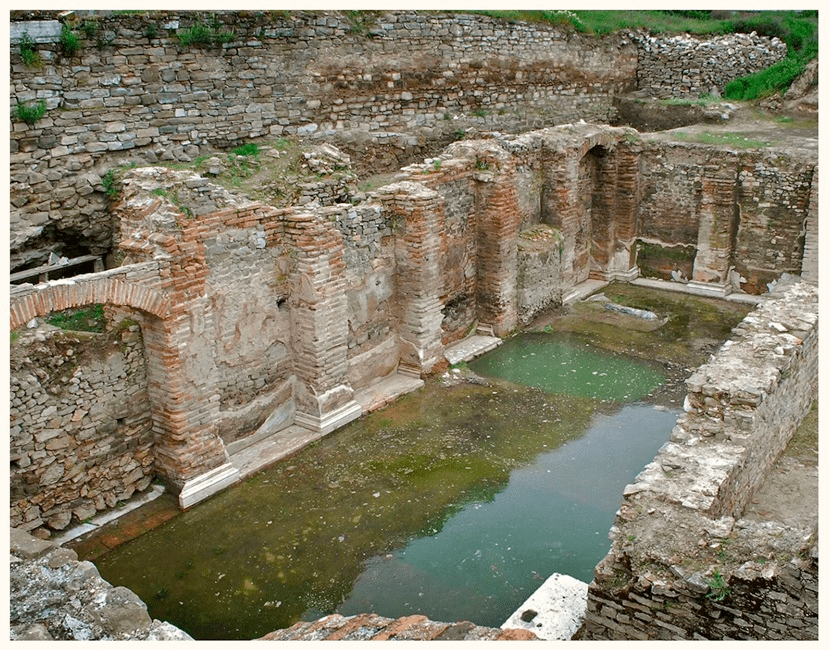
Stobi was one of the most important ancient cities in the territory of present-day Macedonia and one of the most famous urban and cultural centers of the Roman and Paleo-Christian periods in the Balkans. Located near the confluence of the Crna and Vardar rivers, near the modern city of Gradsko, Stobi had a strategic position that transformed it into an important commercial, political and military hub for more than a millennium.
Origins and early development
Stobi is first mentioned in the 4th century BC as a settlement of the Illyrian Paionian tribe, an ancient people who inhabited the central part of the Balkans. The city began to take urban form during the Hellenistic period, especially after the conquests of Philip II of Macedon, who incorporated the region into his Kingdom.
The rise of Stobi’s importance occurred after the Roman conquest in the 2nd century BC, when the city became part of the province of Macedonia. During this period, it became an important administrative and military center. Around the 1st century AD, Stobi gained the status of a municipium – a city with Roman rights – which gave the city numerous privileges and stimulated economic and infrastructural development.
Golden Age and Urban Development
During the 3rd–5th centuries AD, Stobi experienced a golden age. The city had advanced urban planning with paved roads, aqueducts and sewers, theaters, gymnasiums, and many public and private buildings decorated with mosaics and frescoes. One of the most famous buildings is the Stobi Theater, originally built in the 2nd century and later expanded, where dramatic performances and public events were held.
During this period, Stobi also became an important center of Christianity in the region. Several magnificent basilicas were built, such as the Great Civil Basilica, the Northern Basilica and the Episcopal Basilica. The presence of these buildings speaks of the existence of a powerful diocese with a bishop who had an influence on the ecclesiastical developments of the time.
In the 5th century, the city suffered several strong blows from barbarian invasions. The Goths, the Huns and later the Slavs destroyed large parts of the city’s infrastructure. However, a powerful earthquake in 518 finally destroyed the city and marked the beginning of its complete decline.
After it was destroyed, Stobi was never rebuilt as a large city and was gradually abandoned. Over the centuries, its ruins were covered with earth and forgotten for a long time.
Archaeological discoveries in Stobi began at the end of the 19th century and continue to this day. Excavations have brought to light an extraordinary wealth of ancient monuments, including religious buildings, private dwellings, well-preserved mosaics, and everyday objects that testify to life in the city.
Is the history of Stobi “of today’s Macedonians”?
Stobi was an ancient city located on the territory of today’s Macedonia, so in a territorial and cultural sense, it is part of their national heritage. But ethnically and historically, the inhabitants of Stobi were not Slavs – they belonged to the Illyrian, ancient Macedonian, Roman, and Byzantine cultures.
Today’s Macedonians are a people of Slavic origin, who settled in the Balkans many centuries after Stobi had fallen. Therefore, there is no direct ethnic continuity between the population of Stobi and today’s Macedonians.
Ultimately, it is the historical heritage of the country, but not the ethnic history of Slavo-Macedonians.
Reference

 Balkan Academia