
Fahri Xharra. Translation: Petrit Latifi
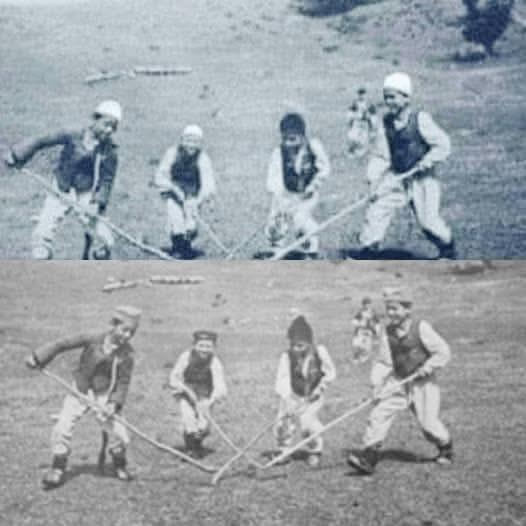
Traditional Albanian game with sticks and a ball on the grass. Prepared by Fahri Xharra. Iconographic and ethnographic evidence
Introduction
The presented photograph, dated to the beginning of the 20th century, shows a group of Albanian children dressed in traditional folk costumes, engaged in a game with sticks and a ball on a grassy meadow. At first glance, the game resembles modern “field hockey”, but in reality it is a traditional folk form, inherited from generation to generation in Albanian lands. This iconographic evidence is important because it shows an element of material and spiritual culture that is not found among other peoples of the Balkans.
Spread and uniqueness
The game with sticks and a ball on the grass has been a form of entertainment and physical exercise in Albanian communities, especially in rural and mountainous areas. According to ethnographic evidence, it is not mentioned as a tradition among neighboring peoples, which makes it an exclusively Albanian phenomenon. The game was usually played in meadows or open fields, often during the cattle’s rest in the pastures, and was part of the daily life of children and young people.
Historical sources
Franz Nopcsa (1877–1933), in his notes on Albanian highland life, mentions that Albanian boys often engaged in “pushing a ball with sticks” as a way of training strength, agility and coordination.
Edith Durham (1863–1944), in her book High Albania (1913), describes boys’ games with sticks and stones, played in the Greater Highlands, describing them as activities that combined entertainment and physical exercise.
The Institute of Popular Culture (Tirana), in its 1970s studies on folk games, documents a game called “me top e shkopinj” in several areas of the north and south, with simple rules, determined by the community, without formal structures like modern sports.
Cultural analysis
This game can be seen as a local protoform of stick sports, developed independently of Western models. The element of using sticks has similarities with training war games, suggesting a dual function: entertainment for children and exercise for physical and tactical skills from an early age. This tradition may have ancient roots, perhaps linked to the pre-Roman and pre-Ottoman periods of Albanian history.
Conclusion
The photograph and the historical sources that accompany it testify to a unique element of Albanian cultural heritage in the Balkans – the game with sticks and a ball on the grass – a tradition that has no documented analogue in neighboring peoples. It is a living reminder of the way in which Albanian folk culture preserved forms of entertainment and physical exercise with deep historical origins, keeping alive its identity and heritage.


 Balkan Academia