
Discovery by Mark Palnikaj. Translation Petrit Latifi.
Summary: The document discusses a 18th-century inquiry by the Sacred Congregation for the Propagation of the Faith regarding the use of the Illyrian language in various Balkan dioceses, including Albania, Macedonia, Serbia, and Bulgaria. Bishops responded about the presence of Latin Priests, Greek schismatics, and the necessity of knowing Illyrian for religious services. Most reported that the Illyrian language was not actively used for Mass or sacraments, with many services conducted in Latin or Albanian. While some Greek schismatics used Illyrian in divine services, bishops generally concluded that Latin priests did not require proficiency in Illyrian to engage with these communities effectively.
The “Illyrian” language mentioned in various Balkan regions
“Investigation of the Sacred Congregation for the Propagation of the Faith among the bishops of Albania, Macedonia, Serbia, Bulgaria and Ottoman Bosnia, relating to the 18th century.
A circular letter was written by Monsignore, Secretary of the Sacred Congregation for the Propagation of the Faith, to the Bishops of Albania, Macedonia, Serbia, Bulgaria and Ottoman Bosnia to obtain the following information from them:
- Whether there is in their Dioceses any Priest of the Latin Rite who celebrates Holy Mass, recites the Divine Office, and administers the Sacraments in the literal Illyrian language.
- Whether there are any Greek schismatics who use the literal Illyrian language in divine services; furthermore, whether they possess it perfectly or whether they have learned it only to read the liturgy and the Divine Office.
- Whether it is necessary for Latin priests to know the Literal Illyrian language, in order to convince the schismatic Greeks of their errors by books written in that language, and convert them to the Catholic faith.”

The Illyrian language being used in Lezhë, Sappa, Shkodër, Durrës and Macedonia
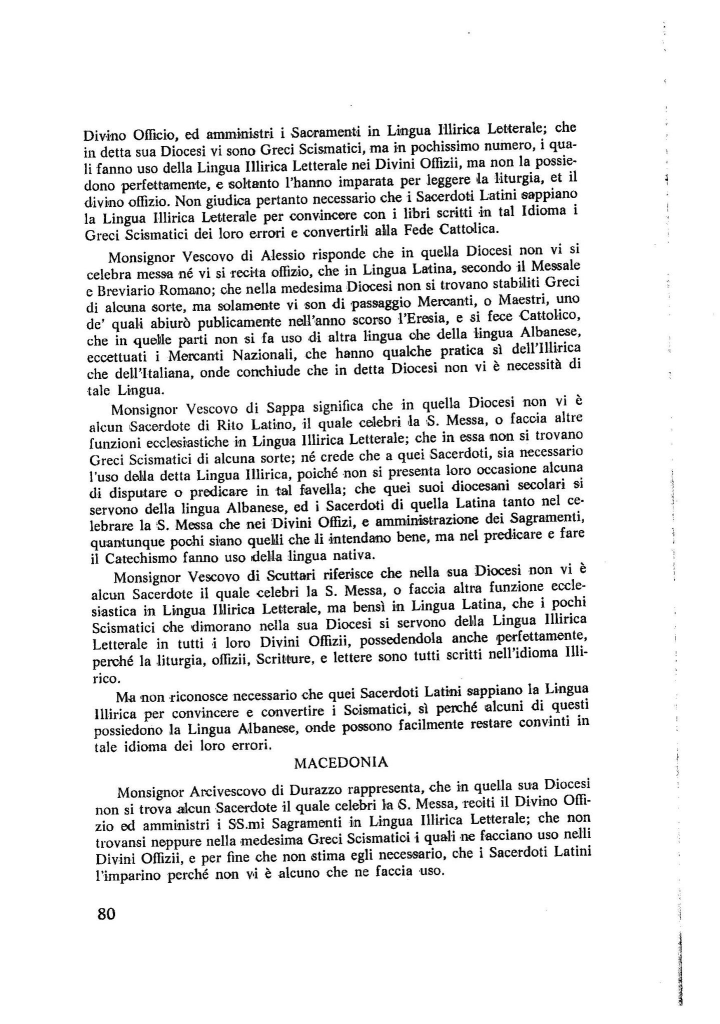
“Divine Office, and administer the Sacraments in Literal Illyrian; that in his said Diocese there are Greek schismatics, but in very small numbers, who use Literal Illyrian in the Divine Offices, but do not possess it perfectly, and have only learned it to read the liturgy and the Divine Office. He therefore does not deem it necessary for Latin priests to know Literal Illyrian in order to convince the Greek schismatics of their errors with books written in that language and convert them to the Catholic Faith.
The Bishop of Alessio replies that in that diocese Mass is not celebrated nor the office recited except in Latin, according to the Roman Missal and Breviary; that in the same diocese there are no Greeks of any kind settled, but only merchants or teachers passing through, one of whom publicly abjured heresy last year and became a Catholic; that in those parts no other language is used than the Albanian language, except for the national merchants, who have some knowledge of both Illyrian and Italian, from which he concludes that in the said diocese there is no need for that language.
The Bishop of Sappa states that in that Diocese there is no Priest of the Latin Rite who celebrates Holy Mass or performs other ecclesiastical functions in the Literal Illyrian Language; that there are no Greek Schismatics of any kind in it; nor does he believe that the use of the said Illyrian Language is necessary for those Priests, since they have no occasion to dispute or preach in that language; that his secular diocesans use the Albanian language, and the Priests of that Latin language both in celebrating Holy Mass and in the Divine Offices and in the administration of the Sacraments, although few are those who understand them well, but in preaching and teaching the Catechism they make use of their native language.
The Bishop of Scuttari reports that in his Diocese there is no Priest who celebrates Holy Mass or performs any other ecclesiastical function in the Literal Illyrian Language, but rather in the Latin Language, and that the few Schismatics who live in his Diocese use the Literal Illyrian Language in all their Divine Offices, mastering it perfectly, because the liturgy, offices, Scriptures, and letters are all written in the Illyrian idiom.
But he does not recognize it as necessary for those Latin priests to know the Illyrian language to convince and convert the schismatics, since some of them possess the Albanian language, and can therefore easily be convinced of their errors in that language.
MACEDONIA
The Archbishop of Durazzo states that in his diocese there is no priest who celebrates Holy Mass, recites the Divine Office, and administers the Most Holy Sacraments in the Literal Illyrian language; that there are not even any schismatic Greeks in the same diocese who use it in the Divine Offices, and for this reason he does not consider it necessary for Latin priests to learn it because there is no one who uses it.”
The Illyrian and Latin language being used in “Servia” (Serbia) and Skopje
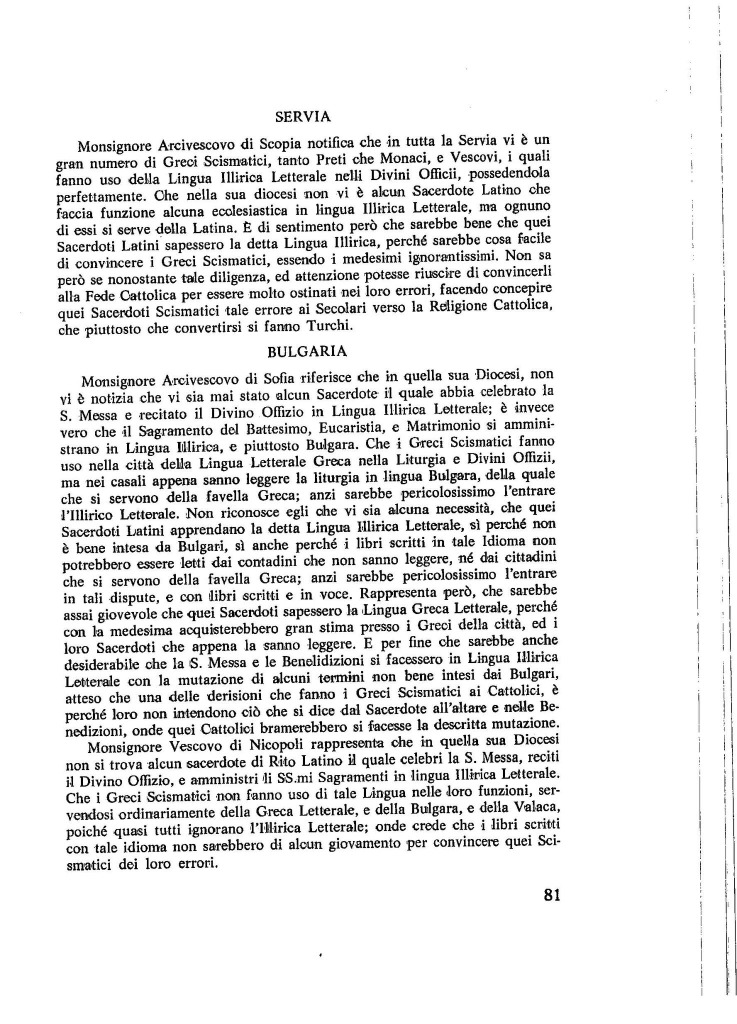
“SERBIA
The Archbishop of Scopia reports that throughout Servia there is a great number of Greek schismatics, both priests and monks, and bishops, who use the Literal Illyrian language in Divine Offices, mastering it perfectly. That in his diocese there is no Latin priest who holds any ecclesiastical office in the Literal Illyrian language, but each of them uses Latin. He feels, however, that it would be good for these Latin priests to know the said Illyrian language, because it would be easy to convince the Greek schismatics, since they themselves are very ignorant.
He does not know, however, whether despite such diligence and attention he could succeed in convincing them of the Catholic Faith, since they are so obstinate in their errors, making those schismatic priests conceive of such error among the seculars towards the Catholic religion that rather than convert, they become Turks.”
BULGARIA
The Archbishop of Sofia reports that in his diocese, there is no record of any priest ever celebrating Holy Mass and reciting the Divine Office in Literal Illyrian; it is true, however, that the Sacraments of Baptism, Eucharist, and Matrimony are administered in Illyrian, and even Bulgarian. The schismatic Greeks in the city use Literal Greek in the Liturgy and Divine Offices, but in the villages they barely know how to read the liturgy in Bulgarian, for they use the Greek language; indeed, it would be extremely dangerous to enter Literal Illyrian.
He does not recognize that there is any need for those Latin priests to learn the said Literal Illyrian language, both because it is not well understood by Bulgarians, and also because books written in that language could not be read by the peasants who cannot read, nor by the citizens who use the Greek language; Indeed, it would be extremely dangerous to engage in such disputes, whether with written books or verbally.
He points out, however, that it would be very beneficial for these priests to know the Greek language, because with it they would gain great esteem among the Greeks of the city and their priests, who can barely read it. And finally, it would also be desirable for the Holy Mass and the Benedictions to be celebrated in the Illyrian language, with the modification of some terms not well understood by the Bulgarians, since one of the derisions that the schismatic Greeks make of Catholics is that they do not understand what is said by the priest at the altar and in the Benedictions, so those Catholics would desire the described change to be made.
The Bishop of Nicopolis states that in his diocese there is no priest of the Latin rite who celebrates Holy Mass, recites the Divine Office, and administers the Most Holy Sacraments in Literal Illyrian. That the Greek schismatics do not use this language in their services, ordinarily using Literal Greek, Bulgarian, and Vlacha, since almost all of them are ignorant of Literal Illyrian; therefore, he believes that books written in this language would be of no use in convincing those schismatics of their errors.”
Reference
Informazione sopra le Chiese Greche di Dalmazia e d’Albania del Prov.re General [della Repubblica di Venezia] Francesco Grimani in data 5 giugno 1785“. Archivio di Propaganda Fide, Roma och Archivio della Biblioteca Querini-Stampalia, Venezia.

 Balkan Academia