
Petrit Latifi
Origin of the Hoti
The Hoti are one of the oldest tribes of northern Albania. Their main territory lies partly in Montenegro and partly in Albania, but Hoti villages also exist in other Albanian regions, and many families of Hoti descent are scattered across different provinces. The Hoti are among the tribes with the most detailed traditions regarding their origin, which makes genetic research significant not only for tracing ancestry but also for comparing scientific findings with traditions preserved over generations.
1. History and Traditions
Among present-day Albanian tribes, the Hoti appear earliest in medieval historical records. As early as 1330, the toponym Malet e Hotit near Plavë is mentioned (the village of Hot still exists there today). By the beginning of the 14th century, the Hoti had already emerged as allies of Venice in the Lake Shkodra region, and some individuals had attained noble status. By the late 15th century, during the final Ottoman conquest of Albanian lands, the Hoti were a consolidated tribe encompassing several villages. According to tradition, the Hoti were the first of the Highland tribes, leading others in warfare.
1.1 In the Highlands
Tradition holds that the Hoti of the Highlands share a common origin, with the main brotherhoods tracing descent from a single ancestor. The first of the tribe is believed to have been Gegë, son of Lazr, who in turn was the son of Lazër Keqi i Keqë Prekë. In some accounts, this lineage is said to have come from the Bosnian region. A 19th-century version of the tradition claims that Lazr was the brother of the founders of the Triesh, Krasniqe, Mrkojević, Vasojević, and Piper tribes. Based on generational counts, Gegë Lazri is thought to have lived about 16 generations ago.
Marriage between families descended from Gegë has always been forbidden. Today, his descendants are found in the historical Hoti lands of Malësia e Madhe, in Shkodra and the surrounding plains, as well as in parts of Montenegro. The main brotherhoods descend from Gegë’s sons: Gjon, Pjetër, Junç, and Lajq Gega. Tradition also notes the presence of certain older families in the Hoti area who do not belong to this male line, and intermarriage with them has always been permitted. It is believed these families were already settled in the area when the Hoti established themselves there.
1.2 In Other Regions
Families of Hoti origin are found in Plav, the Gjakova Highlands (Tropojë), Deçan, Drenica, Llap, and many other regions of Kosovo. Villages named Hot, Hotesh, or similar variations exist in regions stretching from Dibra to Kumanovo. Numerous families across different areas also preserve traditions of descent from Hoti.
In Plavë, all Hoti families are said to descend from a single ancestor. The Berbat, a large brotherhood in Tropojë, likewise claim descent from the Hoti of Plavë, as do certain families in the Has-Rahovec area of Kosovo. Many Hoti families also live in the Sandžak region of Novi Pazar, where, despite many now identifying as Bosniaks, their tribal affiliation is still remembered. Families in Mirdita, Lura, and elsewhere also maintain traditions of descent from the Hoti of Malësia.
2. Genetic Results
So far, 23 DNA results have been collected from families of the Hoti tribe: 10 from Malësia e Madhe (on both sides of the border) and 12 from other areas.
2.1 In Malësia e Madhe
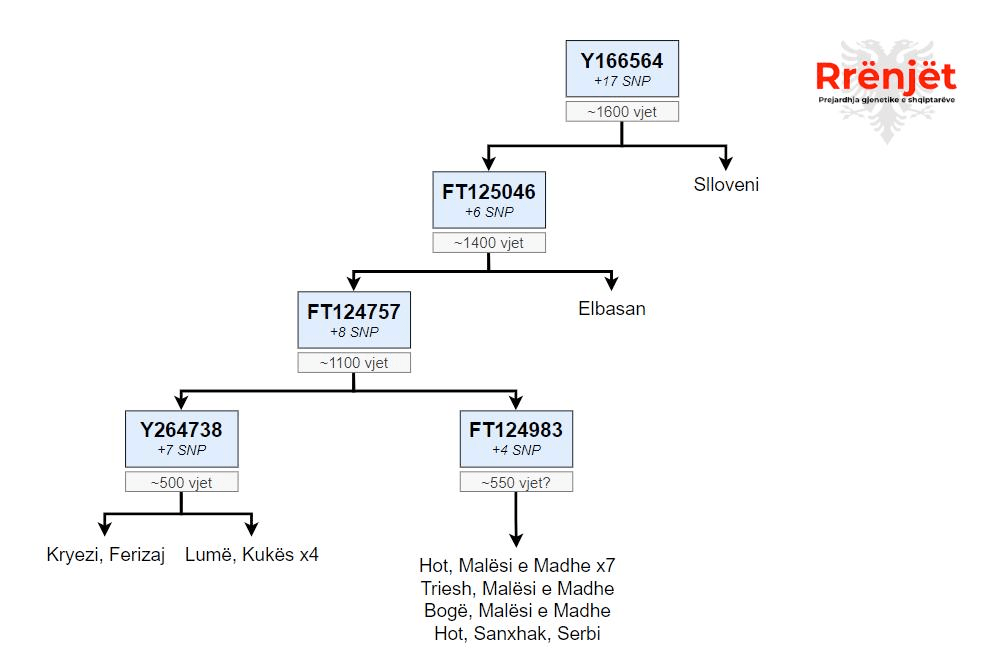
The families who trace their origin to Gegë Lazri, though belonging to different brotherhoods, share the same paternal line: J2b-L283 > Y21878 > FT125046 > FT124983. This lineage has Illyrian roots, with close parallels found in skeletal remains from Kukës (6th century BC) and Montenegro (11th century BC). Its spread seems to have begun in late Antiquity within the ancient Illyrian area.
Besides Hot, this line is also found in Grizhë and Hoten among families of Hoti descent, as well as in a single family in Triesh (per Anase tradition) and one in Bogë. The closest matches outside the region appear in Kukës, Kaçanik, Elbasan, and even Slovenia. These results do not support theories of a Bosnian migration in the late Middle Ages, as some traditions claim. Instead, they suggest the lineage remained localized in the Malësia area through the later medieval period.
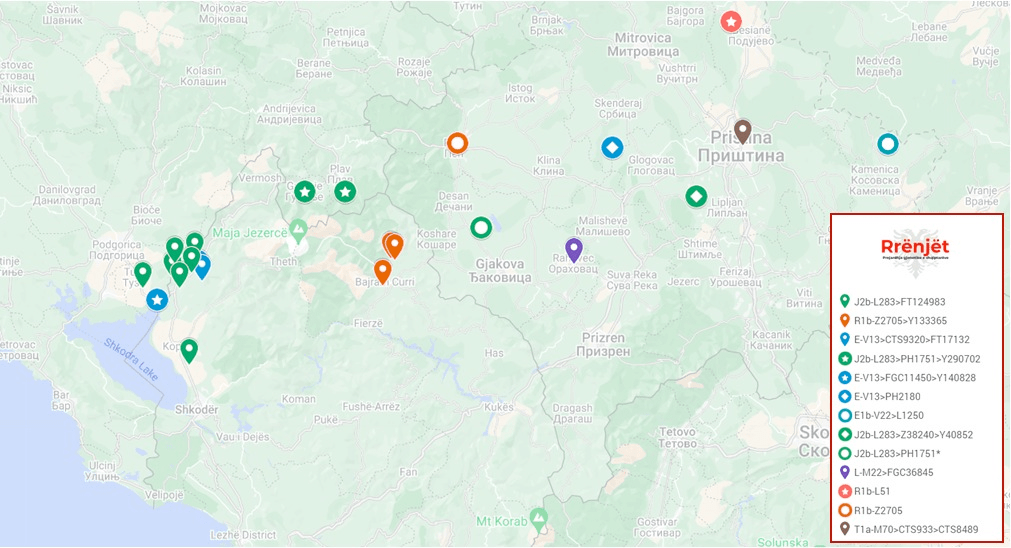
By contrast, the Anasë families have distinct paternal lines, including E-V13 > CTS9320 > FT17132 (closely linked to Kelmendi), E-V13 > FGC11450 > Y140828, and R1b-Z2705 > FT49932 (the latter being of assimilated Serbian/Montenegrin origin, with ties to Triesh, Grudë, and Piper).
2.2 In Other Regions
The Hoti of Plavë belong to a separate paternal line: J2b-L283 > PH1751 > Y290702. Although of the same haplogroup, this line differs from that of the Malësia Hoti. Evidence suggests that most families in Plavë share this lineage, which likely originated among Illyrian tribes in the Dibra–Mati–Puka region during the Bronze Age.
Tests of families claiming descent from Plavë Hoti—such as the Berbat in Tropojë and a family from Krusha e Madhe—revealed different paternal lines: R1b-Z2705 > Y32147 > Y133384 for Berbat (linked to the Thaç-Elshan tribe) and R1b-PF7563 > Y168201 for the Rahovec family (linked to Shala). Thus, neither group is genetically connected to the Hoti of Plavë.
Other Hoti families in Kosovo likewise show unrelated lineages, including J2b-L283 > PH1751* (Deçan), E-V13 > PH2180 (Drenica), R1b-L51 (Llap), E-V22 > L1250 (Kamenica), T-L70 > CTS8489 (Prishtina), and L-M22 > FGC36845. So far, none of these are linked to either the Malësia or Plavë Hoti. In Mirdita and Dibra as well, families with Hoti traditions show different genetic results. The only confirmed connections outside Malësia are in the Sandžak, where some families descend from Malësia Hoti and others from Plavë Hoti.
3. Oral Traditions and DNA Evidence
The genetic findings demonstrate that oral traditions within the Hoti tribe are reliable up to a certain point. Oral history is correct in stating that the Highland Hoti brothers share a common origin—except for the Anasë families, which the results also confirm. Similarly, the tradition of a common ancestor for the families of Plavë is supported by DNA evidence.
However, broader claims in tribal lore are not supported. The supposed kinship between Hoti and the tribes of Triesh, Krasniqe, Vasojević, Piper, and Mrkojević is not borne out genetically; each of these groups has a distinct paternal lineage. Historical documents also contradict the legend connecting Lazër Keqi (said to be brother of Ban Keqi) with the founding of Hoti, since records of “Ban Keqi’s Hut” date back to 1330—some 200–300 years before the estimated lifetime of the first Hoti ancestor.
Sources

 Balkan Academia