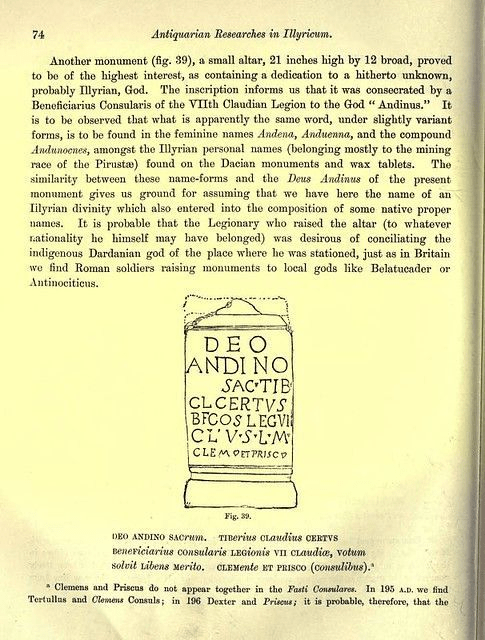

In the publication “Antiquarian Research in Illyricum” we can find an interesting passage on page 74:

“Another monument (fig. 39), a small altar, 21 inches high and 12 inches wide, proved to be of great interest, as it contained a dedication to a hitherto unknown God, probably Illyrian.
The inscription informs us that it was consecrated by a Beneficiarius Consullaris of the VII Claudian Legion to the God “Andinus”.
It should be noted that what is apparently the same word, under slightly different forms, is found in the feminine names Andena, Anduenna and in the compound Andunoenes, among the Illyrian personal names (belonging mainly to the mining race of the Pirusti) found on the monuments and Dacian wax tablets.
The similarity between these forms of the name and the Dous Andinus of the present monument gives us reason to suppose that we have here the name of an Illyrian deity which also entered into the composition of some local proper names.
It is probable that the Legionnaire who erected the altar (with whatever rationality he himself may have had) wished to propitiate the indigenous Dardanian god of the place where he was stationed, just as in Britain we find Roman soldiers erecting monuments to local gods such as Belatucader or Antinociticus.
DEO ANDINO SACRUM. TIBERIUS CLAUDIUS CERTUS beneficiarius consularis LEGIONIS VII Claudia, votum solvit libens merito. CLEMENTE ET PRISCO (consulibus).
Translation: “Tiberius Claudius Certs Benericiarius, consular officer of the 7th Legion of Claudia, willingly fulfills his oath with merit. CLEMENTE AND PRISCO (to the consuls).”
Footnote: Clement and Priscus do not appear together in the Fasti Consulares. In 195 AD we find Tertullus and Clement the Consul; in 196 Dexter and Priscilla.”
Reference
Antiquarian researches in illyricum. Arthur John Evans, published 1883–1885.


 Balkan Academia