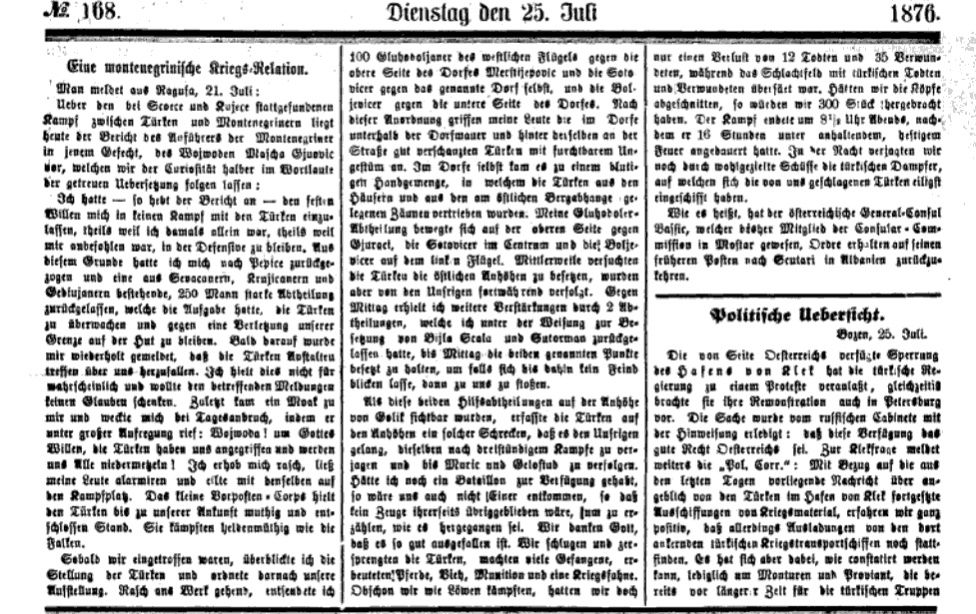

Taken from Historia Krajës. Translation Petrit Latifi.
On July 21, 1876, a war reported was published discussing the Montenegrin Voivode Mascha Djurovic regarding the battle at Marstjepaj and Gjyraç (in Shestan) From the newspaper “Constitutionelle Bozner Zeitung”, no. 168, July 25, 1876. Various publications were also published at the time regarding the fighting in Muriqi and Krajë.
Battle of Marstjepaj and Gjyraç
“There is a report from Ragusa, July 21:
Regarding the battle between the Turks and the Montenegrins that took place near Seoce and Kujece (Krrica?), today the report of the leader of the Montenegrins in that battle, Voivode Mascha Djurovic, is available, which for the sake of curiosity we will follow in a literal translation. :
I had – the report begins – the determined intention of engaging in a war with the Turks, partly because I was alone at that time and partly because I was ordered to stand on the defensive.
For this reason I had retreated to Veryse, leaving behind a company of 250 men composed of Seocas, Krnjicas and Gluhodijan, whose duty it was to guard the gates and guard against any invasion of our border.
Immediately afterwards I was repeatedly informed that the Turks were preparing to attack us. I did not think this was possible and did not want to believe the reports in question. Finally a Moak came to me and woke me up at dawn shouting with great excitement: Vojwoda! sm the will of God, the Turks have attacked us and are recruiting us all so that we will never die!
I rose quickly, notified Lente and with the same I hastened to the battlefield. The small troops of the post bravely and resolutely faced the Turks until we arrived. As soon as we arrived, I observed the position of the Turks and adjusted our formation accordingly. Quickly getting to work, I sent 100 Gluhodolja from the western flank against the upper side of the village of Merstijepevic, and the Sotovics against the village itself, and the Boljevics against the lower side of the village.
According to this order, my men attacked with terrible ferocity the Turks, who were well entrenched in the village below the village wall and behind it on the road. In the village there was a bloody fight in which the Turks were driven out of the houses and from the fences on the eastern slope of the mountain.
My Gluhobol detachment moved on the upper side against Gjyrac, with the Sotovics in the center and the Boljevics on the left flank. Meanwhile the Turks tried to look for the eastern hills, but were constantly pursued by our men. Towards noon I received further reinforcements from two companies, which I had left behind under the instructions of Bijela Skala and Sutorman to hold the two mentioned points until noon, and if by then no enemy was seen, they would join us from the left flank.
In the meantime the Turks tried to take control of the eastern hills, but were constantly pursued by our people. Towards noon I received further reinforcements from two companies, which I had left behind under the instructions of Bijla Skala and Sutorman to hold the two mentioned points until noon, and if by then no enemy was seen, they would join us.
When these two auxiliary companies came out from the heights of Golik, such terror seized the Turks on the heights that Unfer. We managed to drive them off after a continuous fight and pursue them as far as Muriç and Gelostud, if I had still had a battalion at my disposal, not a single one would have escaped us, so that there would be no witnesses left to tell how. We thank God that it turned out so well.
We struck and broke. attacked the Turks, took many prisoners, captured horses, cattle, ammunition and a war paint. Although we fought like seas, we had only a loss of 12 (?) dead and 35 wounded, while the battlefield was full of Turkish dead and wounded. If they had been counting heads, we would have brought 300 here. The battle began at 8:00 p.m., after 16 hours of continuous and intense fire. During the night we used well-aimed shots to drive away the Turkish steamers on which the Turks we had defeated had hastily boarded.
It is learned that Austrian Consul General Vassic, who was previously a member of the Consular Commission in Mostar, has been ordered to return to his previous post in Shkodra, Albania.”
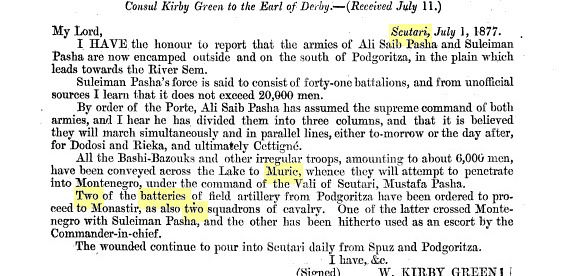
Letter from the English consul in Shkodra Kirby Green, dated July 1, 1876, announcing that 6,000 bashibuzuk have landed in Muriqi and will attempt to penetrate Montenegro under the command of the Vali of Shkodra Mustaf Pasha
Catholic Albanians as Bashi-Bouzukis
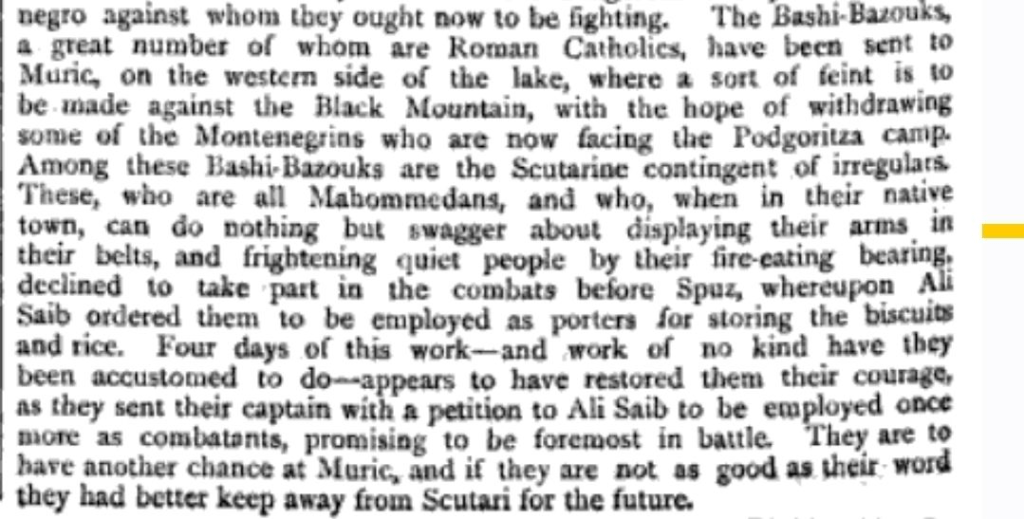
“The Bashi-Bazuks, a large number of whom are Roman Catholics, have been sent to Muriq, on the western side of the lake, where a sort of deception is to be carried out against Montenegro, in the hope of drawing away some of the Montenegrins who are now facing the Podgorica camp.
Among these Bashi-Bazuks are the irregular contingent of Shkodra. These, who are all Mohammedans, and who, when in their native city, can do nothing but fold their hands in their belts and terrify the quiet people with their fire-eating bearings, refused to take part in the fighting before Spuz, whereupon Ali Saib ordered them to be employed as porters for the storage of biscuits and rice.
Four days of this work, and the kind of work they are accustomed to do, seem to have restored their courage, as they sent their captain with a plea to Ali Saib to be employed once more as warriors, promising that they would be the first in battle. . They will have another chance at Muric, and if they are not as good as their word, it is better to stay away from Scutari for the future.”
The fighting in Krajë in 1876
“The English consul in Shkodra describes the fighting in the west of Kraja between Montenegrin and Ottoman forces in July 1876. These fighting have been unknown in detail from our history. Based on this telegram that he sends to his superiors, he explains the circumstances of the fighting in Krrica, Shestan and Muriq. According to him, Ahmet Hamdi Pasha had sent a battalion of regular soldiers and 2000 volunteers with Catholic and Muslim (Albanian) peasants lightly armed to Muriq.
On July 10, 1876, the commanders of this Ottoman force, seeing the advance of 2000 Montenegrin soldiers, launched a counterattack without waiting for the order of the command. The fighting took place on a mountain pass in Shestan, and the Montenegrin forces defeated the Ottomans, who gathered in a safer place to resist until military help arrived.
Among the escapees in Shkodra was Bajraktari. The Pasha immediately rearmed the volunteers and gathered another 250 soldiers and sent them to Muriq. Meanwhile, he sent 2 battalions from Tivar, and another that had come from Istanbul he sent to Muriq on July 12. On the 13th, the Pasha made a tactical move, sending with local boats and a ship some troops from Muriq to the shore of the lake in Montenegrin territory, surrounding the Montenegrin forces that were in Shestan and Kernica from three sides, forcing them to retreat.
Furthermore we bring the Consul’s telegram translated below:
_________________________
No. 329 Consul Kirby-Green, to the Earl of Derby (Received July 26th.) (No. 39.) My Lord, I have the honour to enclose herewith, for your Lordship’s information, a copy of a despatch addressed to-day by me to Sir Henry Elliot, on the subject of the recent skirmishes between the Turks and Montenegrins. near Podgorica and in the Krajë. Shkoder, July 14th, 1876. W. KIRBY-GREEN.
____________________________
Inside No. 329. Consul Kirby-Green, to Sir H. Elliot. Shkoder, July 14, 1876. Sir, Referring to my dispatch of the 11th, I have the honor to inform you that yesterday afternoon I telegraphed to your Excellency that the Turkish forces which had driven back the Montenegrins along the entire length of the frontier between Medun and Podgorica and that a detachment of regulars and irregulars, which had been surrounded in Krajë by the Montenegrins, had been relieved by troops sent from Shkoder and Antivar.
The fighting of the 9th and 10th near Podgorica resulted in an undoubted success for the Turks, although on the first day they were forced to seek the protection of Podgorica. They resumed the offensive the next morning, with 4,000 men, and, after inflicting considerable losses on the Montenegrins, who had now withdrawn well within their territory, re-established their communications with Medun.
In the Krajë, a regular battalion and about 2000 irregulars, composed of highlanders and Mohammedan and Catholic peasants, mainly from the neighboring villages, had assembled in the village of Muriqi, on the borders of the lake, where they had been instructed to await further orders; but, hearing that the Montenegrins, about 2000, had occupied the villages of Shestani and Kernica, near the Montenegrin frontier, the Turkish commanders could not resist attempting a surprise of the enemy, and with this purpose advanced towards Kernica before dawn on the morning of the 10th.
The Montenegrins, however, were fully prepared and suddenly attacked the Turks in a mountain gorge. A panic seems to have seized most of the highlanders and they communicated with some of the regular troops and they sought safety in taking part in the fighting. Such of the regular and irregular troops as held their position were obliged to take up a position from which they could only hope to emerge by the arrival of a relief force.
As soon as Ahmed Hamdi Pasha became aware of this critical state of affairs, by the appearance of some of the fugitives at Shkodra, he collected the few remaining troops, not more than 250, and sent them to Muriq, while he directed two battalions which were encamped near Antivar to march towards Kernica in their turn; and a battalion which was arriving from Constantinople at Shkodra the next day, on the morning of the 12th, was also escorted to Muriq.
Yesterday early some of the troops of that village embarked in the native boats and in one of the lake steamers and were sent towards the Montenegrin shores, as if with the intention of landing there. This threatened movement had the desired effect of drawing the Montenegrins from the heights which surrounded the engaged Turks, and thus a junction was made between the three Turkish corps without encountering any opposition, and the whole army is now safely encamped at Muriq.
Among the escapees from Kraja were a major and a lieutenant of the regular troops and the bajraktari, or standard-bearer and leader of the Antivar volunteers. The Highlanders justify their escape by saying that they were not sufficiently armed with their rifles, compared with the Montenegrins, who were armed not only with rifles but also with ira, but also with revolvers.
They are now all equipped with Enfield rifles, and therefore they now show themselves ready to meet the enemy again. The Pasha informs me that he has been promised by the Porte a reinforcement of 15,000 regular troops, and there is no doubt that with this addition to the present forces, which, together regular and irregular, also amount to about 15,000 men, he would be able to repel any attempt on the part of Montenegro to invade Northern Albania, but I am of opinion that Prince Nicholas is too well acquainted with the hostility with which the Slavs are regarded in this province, to think for a moment, under present circumstances, of invasion, except on the outskirts of his borders, which are inhabited by tribes of Montenegrin origin.
(signed) W. KIRBY-GREEN.“


 Balkan Academia