
Written by Petrit Latifi.
Summary:
Serbian governmental theft of Albanian traditions, costumes, attire and customs has been a common reoccurring phenomenon. Here we can read an article titled “Serbian men’s folk costume, second half of the 19th century and 1912”. The man in the drawing is dressed as an Albanian, with Albanian tirqe, wool pants and he is wearing the plis (qeleshë), the white cap. This is not Serbian attire – this has been stolen and appropriated by Serbian authors and propagandists. It is ironic that Serbian chauvinists, who have been murdering and oppressing Albanians for 200 years, would wear Albanian wool costumes. The following is a critical review of this article.
Cited:
Assumption: “It is known that among everyday hats, the rolled cap with a conical top, both in material and in the way it was made, was one cap. According to Mitar S. Vlahović, the rolled cap with a conical top was worn in Polimlje, old Raška, Kosovo and Metohija, and parts of the Balkan Peninsula.”
Assumption:
“It has survived to this day in Albania, both with a conical top and with a flat bottom. These are also known in Old Montenegro and the Montenegrin Hills, and the names. Mitar S. Vlahović considers it “our national hat, which became in our environment, in a peasant house, from a domestic mixture with other non-Slavic peoples, and the name itself changed”
Truth: This wool cap has not “survived” in Albania, it originates from Albania.
Assumption:
“Such changes are also visible in Ibarš Štavica and the Deževo region, where, instead of the name mazn, the term čulav was used, the Turkish, or Persian knitted cap čelepoš has a wider distribution, and the name javlj is used. Knitted hats made of woolen yarn were worn in Bacoje cotton in Kosovo and Metohija”. The fez is also widespread in our region, and in more recent times. It was adopted through Sima Trajanović believes that it originates from Greek antiquity.”
Truth: The plis is an ancient Albanian, even Illyrian tradition, which has existed for thousands of years before Slavic migrations. The plis or qeleshe can be seen in ancient drawings of Ancient Greece (Illyrian regions). Serbs adopted this from the autochthonous native Albanians of the Balkans. It is also ironic that the author mentions regions like Polimje, Rashka, Deževo and that the locals wore that cap. This confirms that these regions were inhabited by Albanian tribes before being violently slavicized”.
Assumption: “Serbian men’s folk costume, second half of the 19th century and 1912 or basic parts of men’s folk costume “
Truth: This is an Albanian wool costume, called “tirqe”, which have been worn for centuries by Albanians, stretching from the Byzantine era.
Studies to date have shown that the components of traditional clothing are not all of the same age. There are parts that are reminiscent of medieval clothing, with Byzantine and oriental influences, others that come as an echo of ancient times, but there are also elements that can be linked to Illyrian culture. We can thus mention the analogies observed between the folk line and Illyrian “symbolism”, such as between hoods, scarves (shawls), opings, etc., and the respective elements used by the Illyrians. Thanks to these elements inherited from the Illyrian culture and that of the medieval Arbërs, during their historical development, folk clothing has managed to acquire a series of original features, which take on the values of an ethnic indicator, which distinguishes Albanian clothing from that of other peoples.

Albanian folk costume in a Serbian museum.
It is also known that Serbian chetniks, who murdered Albanian civilians, would wear Albanian pants.

Vojislav Tankosic, photographed outside Isa Boletini’s house in 1911, dressed in Albanian clothing disguised as an Albanian, during talks for cooperation against the Ottomans.
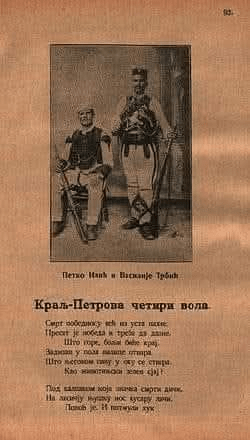
Petko Ilic and Vasilije Trbic, dressed in Albanian wool pants. A page from Duke Vuk Popovic’s book. Calendar for the simple year 1927, Belgrad.

Urosh Kostic Rudinac dressed in Albanian traditional costume (right)
According to the book “Narodna enciklopedija srpsko-hrvatsko-slovenac̆ka” by Stanoje Stanojević in 1925, the Serbian folk costume comes from Albanians.
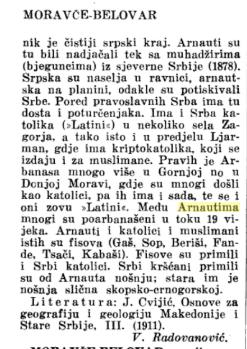
“Srbi kršćani primili su od Arnauta nošnju stara im je nošnja slična skopsko crnogorskoj.”
Translation:
“The Christian Serbs received their traditional costume from the Arnauts, their old costume is similar to the Skopje-Montenegrin costume.”
References
Narodna enciklopedija srpsko-hrvatsko-slovenac̆ka https://www.google.se/books/edition/Narodna_enciklopedija_srpsko_hrvatsko_sl/BaoEAAAAYAAJ?hl=en&gbpv=1&dq=arnautima&pg=PA858&printsec=frontcover&fbclid=IwY2xjawJa9X1leHRuA2FlbQIxMAABHbWg8e0jbZ9uFMy7iC6Seegvuemb8RsiDHdN5B7ruPMPTf3q38Jm50i_eQ_aem_l4FtPrZP7HCA4jNSy1CIBA
“Albania”, Encyclopedia of National Dress: Traditional Clothing Around the World, ABC-CLIO, 2013, p. 16, ISBN 9780313376368
Leyla Belkaid (2013), “Albania”, in Jill Condra (ed.), Encyclopedia of National Dress: Traditional Clothing Around the World, vol. I, ABC-CLIO, p. 16, ISBN 9780313376368
Photo of the article:

Article reference
Men’s costume, second half of the 19th century and 1912. Watercolor Radmila Lazar. Collection of the Ethnographic Museum in Belgrade


 Balkan Academia