

By Dr. Qazim Namani. Translation Petrit Latifi
The Kingdom of Dardania undoubtedly reached a high level of economic and cultural development during the 4th century to the 1st century BC. The sources so far tell us that during this period, mining and metal processing were developed in Dardania. The Dardanians were known for their gold processing, so they did not lag behind in economic and cultural development with neighboring peoples.
During this period, the Kingdom of Dardania also emerged as an important military power in the region. Considering these sources for the development of Dardania, we must believe that writing was also developed in its territory, in various materials like in the neighboring peoples around it.
In order to understand at least a little the reality of that period regarding the alphabet and ancient writing of the Illyrian tribes, we are providing some data from the studies so far.
Albanians speak and write a language that is very unique from other languages and is considered among the oldest in the Balkans and Europe. Regarding the antiquity of the Albanian language and its connection with other languages, also proven through epigraphic writings, we are giving some of the opinions of the most eminent researchers in this field.
Petro Janura in his book “Nga historia e alfabetit të gjuhës shqipe” writes that the Albanian language is a very ancient language, but its documented writing is quite new.
Enzo Gatti in his book Illyrians quotes the professor of the University of Tubingen De Simeone who states that: With the knowledge we have to date, it is not possible to reconstruct even partially an Illyrian language, since no typical Illyrian inscription exists to date.
Enzo Gatti provides us with information that two ancient scripts have been discovered in the Drava River Valley (Dali, 3200 BC). These are probably the first alphabetic scripts in the world. Two different writing systems are observed in these scripts. One has solemn letters (large print) and the other has small cursive letters (small with squiggles).
One of them is the first of all Roman lapidary type scripts, while the other is of the Phoenician Arabic type. From these prototypes arose the two great branches of world alphabetic scripts, the West and the East, the uppercase and lowercase letters. So the first alphabet was born in the heart of the Balkans, and the linguistic source of the old scripts must be sought in a Balkan language.
Robert D’Angely writes that the Albanian language was written in antiquity, and this is proven by the Etruscan or Albanian inscriptions and by those also Albanian or Lycian and others, which have been discovered in Asia Minor, in Lemnos, in Crete and in Italy.
Petro Janura writes that it is assumed that the ancestors of the Albanians, the Illyrians, used the ETRUSCAN alphabet and the Latinized Greek alphabet until the Latin alphabet was established in the 3rd century BC.
Niko Stylo in his book “The Sacred History of the Arvanites” provides data on an Etruscan script discovered on a mummy’s bandage. The mummy was donated by the heirs of the Croatian Michael Barič to the National Museum in Zagreb in July 1862. This script was unknown at the end of the 19th century to Professor Henrich Karl Brugsch.
After the written fragment was sent to the University of Vienna, specialists noted that it was in the Etruscan language. Carbon dating determined the date of the writing with Plutarch’s historical notes on the embalmed body of Alcmene (to the Greeks), the mother of Hercules. According to Plutarch, Alcmene’s burial and reburial occurred during the time of the Egyptian pharaoh Nectanaeus I, whose reign began in 378 BC.
Nermin Vlora Falaski quotes Herodotus: “The Etruscans spoke the language of an ancient people who lived in the Mediterranean region before the arrival of the Greeks.
The Pelasgians were called a divine people by Homer. Herodotus noted that Greece before the arrival of the Hellenes was called Pelasgium and that the Pelasgians taught them metalworking, wall building and even the alphabet.
Etruscan inscriptions are interpreted through Illyrian, so it makes sense that the Romans called the Etruscans TOSCHI (TUSCI), knowing that they spoke the same TOSKE language of southern Illyria.
The Italian scientist, Abbot Emidia Luzi, in his work “Epoca Eroica”, published in 1847, writes: the Pelasgians were the oldest inhabitants of our Italy….In fact, the natives, the Ombiuenes, the Osones, the Oscans, the Britons, the Rutuales and The Oenotriens are the first names of the Italians that denoted a single people of the same origin….with the Pelasgians who were called a divine people by Homer.
Pliny the Elder, in the first century, explains that the letters of the phonetic alphabet were brought to Italy by the Pelasgians. According to Diodorus Siculus, the Pelasgians were the first to bring the alphabet to Europe by adapting the system of letters to the language of the country with some changes and improvements. Diodorus writes that this alphabet, known as the “Pelasgian” alphabet, was used by all poets before Homer. In 1875, two French archaeologists discovered traces of a pre-Hellenic script on the Pelasgian island of Lemnos (Aegean).
The scholar L. Benlow, in his work “Greece before the arrival of the Greeks”, published in 1877 in Paris, writes: Many names of places, mountains, rivers, legendary characters, cannot be explained by Greek etymology. Only one language has been able to shed light on the names of these places, and this is the Albanian language.
The inscriptions discovered in Albania are numerous, but we are highlighting the word XAIPE=HAIRE, which is often found at the gates of cities, to say “May you have hair” upon the arrival of guests.
Nermin Vlora Fallaski writes that the Illyrians and Etruscans usually wrote without interruption, therefore each script requires special analysis to make the exact place of division, so that the phrase has a logical meaning. Since the Etruscan language can be interpreted through the Albanian language, it is proven that the latter language is a continuation of Illyrian.
The type of epigraphic writing is almost identical in a wide geographical area from the Aegean Sea (an example is given by the stelae of Lemnos), to Illyria (inscriptions from Durrës, Kosovo and other places), to the Veneti, the Mesapi and of course the Etruscans.
The linguistic connection between Etruscan and the Albanian language has been extensively examined by Prof. Zacharie Mayani, lecturer at the University of Sorbonne. Prof. Guiseppe Catapano in his study “The Antiquity of the Albanian Language” confirms the traces of the Pelasgians in the territories inhabited by the ancient Egyptians, the Phoenicians, the Carthaginians and the Babylonians.
The cultural connection between the Etruscans and the Illyrians is also proven through material culture, such as the two-story monumental tombs discovered in Albania that are strangely similar to the contemporary Etruscan tombs, presenting the same features.
Many researchers have concluded that the Albanian language has elements in common with Thracian. In the territory of Romania, it has been proven that there are Pelasgian inscriptions that are understandable through the Albanian language, because the Thracians, the ancient inhabitants of that territory, were one of the largest Pelasgian tribes.
Romanian academic Grigore Brancusi writes that among all the Balkan languages that have features in common with the Albanian language, the first place is undoubtedly occupied by the Romanian language. Albanian and Romanian have close connections in the fields of phonetics, morphology, lexicon, word formation, syntax, phraseology, proverbs and proverbial idioms.
The common pre-Latin elements that unite Albanian and Romanian reveal their genetic connection through many common words.
There are several words from the common Romanian-Albanian fund, pre-Roman that end with the letter S (SH) which are very old and have come from both languages such as: Gushë (Gusa), Mosh (Mos), Mushk (Musc), Shapi (Shaparla), Shtirë (Shtira) etc., writes Brankush. This researcher in his book provides data on many place names that are based on the word “Gushë” in Romania and Albania, I am highlighting the village of Gushtericë in Kosovo, which based on the studies of the Romanian academic Brankush, if we remove the suffix icë from this place name, then the name of this village comes out in Albanian as Gushter (Gusha e terur-tharë).
Grigore Brancusi in his studies found that vernacular Albanian and old Romanian have many features in common.
Eqrem Çabej in his studies has provided data and assumptions about the origin of the Albanian language. According to him and many other researchers, Albanians are descended from the Illyrians and the Albanian language is Illyrian itself, but without denying the possibility that the Albanian language derives from a mixture of Illyrian-Thracian.
Vladimir Georgiev, during archaeological excavations in the Bashova hill in the village of Duvanli in Plovdiv in Bulgaria, announces that several inscriptions have been discovered on a vessel and on a ring dating back to the end of the 5th century or the beginning of the 4th century BC. The inscription DADALEME was found on a silver vessel, but as such the Thracian name was unknown. The text contains three words that can be translated word for word into Albanian. A gold ring with a knight’s figure with the text EYSE…DELE MEZHNAI was also discovered at this site.
Aleksandër Stipqeviqi in his book History, Life and Symbols of the Cult provides information about many “Barbarian” coins as they were known at that time in the second century BC discovered in the Danube basin and in the village of Ribnjaça, the name of the local ruler Sosthenes was written in Etruscan letters.
Duje Rendic-Miocevic thought that an inscription from Grebeshtica in Šibenik was a local variant of the Latin script. In an inscription found in Brac, the two-part name Veselia Felicitas is written. The first part Veselia is an Illyrian word while the second part Felicitas is a Latin word that means luck, writes Aleksandër Stipqeviqi.

Ecrem Qabej in his work Studime Gjilansore (V) reports that in the necropolis In the Dalmacija fortress near Komoni, it is known that at the beginning of the 20th century, among other objects, a thin bronze ring was found, which bears the inscription ANA OHOH ICER (ICEB). This inscription was studied by researchers Degrand, Traeger, Ippen, Nopça, etc.
Ippen was the first to express the opinion that it is likely that we are dealing with an inscription in the Illyrian language. His opinion was later reinforced by Hans Krahe, who, according to him, we are dealing with an inscription in the Balkan Illyrian language.
The meaning of some ancient Illyrian names has been possible to know through the Albanian language, the only contemporary language in the Balkans that can be considered a direct heir to Illyrian.
These data, although scarce, are evidence that the Illyrians, along with neighboring peoples, had their own alphabet. In addition to the alphabet, it is impossible that the Illyrians did not have their own libraries, alongside the developed libraries of the time in the Mediterranean.
In this period of time, there were famous libraries such as in: Alexandria, Athens, Rome, etc. that brought together the most learned people of the time in the Mediterranean. The Illyrian kingdoms, living in the neighborhood of these peoples in the absence of written sources, we assume that they also had their own libraries.
This is also evidenced by Aleksandër Stipçeviçi, who leaves room to think that there were libraries in Illyria when he writes that: Octavian Augustus, after the subjugation of the Illyrians, returning to Rome, from the loot he brought from Illyria ordered the construction of a large public library, which he named Octaviana in honor of his sister, Octavia.
In later periods, it should be rightly noted that the Illyrians (Albanians) used the Latin alphabet in their writing, when Rome influenced the Illyrians in terms of culture. During the rule of the Roman Empire in Illyria, Christianity began to spread through Christian missionaries. With the legalization of Christianity, according to written sources, we can speak of a stage of religious education in the Illyrian language as well.
Budimir Milan, in his book “O etnickom odnosu Dardanca prema Ilirima” writes, among other things: The migration of the Dardanian tribe Galabri-Calabri to Italy, in addition to the Dardanian wealth that they took with them to Rome, they also brought the library.
This information is also found in the book “Israeli Connection”, where it is written that the Galabri-Calabri, a Dardanian tribe, migrated to Sicily, the Dardanian wealth and the library were brought from the east to Rome by the victor PERSEUS.
Fanula Papazoglu, referring to ancient authors, provides data on the connection of the name Calabria with the Galabri of Dardania, as well as the Dardanians in Italy with the Dardanians. These historical data prove that in the Kingdom of Dardania, there were writings and libraries rich with important data for the time.
From historical sources we learn that in central and eastern Dardania lived the well-known Dardanian tribe Galabroi, about which we also have data from ancient authors, about the economic development and migration of some of them, to Calabria in Italy.
The archaeological traces, discovered so far in Dardania, testify to a developed civilization. Ancient authors have also written about the existence of cities in Dardania, before the Roman conquest. So far, the ruins of the Dardanian city in Kërshevicë near Vrajë have been discovered. Many researchers support the opinion that the cities of Aria and Damastion should also be sought in central Dardania, as the most developed area for the exploitation and processing of metals.
Strabo, one of the ancient authors, writes that they are a large tribe of the Dardanians, on whose land there is an ancient city. According to Strabo, the Galabrians were a powerful sub-tribe, within the Illyrian tribe of the Dardanians. To the east of the Galabroi tribe, lived another well-known Dardanian tribe of the Thunates
They owned a large region in present-day Eastern Kosovo, present-day southern Serbia and many territories in present-day northern Macedonia. The territory that the Galabrians owned included many important settlements that developed during the Roman period, such as: the cities of Nishi (Naisusi), Vendenisi (Gllamnik), Ad Fines (Hamenium-Kursumlija), Herculium (Prokupla), Viminacium (Kostolac), Vicinianum (near Ulpiana), between Vendenisi and Theranda, Tranupara, between Astibus (Shtip) and Skupi (Shkopje).
Skopje became the capital of Dardania, which extended, in the second century BC, to Bylazora (present-day Veles). From this we understand that in terms of economic and military development, Dardania and its cities did not lag behind the civilization of that time, and that the Kingdom of Dardania was among the most powerful kingdoms in the Mediterranean.
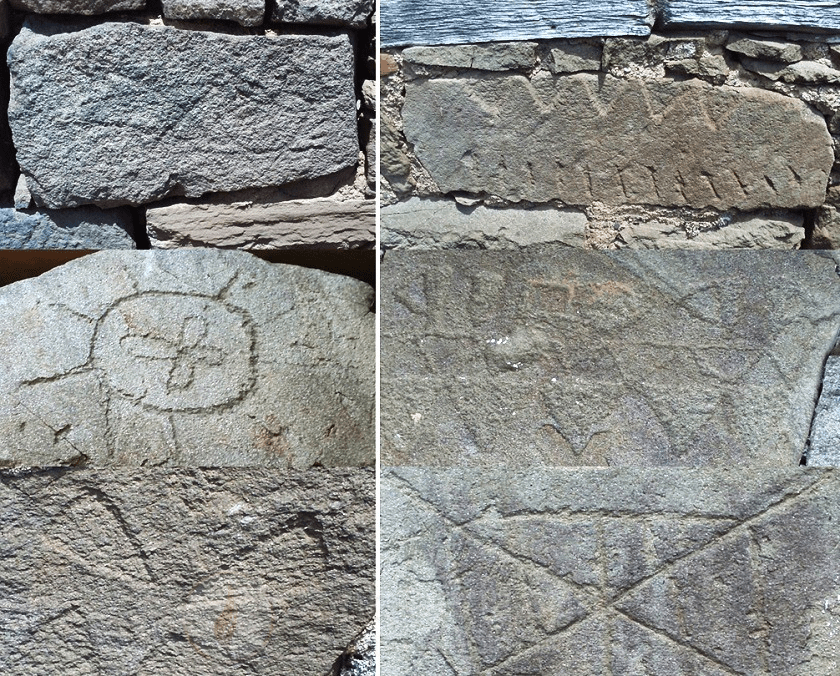
The inscriptions on the stones that are being photographed were found on the walls of a residential house in the village of Dumnicë e Epërme, in the neighborhood of Tihovce, municipality of Besiana.
The territory of this village lies in the present-day border strip between Kosovo and Serbia. As the territory between the cities of Besiana and Kusumlija, and near the well-known ancient road Niš-Lezha, we can assume that these stones were taken from the ruins of a local archaeological site, to be walled in the wall of this house. This is confirmed by the fact that in the walls of this building, many other stones with stone plastic, symbolizing astral and mythical symbols, are also walled in.
The house where the stones with inscriptions and stone plastic are walled in is two-story, and was built during the 20th century. Inscriptions on stones, in the foundations of the house in the village of Dumnicë e Epërme, Besiana municipality.
While one of the stones with inscriptions is walled in, in the foundation of the building, the other stone is walled in on the second floor, about 1m below the roof of the building. The position of the walling of these stones in this residential building clearly proves that the stones were carried from the roots of a much older building.
The position of the stones with inscriptions embedded in the wall in this residential building
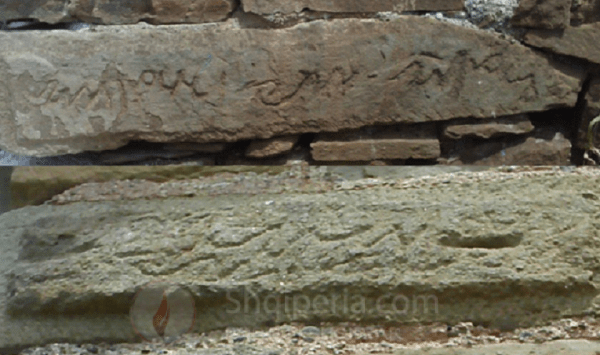
In addition to the stones with inscriptions found in the village of Dumnicë i Epërme in the municipality of Besiana, two other stones with inscriptions were discovered in 2005, in the village of Gërmovë, municipality of Viti.
The stones discovered in the foundations of the entrance hall of the old mosque in the village of Gërmovë in the municipality of Viti testify to the ancient culture of writing in our country. I think that we are dealing with a very old writing, since together with these two stones an unprocessed altar was also found.
The letters in these inscriptions are quite damaged. It is noticeable that the writing style was used without interruption, therefore it is of scientific interest for this inscription to be studied by experts in this field. These stones stand in a corner of the mosque courtyard and are in danger of disappearing due to negligence since the competent institutions did not take any measures to take care of them.
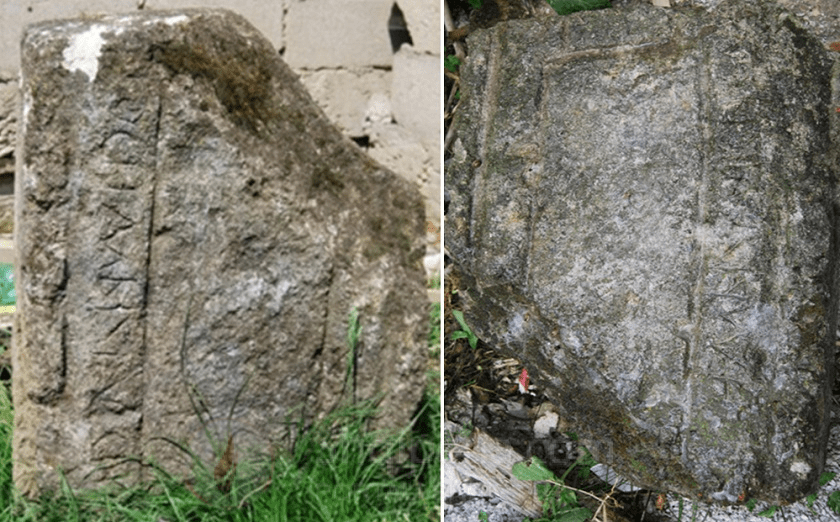
Inscriptions on stones discovered in the village of Gërmovo, Municipality of Viti

Inscriptions on stones discovered in the village of Gërmovo, Municipality of Viti
I think that these stones have great value for cultural heritage, and it is of interest to transfer them to the institutions that deal with the preservation of monuments.
Original article

 Balkan Academia