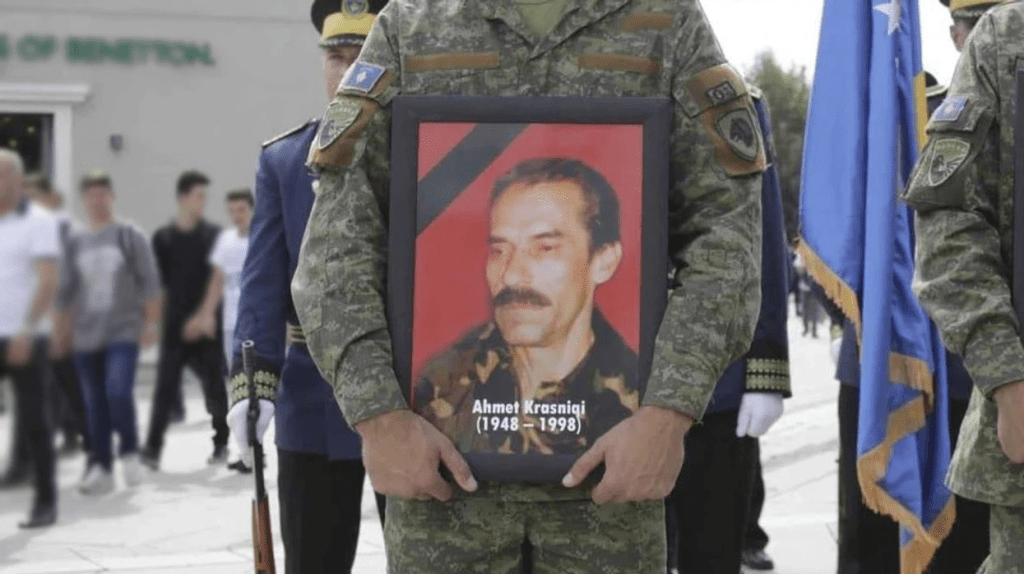

Photo taken from Telegrafi.com
Ahmet Krasniqi (15 January 1948 – 21 September 1998) was a Colonel of the Kosovo Liberation Army (KLA) and commander of the Armed Forces of the Republic of Kosovo (FARK) during the Kosovo War. He was born on 15 January 1948 in the village of Zhilivodë in the Vushtrri Municipality in Kosovo and was assassinated on 21 September 1998 in Tirana, Albania.
During the Yugoslav Wars, he fought in the Croatian War of Independence and the Kosovo War. After the end of the Kosovo War, he was declared a Hero of Kosovo. He is known as the “Minister of War” in honor of his patriotic work.
Awards Order of Hero of Kosovo (posthumous)
Colonel Ahmet Krasniqi was born and raised in the family of the well-known patriot Aziz Zhilivoda. He completed his first four years of primary school in his native village, then continued his education until the eighth grade in Hade, where he lived with his uncle, in the Avdijaj neighborhood (Grajqevci), and Technical High School in Prishtina (1964–1969), where he lived with his niece Elife Grajqevci, since the possibilities of traveling from his birthplace at that time were impossible. During this time, he was distinguished for his patriotic activity, as a close associate of the devoted patriot, Metush Krasniqi and an active participant in the student demonstrations of 1968 in Prishtina.
After completing high school, Ahmet Krasniqi managed to enroll in the Military Academy of the Land Army in Belgrade, where he distinguished himself as one of the most capable cadets and managed to graduate with high success, in record time (1969–1973). The young Albanian officer was not satisfied with this and continued his studies at the Command Academy of the Commanding Staff, which he completed with complete success (1981–1983).
After that, he began his military career in Zagreb, and then was appointed commander of the Gospić Garrison, where the Croatian-Serbian war took hold. As a good connoisseur of history, the reality of the time, the composition and functioning of the Yugoslav federation, the military expert, Colonel Ahmet Krasniqi, had a completely clear understanding of the goals of the war instigated by Serbian-Slavic hegemonism, therefore, at the first opportunity to escape, he deserted the ranks of the Yugoslav army and joined the Croatian army, to which he rendered high and very useful services, which even the Croatian military institutions could not have done.
However, his extraordinary work and effort are not only not appreciated, but are despised and despised to the point of complete denigration by the Croatian side, which, after completing its work, turns its back on him and leaves him to the mercy of the Serbian enemies, who investigate Colonel Krasniqi’s pro-Croatian activity, therefore imprisoning him, on the charge of “Undermining the defensive power of the Armed Forces of the SFRY!”.
After the first investigations in the Rijeka prison, Colonel Krasniqi is extradited to Belgrade. He falls into the mouth of the wolf, and when everything seems to be approaching the end, in the chaos of the Serbian war against Croatia, the Colonel is taken out of prison and sent to the war front, where fate works for him: he manages to escape and temporarily takes refuge in Kosovo, then passes to Macedonia, to Albania and from Albania returns to Croatia.
The government of Croatian President Franjo Tudjman and senior military figures, although they knew the contribution of Ahmet Krasniqi in the Croatian war, did not welcome his return, because they found it difficult to accept the great merits of an Albanian officer, therefore they left him in the shade, as an ordinary citizen, who had to fight for his bread, which he earned as a manual worker.
At this time, Colonel Ahmet Krasniqi contacted the Government of the Republic of Kosovo, which, knowing his high patriotic and professional personality, appointed him Minister of Defense and Commander of the General Staff of the Armed Forces of Kosovo. Aware of the situation in Kosovo and happy to have been given the opportunity to serve his captive homeland, Ahmeti set to work with fervent dedication, for the creation of the Armed Forces of Kosovo.
However, he does not manage to achieve this objective until the end, because seeing his serious commitment and true desire to make Kosovo with the best possible army, a black hand (undoubtedly a hand of betrayal) secretly shoots him with a gun and kills him, in the late night of September 21, 1998, in Tirana, Albania.
This was a planned assassination attempt of betrayal, which outraged the broad Albanian freedom-loving public, which, in Colonel Ahmet Krasniqi, had supported the hope of the liberation war and the definitive liberation of Kosovo. The very massive participation of people in the The funeral ceremony, which was organized in the capital of Albania, was a testament to the love and adoration of the great figure of Ahmet Krasniqi, the soldier and devoted patriotic fighter, the officer with the highest academic training and the expert proven for extraordinary skills in the art of war, who spontaneously and without any dilemma offered him the choice of Minister of Defense of the Republic of Kosovo and Commander of the Armed Forces of the Republic of Kosovo – FARK, in which the duty was assassinated, to be immortalized in proud pain by taking the place of honor in the pantheon of the most distinguished figures of the Albanian nation.
Colonel Ahmet Krasniqi is the author of many scholarly and journalistic works, which have been published in professional newspapers and magazines. He has also left unpublished several manuscripts and a diary, which are interesting and of interest. From his notes it is seen that he was a passionate reader of literary creativity, he wrote poems and he was a great admirer of painting.
From his friends and associates, collaborators and all those who knew him closely, it is learned that he was a very special man, with high human virtues, a humanist, brave and determined, courageous and loyal, optimistic and modest, a pure patriot, a great believer in the strength of his people. Ahmet Krasniqi left behind his two children, son Florentin and daughter Teutë.

 Balkan Academia