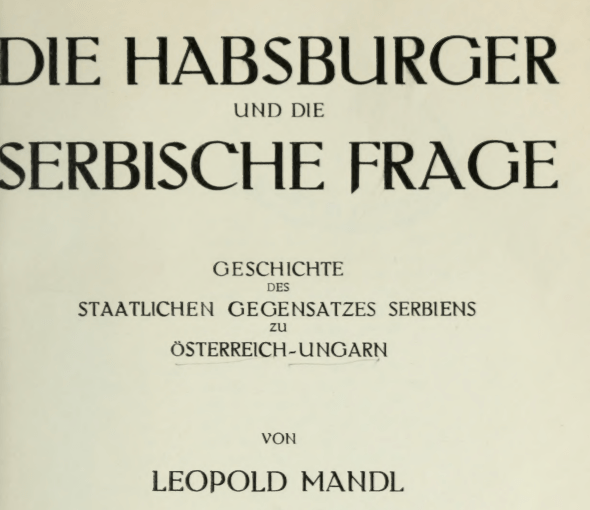

Despite talk of “Slavic unity” in the Balkans among Serbian extremists, one part of this agenda was the total extermination of Montenegro as a kingdom, and instead, the usurpation into the Greater Serbia vision. According to them, Montenegro could only survive on Russian donations. Another plan was to murder King Nikola Petrovic. Leopold von Mandl writes that, among other tings, Petar I, Bishop of Cetinje, had all Muslims (Albanians and Bosniaks) murdered in one night.
Cited:
“In Montenegro, too, Serbia’s official and committee policies only seemingly diverged. The elimination of Montenegro’s statehood had been an important tenet of Greater Serbian policy since the times of Prince Mihailo. According to Greater Serbian radicalism, Montenegro had absolutely no right to exist. It owed its emergence in modern times to a kind of Sicilian esper, orchestrated by the Bishop of Cetinje, Petar I, when he had all the Muslim renegades living in Montenegro murdered in one night.
The Papal States thus created could only survive on Russian subsidies. In 1847, it was transformed into a secular principality. Since 1899, Russia paid an annual subsidy of 500,000 rubles to the Montenegrin state budget, which in 1907 amounted to approximately three million francs. “There is no budget,” writes the Belgian M. C. Verloop, “more improbable than this, because Montenegro’s expenditures amount to at least six million francs. One can only conclude that the country’s unknown income must be at least three million francs.”
In fact, Montenegro’s existence was well-supported by scholarships from the Serbian Sveti Sava Society, a student group called the “Revolutionary Montenegrin Emigration” was formed in Belgrade in 1903.
Montenegrin radicalism reacted with caustic severity to the patriarchalism of King Nikola, who had been wearing a constitutional cloak since November 1, 1905. The meeting point for the students from the Black Mountains was the academic reading club “Slovenski jug.” There they associated with like-minded elements from the younger Serbian officer corps, with Bosnian revolutionaries, and with clerks and secretaries from the Serbian ministry.
This club, on the occasion of the art exhibition it organized in September 1904, sent the signal that all South Slavs should rally around the Karageorgevic family as the South Slav royal house. Now, a nationalist clique that had formed there was planning to eliminate Montenegro’s statehood by exterminating its royal house. The idea came from Captain Jasa Nenadovic, who had emigrated from Montenegro and was appointed police border commissioner in Uzice.
The bombs were supplied by the royal Serbian military arsenal in Kragujevac. The assassins were represented by the revolutionary Montenegrin immigration and the nationalist movement in Montenegro. Both were root-elite offshoots of Serbian radicalism. The blame for the attack was likely provided by Crown Prince George of Serbia. They intended to kill King Nikola and his sons with bombs at the opening
of the Skupshtina in Cetinje on November 1, 1907.”
Reference
DIE HABSBURGER UND DIE SERBISCHE FRAGE: GESCHICHTE DES STAATLICHEN GEGENSATZES SERBIENS zu ÖSTERREICH – UNGARN. Author: Leopold von Mandl. Published 1972. Digitalized 2010.
“https://ia600204.us.archive.org/3/items/diehabsburgerund00mand/diehabsburgerund00mand.pdf

 Balkan Academia