
An authentic journey through time and symbolism of a powerful country.
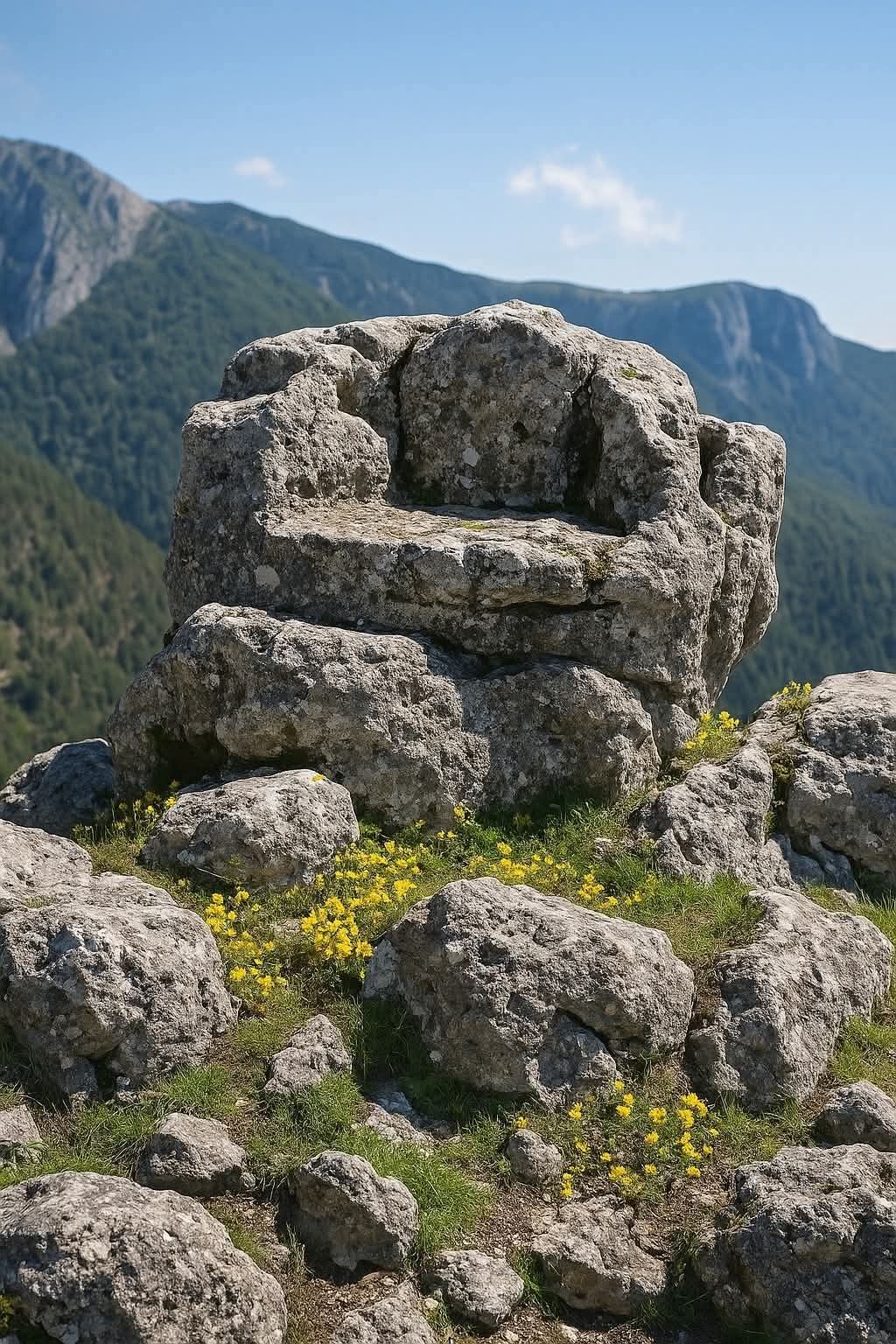
42 stone chairs were discovered in the territory of what is today Bosnia. Most of them are carved into solid rock, while others are mobile – made of stone blocks.
Their functions could have been different: thrones of rulers and nobles, places of judgment, or observation of the territory.The stone chairs of ancient Bosnia are not just archaeological remains of an era – they are silent testimonies of the power, identity and spiritual heritage of the people who lived in these areas long before official history defined them in the Middle Ages.
According to Šefik Beslagić and his work published in 1985, 42 stone chairs have been identified on the territory of the medieval Bosnian state. 31 are stationary, carved into the living rock, and 11 are mobile, carved from separate stone blocks. Their basic function was symbolic and practical: they represented the thrones of rulers and tribal leaders, used for trials, thrones and other forms of public power.
The largest number of chairs have backrests, while the smallest number have armrests or are completely without them. Some are more similar to benches, others have footrests. Some are decorated with reliefs and inscriptions.It is interesting to note that many stone chairs are located in cities or strategically important places.
National tradition often associates them with “ban”, “royal” or “judicial” functions. The chair from Donja Bukovica, due to the relief of a female figure with a crown and a heraldic lily, is associated with Queen Jelena Gruba.
There is a “King’s Table” in Klek, possibly associated with the ruler Kotromanić.But there is also a deeper layer – the layer of history that speaks not only of feudal hierarchy, but also of national memory. The lily symbol, present on the chair, is repeated on the swords.
Inscriptions such as “A SE SIE KAMEN” are closely related to phrases found in Illyrian-Celtic and Druid traditions throughout Europe.Some scholars and authors, such as Petko Nikolic, ask the question: are these chairs truly medieval, or are they much older, and only later were they used and marked in the context of government?
And could the similarities with the Druid “judgment chairs” from Western Europe point to a deeper, prehistoric, shared spiritual past?The presence of the same symbols – spirals, zigzag motifs, anthropomorphic and zoomorphic figures – on our stone benches and chairs could point to a common symbolic heritage that has survived through the centuries across Europe.


 Balkan Academia