

In 1871, the Albanian malesori requested to visit Shkodër. Mehmed Ali Pasha, governor of Shkodër, granted the request with the condition that the Albanians surrender their weapons. The highlanders refused. Mehmed Ali Pasha then ordered his troops to fire on the Albanian tribes, which killed 400 people. The Turkish forces then marched into villages and many – including 14 women, according to an article in the “Der Bayerische Landbote,” in 1871. A Montenegrin paper also published an article about the Albanian uprising in Vrakë and Mullinjteë against the Ottomans.
Turkish massacres in Vrakë in 1871
“Seldom has so much human blood been shed in such a barbaric manner as on the tragic day of August 23rd, on Wraker Mountain.
The Malissoren claim they had no intention of deceiving the Turks; they simply requested to be allowed to go to Shkodër. However, Mehmed Ali Pasha made the surrender of weapons a condition for granting this permission. As the tragic consequences have shown, this demand sparked deep—though unfounded—fears among the people.
But an Albanian man does not voluntarily surrender his weapons—they are his pride and honor.
When the order to fire was given, the crowd quickly dispersed. In just a few hours, 400 people out of 2,000 had fallen. Those who carried out the initial attack fled immediately, but the Turkish cavalry showed no mercy. They pursued the fleeing through four villages, killing a large number of people—including 14 women.
Only on the second day did the cavalry begin their march back.
You can imagine that this bloodshed has inflamed the fury of the revenge-seeking Arnuts (Albanians) to such a degree that a terrible uprising is now expected throughout Albania. According to reliable sources, the chiefs of various tribes have already met in council in the mountains and decided on a fight to the death.
Montenegro remains quiet for now. Meanwhile, the Russian consul in Ragusa has arrived in Cetinje. The purpose of his visit is unknown, but it is suspected to be connected to the unfolding Albanian uprising.”
Battle of Mullinjtë in Vrakë of 1871
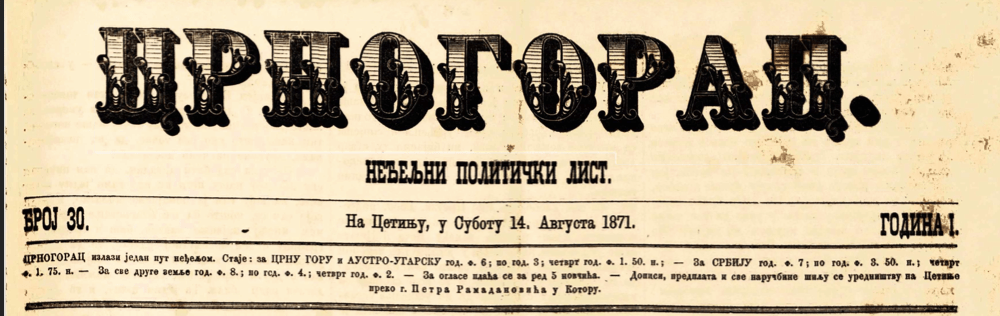
(ЦРНОГОРАД. НЕБЕЉНИ ПОЛИТИЧКИ ЛИСТ) nr. 30, published an article describing the Albanian uprising against the Ottomans in the region of Mullinjtë of Vrakë in Shkoder. There is also information of Turkish atrocities against the Malesori tribes.
Saxed from the newspaper:
“So blood was shed in Albania. As the readers of today’s newspaper will have seen from the Shkodër letters, on Saturday, the 7th, a fierce battle took place between Malisor and the Darokog Nizams near Shkodër and Vrakë.
Over 400 of Skanderbegs’s troops were instantly dead on the field, some from the bullets of the Nizam’s soldiers, and others from the knives with which the Nizam’s monstrous soldiers slaughtered the helpless wounded. The fierce battle lasted for two full hours, or rather, for two hours, the Nizam mercilessly pursued and cut down the Arbavas (Albanians).
Our readers will certainly find it strange, it is possible, that the Albanians perished so horribly, as we know that Albanians was a hero of war, such as he could only be. But from the event itself, which is clearly explained below in our Shkodra articles, they will see that it was not strange, and that it was a greater miracle that they were killed with such great loss.
2000 to 2500 of them descended without any preparation and surrendered, with a first strong impression of irritation and bitterness, straight towards Shkodër. Six camps of soldiers came out to meet them, with plenty of powder and good ammunition. The Malisors were all in a crowd, pressed together, without any order, and the six camps of the Nizam, who surrounded them, suddenly fired their rifles into the crowd.
The line did not therefore strike at the brave Arbanasis, but at the crowd of people, who immediately fled, seeing them dead in one moment and seeing themselves on a flat field without powder and with inferior weapons, compared to 4000 regular troops well armed. But now the Malisors prevailed, they worked without a head and for that – and for that alone they paid.
It is much more important here, to see what greater significance this event had and how much. We can freely say that the battle of Vrak, despite everything, which ended so sadly for the Albanians, or rather, that only one — the imperial — side worked, and the other — the people’s — was only trifling, has a great significance, which can easily have the most serious consequences.
First of all — all the previous events in the matter of disarmament were reduced to Shkodra itself. The events in Shkodra by themselves could not in any way cause the Porte great concern, and the diplomatic fear that the Eastern Question would flare up from there. In Shkodra, there are mainly čaršilije, and čaršilije are in the past the same as in the French struggle of the “bourgeois”. Therefore, it is not easy to expect from them that they will open a life and death struggle for their right, for their freedom.
Because their enthusiasm is always extinguished by the fear of losing what they have. Therefore, everyone who is well acquainted with the matter was of the opinion that Smajil Pasha with a few lines will easily restore order in Shkodra, as it actually was before the battle of Vrak. For the same reason, we are also convinced that there can be no talk of an uprising in Albania until the uprising is crushed in Shkodra itself.
Today, on the contrary, the situation is completely different. Now there is no talk of any strife in Shkodra. As a result of the bloody conflict at Vrak, the name of Albania now appears on the stage of all possible events. Now it can be said with full right – an uprising has broken out in Shkodra. And this is the first and most important significance of the Albanian defeat at Shkodra.
The second significance is in the magnitude of the defeat and the extent of the loss of the Albanian army. The defeat is great. This is evidenced by the number of dead. But the way in which so many Albanians were killed by the Nizam is horrible. The Nizam, the deposed emperor, behaved towards the Albanians, and if they rebelled, not as towards his own citizens, but rather as towards the most hated enemies, whom he had threatened to exterminate with all his might.
The Albanians had not yet said anything other than that they wanted to join forces in Shkodra. They did not even write in words that they declared their intention, for example: to secede from the empire, so that the Porte would have the right to treat them as outlaws, as enemies. And the work of justice and humanity and the work of the very interest of the port, the unifying army was supposed to repel the rebelling people without blood, and now that was not possible, and with as few victims as possible.
But he worked with all his might. Nizams not only killed over 400 people on the spot with a terrifying volley and without sufficient reason, he also started a chase, constantly shooting at the fleeing Albanians, and chasing them for a full two hours, they passed by the villages of the Albanians and in that pursuit they cut down eight Albanian women. They destroyed and trampled everything in their path.
And that was not enough for them, but when they were returning to Shkodra, many wounded lay among the dead, who had recovered from their wounds, but the Nizam came and slaughtered every one of them. To make the story more true and complete in its horror, we must also add that when the Nizam brought down a volley on a crowd of Arbanasi, all the male heads of a village died and that now there is no one in that village except for the women, children and a few elderly men.
Such a massacre, carried out in such an inhumane manner, gives, as we have said, much significance to the conflict at Vrak. The battle itself interrupts the local significance of the Shkodra movement, and takes the form of a real uprising in Albania, and this terrible defeat makes it impossible to maintain the movement only in this area, at least not without great sacrifices.
Anyone who knows the Albanians, their life today and in the past, will not doubt this for a moment. The Albanians are bloody heroes. They are very lively when they fight. It is easier for them to die than to sleep for a day. They do not inspire any fear, and least of all the spirits. And today, because of that death, they are bitter, raging like a lion. And as we are told from Shkodra, all the Albanian tribes are already calling out to unite.
We hear that in the past the leaders had a meeting. What they decided is still unknown, but in general they were unanimous, that they parted with the unanimous voice: “Let’s fight!” In addition to all this, it is also important that now the Shkodrans have revived in spirit and that some of them have gone to the tribes to organize a real uprising.
And then very important events can easily and quickly develop in your neighborhood. If an uprising has really developed throughout Arabia, and today at least such are the prospects, then the most serious consequences of this can quickly manifest themselves among all Christians in Turkey.
It would be absurd for us to blame the “brilliant Porte” for causing an uprising in Albania by its Turkish actions, and also to advise it on what to do to suppress the uprising. It did its thing: it caused an uprising. What the great powers were protecting Turkey from, it itself created – a very huge momentum, to panic and to flare up for the sake of a black solution to the Eastern question.
No less, no more, but that is exactly what we saw in the Albanian uprising. Therefore, the most important thing for us now is to know our position and task. We have been making mistakes in this until now, and now we are making more and more mistakes. The development of events in Albania will give you enough reason to openly, as is our custom and duty, declare the task of our people in this event.
The Pasha then called Chun Mula to speak to him. He understood everything that the pasha was telling him. He knew that the pasha wanted to hold them back for now, and that the battle with the Svadro was over, so that he could then come to their turn, to make them a gift to the people.
When Chup Mula arrived, the Malsori, the Hoti, immediately gathered to ask him why the pasha had called him. Chun told them everything in order, what the pasha was telling him, but they all jumped on Chup to kill him, saying: “You sold us to the Turks, we will be together. And you are a traitor!” Chun answered them: I will never betray you, but you want to fight, and you decide to fight with all Malsori and see what happens.”
They tried to get him to speak, but they shouted at him in a loud voice. He told them to wait, and when they would not listen to him, he got fed up, and began to scold them, saying: “And you are the heroes behind me, so that we can enter Svadar and die!” So they called the other Malisors, Castrates, Rvola, Griza and all the nearby people, and then they all set off for Shkoder. But there they were met by fire from a smokestack, killing up to 400 Albanians in the barn.
The Albanians, not expecting a man, and being unprepared, immediately retreated without any order. This terrible news of horror alarmed Shkoder, and from the interior of Albania all the voices of war arrived. There is much talk, and most of all that peace is more important. About this and about the battle itself, I will tell you immediately, as I am better informed. This is written to you now, and it is written from word to word.
As I promised, here I am to inform you in detail about the terrible event that happened to the army on Saturday, the 7th of April at Bravo near Shkudar. I can tell you the same thing, this is what happened, because I learned it from the most reliable sources. When the barjavtar Chun Mula, as you already know, was forced by Malisor to lead them unprepared to Svadar, he quickly ransomed as many of Malisor, Caetrat, Riola, Griza and others as he could and went with them to Shkudar. When they arrived at about one o’clock near the city of Svadar, the pasha sent several emissaries to Chun Mula to tell him to return, but the Arbanasis did not want to go there.
The Pagha and the Oath sent the Nizam with the same order, and Chun Mullah replied that he (i.e. the Pasha) should go, because he wanted to enter the market and the city of Svadarsk armed. The Pasha began to threaten him, and Hoti then fired at the Nizam and killed the wolf. Now the Nizam let loose a volley of arrows at the Arbanasi and suddenly a crowd of soldiers remained.
The Albanians were alarmed and frightened by this, because they had not nearly enough gunpowder for themselves, so they all took knives to their guns, and they began to flee, and the Nizam started after them, firing continuously, and they pursued them for a full two hours, and when they had already scattered them, they still shot after them into the wind. In this entire massacre, over 400 people died from Malesia, and even more, and 18 from the Nizam were killed, and 32 were wounded.
The Nizam acted most inhumanly in this conflict with the Albanians. The Nizam’s commanders completely forgot that their duty was to maintain peace, because they were not at war with an external enemy, so they went out to suppress the rebellious people. And they only responded to a few rifles of the insurgents with a volley and killed up to 300 people on the spot, but they went even further and killed everyone they could, and they turned them into beasts.
What is more, the Arbapas, passing by their villages, slaughtered eight women. That is true, and they say more. Here the Malisaoris perished in anger, although they themselves were quite bloodthirsty, because they had ventured into the plain, and if they had done so, they would not have suffered so much. But with all this violence, the uprising was not only not suppressed, but on the contrary, the barbarity of the ranks made it possible for the rebellion to spread quickly and easily throughout Albania.
They are very angry and we can take matters into our own hands. They are already calling the Shala, Shoshi, Kelmendi, and other ill-fated minorities to help, and they will soon rise up to arms. It is not yet known about Mirditë, but if they all rise up, it will be difficult for this one to be absent.
Nothing is yet heard from Krajina; the market is being entered. They are guarded by steamers all night long in the mud. Yesterday, three camps of the army went to the side of Lezhë. And one Shkodran went there to raise a bomb. From this it can be seen that the uprising is seriously being prepared and that the Shkodrans are now pressed by the army, and do not think only of seeing what happens. In the aforementioned battle there were up to 30 Shkodrans, of whom only one died.
From all this you can see that now the Shkodrans uprising has taken on a different form with itself and that from what has happened to this day events can be easily deduced, the end of which is unknown.
From SPUŽ, August 9. — Kajiavam Spužn, having received the order to receive the imperial troops and to destroy them in Pisa, immediately summoned Selim Hadžić to tell him that he would accept Spužan, and that he would obey the emperor’s orders and surrender his weapons.
Selim made an agreement with the Spužans four times and finally accepted them, and the Spužans surrendered their weapons and obeyed the emperor’s orders. When it came to enrolling the people of Podgorica in Pisa, they argued that they were guarding all Morača and that they were in trouble, and that was why they were burning the emperor’s weapons.
But when word reached Podgorica yesterday that the Shkodra platoon had been attacked and that 600 Albanians had been killed (he said, but more than 400 U.) and that the army had not yet reached Podgorica, all the leaders of Jus Mučin’s lačardav gathered and made an agreement there to accept the rifles, but to keep them all together, even if it came to the end.
Due to the Shkodra surrender and the fighting in the area, Podgorica ordered that no Crvena zagreb was allowed to enter Podgorica with a weapon, but that each person should leave it near Ribnica in a Christian house.
Jusuf Muča Begu forced the Podgorica residents to go around the city without weapons, in order to thereby show the townspeople their obedience. Here the people are afraid and all the fools, fearing the exile and the lack of an absolution, are making agreements, so that they will fulfill everything that the gift commands in a more peaceful way.
A certain Spuzh man told me all this, but I cannot believe that this fear really prevailed, because as I hear and see, the death of the Shkoder leader has caused more bitterness and anger than fear, and if I continue to act cruelly, there will be clashes on the other side. Given everything that is happening today, I believe that I will soon be able to write to you about more serious events.”
References
MONTENEGRO. NON-WHITE POLITICAL NEWSPAPER. ISSUE 30. In Cetinje, on Saturday, August 14, 1871.
Der Bayerische Landbote, 1871. https://www.google.se/books/edition/Der_Bayerische_Landbote/CH9TAAAAcAAJ?hl=sv&gbpv=1&dq=Malisforen&pg=RA21-PA25&printsec=frontcover

 Balkan Academia