
by Lulzim Osamanaj. Translation Petrit Latifi
Since the earliest period of human civilizations, beer has occupied an important place in both everyday life and in the culture of many ancient peoples. It was not only a drink, but often also a food, a medicine, and even a symbol of well-being and health. From ancient Mesopotamia to the Illyrian lands, beer has been evidence of the agricultural, technical and social development of humanity.
Barley beer first reached Illyricum and Hellas around 700 BC. The Hellenes, unlike the Illyrians who had a special name for beer, called it zythos. Through trade relations throughout the Mediterranean, the drink quickly spread to all neighboring regions and became known among the Gauls, Germanic tribes, Iberians, Illyrians, Pannonians and Scythians.
The Romans called Egyptian beer zythum, Gallo-Germanic beer cer(e)vesia, Pannonian beer alssabaia, and Spanish beer ceria.
The Romans, however, did not view beer with sympathy. They referred to it with disparaging terms such as “barley wine” or “watered grain.” To them, beer was a drink of barbarians and was consumed mainly by peoples beyond the Alps.
In Italy, wine was the favorite drink and a symbol of civilization. According to Diocletian’s Price Decree, beer was among the cheapest goods—even the simplest peasant wine cost twice as much. However, in the provinces and especially on the imperial borders, the situation was different: Roman soldiers often consumed beer for its nutritional value and because it was cheap and easy to produce.
In addition to its use as a beverage, ancient beer also had medicinal and cosmetic uses. It was used as a remedy for glandular inflammation, chronic cough, and worm infestations. Pliny the Elder even mentions that beer foam was used as a means of skin beauty.
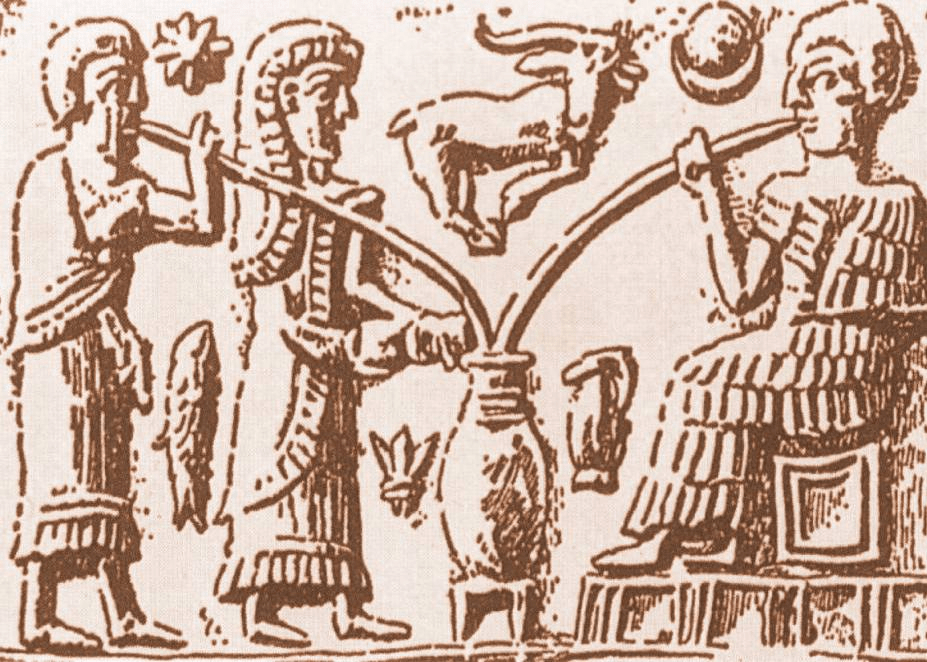
In ancient Egypt, beer had a special importance. It was mass-produced and considered part of the daily diet. An inscription found in the Saqqara pyramid, dating back to the 4th millennium BC, mentions that the god Osiris was the inventor of beer. The Egyptians drank beer through a straw to avoid the cloudy residue that formed during fermentation. At that time, beer was stored in clay jars, thus being protected from parasites and contamination.
In Mesopotamia, about 6,000 years ago, the Sumerians discovered the process of fermenting barley with wild yeast and produced the first versions of beer. These beers were very different from today’s beers – thicker, sweeter and without gas. It was only with the scientific developments of the 19th century and the Bavarian Purity Law of 1516 that beer took on the form we know today.
This law, promulgated by William IV, Duke of Bavaria, required that beer contain only water, barley and hops, while yeast as an ingredient was included later, after Emil Christian Hansen developed the method of cultivating pure yeast in the Carlsberg laboratory in 1883.

Beer among the Illyrians
Among the peoples known for the production and consumption of beer were the Illyrians. The Romans mention an Illyrian beer called SABAIA, which was a barley or wheat beer, produced in the Illyrian and Pannonian regions. This name is also included in Roman writings, where it is mentioned that Pannonian beer was also called sabaia, indicating that the drink was widespread throughout the Illyrian-Pannonian region.
Although archaeological evidence for Illyrian beer production is scarce, there is a considerable number of historical references. Sabaia beer is thought to have been a lager-type beer, fermented at low temperatures with yeast deposited at the bottom of the vessel. While Bryton or Bruton was a type of ale, fermented at warmer temperatures and where the yeast remained on the surface.
The word sabaia is found not only among the Illyrians, but also among the Thracians, where Sabazios, the god of beer, is mentioned.
In addition, other names for beers from neighboring regions have been documented:
Parabias, a beer made from millet, used by the Paeonians.
Kamon, a beer mentioned by the Dalmatians.
The Illyrians were known for their parties and celebrations, where women also participated and where all kinds of alcoholic beverages were consumed. The Greek god of wine, Dionysus, was called Dualos by the Illyrian tribe of the Paeonians, a name related to the Albanian words “dej” (drunk) and “dwals” (mad). This shows a deep linguistic and cultural connection between the ancient Illyrian and modern Albanian traditions.
According to Saint Jerome, the Illyrians produced beer from barley, which they called sabaia, and they also knew beer with honey. The Roman emperor of Illyrian origin, Valens, adored this drink so much that his contemporaries called him Sabaiarius, “the man of beer”. Historians such as Polybius and Theopompus mention that Illyrian kings, such as Genci and Agron, were heavy consumers of alcoholic beverages. Agron is even said to have died after a night of excessive drinking, after suffering pleurisy.
In an account by Theopompus, during a battle between the Celts ve and Ardiae, the Celts retreated from their camps, leaving behind poisoned food and drink. The Ardiae, known for their love of beer and food, fell upon them carelessly and were easily defeated.
According to Pseudo-Aristotle, the Illyrian tribe of the Taulantes produced a honey drink that the Greeks later learned about – a type of fermented honey that resembles today’s raspberries. The Byzantine author Priscus reports that in Pannonia, during his visit to the Hunnic king Attila, the locals consumed a beer-like drink, which they called medos
This evidence clearly shows that the Illyrians had a rich tradition in the production and consumption of beer, which has deep historical and cultural roots. Sabaean beer, in addition to being a pleasant drink, was part of their identity and way of life.
Therefore, preserving the ancient name SABAIA and reviving this tradition is not only a cultural act, but a reminder of our ancient Illyrian heritage and proof that in beer production, we do not lack either history or tradition.
References
- Pliny the Elder (Plinius Secundus) – Naturalis Historia, Book XIV, Chapters 29–30.
Mentions beer as “zythum” and “cerevisia”, as well as the use of beer foam for skin care. - Dioscorides – De Materia Medica
Mentions “zythum” and “cerevisia” as fermented barley drinks, also with medicinal uses. - Pseudo-Aristotle – De Mirabilibus Auscultationibus, Chapter 51.
Mentions the honey drink of the Taulants (Illyrians) taught to the Greeks. - Theopompus (extracts preserved from Athenaeus, Deipnosophistae)
Describes events involving the Illyrians and their drinking habits. - Polybius – Historiae
Mentions the Illyrian king Genci as a heavy drinker of alcohol. - Hieronymus (St. Jerome) – Commentaria in Esaiam
Mentions the Illyrian beer, called Sabaia. - Priscus Panites (Priscus of Panium) – Fragmenta Historicorum Graecorum, vol. IV.
Mentions the Pannonian drink “medos” during a visit to Attila. - Diocletian’s Edict of Prices (Edictum de Pretiis Rerum Venalium, 301 BC)
Includes the prices of “zythum” and “cerevisia” as cheap goods compared to wine.
Modern Sources and Historical Studies - Hornsey, I. S. (2003). A History of Beer and Brewing. Royal Society of Chemistry.
Analyzes the development of beer from Mesopotamia to the modern era, with mention of Egyptian, Greek and Roman beer. - Nelson, M. (2005). The Barbarian’s Beverage: A History of Beer in Ancient Europe. Routledge.
Explores beer production in ancient Europe, including the Gauls, Germanics, Iberians and Illyrians. - Dietler, M. (2006). “Alcohol: Anthropological/Archaeological Perspectives.” Annual Review of Anthropology, 35: 229–249.
Describes the social and ritual role of alcohol in ancient European cultures. - Wilkinson, T. (2003). The Rise and Fall of Ancient Egypt. Random House.
Includes chapters on beer production in ancient Egypt and its use as food. - Meussdoerffer, F. G. (2009). “A Comprehensive History of Beer Brewing.” Handbook of Brewing, 1–42.
Includes data on early fermentation and the development of beer purity laws. - Gjergj Filipi (2002). The Illyrians and Their Cultural Heritage. Academy of Sciences of Albania.
Mentions Sabaian beer and its connections to Illyrian material culture. - Encyclopedia Britannica / Britannica.com – Article “Beer – Ancient origins.”
Outlines the evolution of beer from the Sumerians to the Romans. - Bavarian Purity Law (Reinheitsgebot, 1516) – original historical document, promulgated in Ingolstadt.
Mentioned basis for “Beer Day” on April 23.

 Balkan Academia