
by Don Frok Zefi. Translation Petrit Latifi
During the 17th century Albanian retreat there were about 4,000 (four thousand) Catholic Albanians, together with the Archbishop of Skopje, and six missionaries. However, on October 12, 1737, betrayed by the Serbian patriarch, Arsenije IV Javanović Šakabenta, they were ambushed by Mehmed Bey of Zvornik, in Klanac near Valeva, who captured a third of the Catholics along with 100,000 (one hundred thousand) head of livestock that they had with them, and two missionaries, all of whom he massacred.
Along with Archbishop Summa, there were also 300 Albanian families, with about 1,200 souls, and four Franciscan missionaries, who took refuge under Austrian protection near Belgrade; 1,400 of them were massacred, while another 1,400 were taken prisoner into slavery by the Turks.
After this painful defeat, Archbishop Summa was forced to remain in Belgrade until mid-August 1739, while the Catholic Albanians who were with him moved to Srijem, where they finally settled in two villages that became their strongholds: in Hrtkovce and in Nikince, where they established the “special Kelmend mission,” with headquarters in Hrtkovce.
The arrival of the Kelmendi in Srijem (Srem)
At the end of October 1737, the so-called Serbian militia passed through the Sava River in Srijem along with the army. With them passed two Albanian detachments led by princes Deda and Vata.[1]

Photo Marija Pakić from Hrtkovce in national dress in 1910
At the time of the arrival of the Kelmendans in Srijem, many villages were devastated by war and the plague epidemic. Since they were not officially stationed by the state, Albanians and Serbs forcibly occupied the abandoned villages and wastelands. Albanians with their flocks roamed throughout Srijem like nomads, living in forests and spending their lives in underground shelters (“zemunica”).
At first, the Franciscans remained in the field with the large crowds of believers. This is also confirmed by the proposal of General Engelshoffen, that a Franciscan from the deserted fields of Kukinjaš (Irid) be assigned to Hrkovci.[2]
The Kelmends from Kosovo moved together with the church organization, so they remained grouped in this way even during the population in Hrtkovci and Nikinci. The Kelmends from Peshter settled in Hrtkovci, while those from Rugova settled in Nikinci.
Among the priests who were in Hrtkovci from 1738 to 1748 was Fr. Dominic from Pieva, who was previously a missionary in Rugova, who was also a prefect,[3] and Fr. Leonardo from Castelluccio, who had come from Kamenica e Peshterit.[4] According to the baptismal records, from 1738 to 1745, Friar Peter from Arezzo served in Nikinci, together with Friar Ludovik from Dinamia.[5]
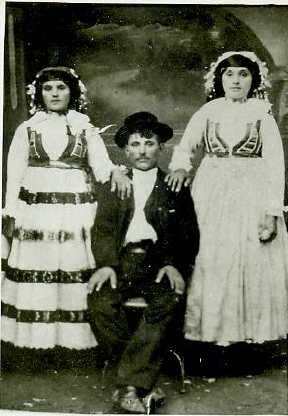
Photo by Ana Ulić, born Cakiq from 1927
The Kelmendi in relation to the missionaries and the bishops of Srijem
On 15.07.1741, the papal nuncio in Vienna, Camillo Paolucci, wrote from Pozhun to the Congregation for the Propagation of Religion in Rome that he who had previously been interested in the Catholic Kelmendasi, who had settled in Slavonia, in order to keep them in the Catholic religion. He begged the Royal Porte to settle the Kelmendese in the Banat of Tamiš (Tamiški Banat), so that houses and churches could be built there and their leaders and priests could be provided with decent salaries.
The only thing that the Kelmendese needed to be asked was what they wanted: would they remain soldiers, or would they become farmers or herders.[6] The nuncio sent Fra Donat from Trento to Srijem to see what the Kelmendese wanted. In November 1741 he announced that they wanted to remain soldiers, that they were about 160 families and that they could gather in a single village. Two spiritual leaders, he estimated, would be enough for them and proposed that Fr. Leonardao from Castellucio and Fr. Ludvik from Dinamia be called to serve.[7]
At the beginning of the following year, the aforementioned missionaries were indeed called. Surprised and astonished by this decision of the Congregation for the spread of religion in Rome, both missionaries and respectable believers complained, but without success. On 06.04.1742, all the Kelmend captains and officers in Srijem with all the members of the Kelmends and the Albanian community wrote to the Congregation for the spread of religion in Rome.
They emphasized that Fra Leonardo was sent by the same congregation with a mission to Kamenica (in Peshter) and had truly been the guardian of their souls from the Turks and other enemies of the Christian name, preaching for the only saving Roman Catholic Church. He organized the Albanians in an uprising during the last war against the common enemy and under “his influence we have left our villages, our homes and our property and because of the Christian religion and name and we have passed from Turkey to the kingdom of Srijem.”
They emphasized that they respect that Leonardo as a faithful shepherd and leader, who in the most difficult circumstances educated us in religion, shared the sacraments with us and with effort, sacrifice and his pastoral work won their unconditional trust. Because of this, they ask that you leave this missionary. Their request was witnessed by the signatures and seals of captains Vata and Deda, two of their fellow countrymen, and two guard commanders, and then the signatures of three ensigns and three corporals are found.[8]
Eight days later, from Petrovaradin, on April 14, 1742, the two captains Deda and Vata again wrote to the Cardinal Prefect of the Congregation for the Propagation of Religion on behalf of all the Albanians of Kelmenda, settled in Srijem. They ask the Congregation not to take away Fra Leonardo, so as not to deprive them of great spiritual comfort. In fact, Fra Leonardo has been in Turkey for so long, and now under the rule of His Majesty the Tsar, he has distributed the sacraments and led the pastoral work among this people with whom he has experienced many difficulties from the Turks.
He speaks Albanian excellently. If you remove this missionary now, the Albanians suspect that the next missionary will not know how to speak Albanian. For all the above, they pray that Fra Leonardo will not be transferred elsewhere.[9] The missionaries called with broken hearts and tears in their eyes had to pass through Osijek back to Italy.

Detail “Wreath in the Hat” Marija Pakić, Antun Nikić, son of Paskal, in national men’s dress around 1931
The Bishop of Srijem Ladislav Szorenzei, now the ordinary of the Kelmends settled in Srijem, in 1743 made his own note about the new believers settled there, in which he says: “With the arrival of this people from Serbia, called Kelmends, the number of Catholics in Srijem has increased. The situation of the Kelmends is as follows: This people is all soldiers, consisting of two companies, which are currently located not far from Mitrovica in the Jurjevci estate (Hrtkovci F.Z.) and in four other estates.
There are 160 families with 1200 souls. They speak a special language. Their spiritual fathers are the missionaries Father Dominik from the City (Pieva F.Z.), who is the leader of the mission, and Father Pjetri from Arezzo, both of the reformed order of the Franciscan Friars Minor, Italians, who speak the language of the Kelmendese, who have also shown me as an ordinary, the original documents for their mission and the special privileges they have been granted.[10]
In 1744, the Kelmendese missionaries from Srijem reported to the Empress Maria Theresa in Vienna in an undated letter, in which they described their difficulties. Their churches are built of old wood and are covered with straw and do not resemble temples but stables, they are damaged by rain and snow.
The church vestments are in a deplorable state, while the altar decorations do not correspond to the regulations of the Church. The Orthodox, who can be proud of their beautiful churches, make crude jokes about our churches. The missionaries’ dwellings are deplorable and not comfortable. The Kelmendese give them some grain and some lamb.
For this reason, the missionaries, in addition to serving in the parish, accepted to heal the sick and prepare medicines, so that they could earn money necessary for survival. And they ask the empress to allocate 150 forints from the parish treasury in Pozhun.[11]
On 05.03.1745 the royal council from Pozhun informs Bishop Szorenyi that, according to the modest request of the missionary fathers, who in the previous war had settled in Srijem together with the Kelmendese and which he presented to the imperial majesty, it has been determined that each missionary will receive 75 forints per year from the parish treasury in Pozhun, as their annual salary.[12]
In 1745, a dispute arises between the Albanian soldiers of the Catholic religion and their Orthodox officers, as well as between Colonel Atanazije Rashkovic and the Kelmendese captains Deda and Vata. It seems that the conflict was based on religion, as it followed the order of Empress Maria Theresa dated 28 July 1745, sent to the Vice-Marshal Marquis Askan Guadagni in Osijek, that Catholic Albanians from Kuqi, called Kelmendas, should be assigned Catholic officers, while Orthodox Albanians should be assigned Orthodox officers.[13]
In 1746, the bishop of Srijem, Ladislav Szorenyi, made the first canonical visit to the “Kelmenda people”. The bishop writes: “On May 17th I went from Zemun to the Kelmends, a Christian people who 8 years ago were settled in Srijem from Serbia and are currently in the estates of Jurjevci (Hrtkovci – F.Z.) and Nikinci, where on the 18th and 19th I confirmed approximately 700 people, mainly the oldest and adults of both sexes.[14]
In 1746 the Albanians in Srijem experienced another disappointment. The Austrian government, in order to establish a military border, intended to form a new nation from the different population – the nation of the Borderers or Krajišniks. In order to achieve this as easily as possible, the national and tribal names that had been used until then were banned, including the names “Albanian” and “Kelmend”.
The bishops and priests did not adhere to this ban at all, so with the Mission in Hrtkovci and Srijem with insistence continued to call the Kelmendese mission and to preserve the national consciousness of these people about their Albanian belonging.[15]
On 13.03.1747, Empress Maria Theresa wrote from Vienna to the Bishop of Srijem, Ladislav Szorenue. The Empress personally verified whether the missionaries’ statements about the number of Kelmendese are correct, that according to the missionaries they are about 1200 souls and whether it is true that there are only two missionaries.
Should, in the Bishop’s opinion, another missionary be sent, as they themselves have requested? Would there be a priest or a religious in these areas who knows the Kelmendese language well, and whether the missionaries receive a salary of 150 forints from the parish treasury of Pozhun.[16]
The year 1748 passed with preoccupations about the construction of the church in Hrtkovci and the chapel in Nikinci. On 22.03.1748 the imperial council in Požun approved the sum of 400 forints, informing them that they could receive the money in Osijek from the chief tax collector for Slavonia, Augustin Kollhundt.[17] A preliminary estimate was made for the church in Hrtkovci.[18]
The prefect of the mission, Fra Bonaventura Prugger, sent a preliminary estimate (preventive) and the episcopal plan for the new church in Hrtkovci.[19] Construction did not begin immediately, so the cost of the expenses increased. On 26.09.1750 the sum of 700 forints (florents) was approved, so that 400 forints would be allocated for the church in Hrtkovci, and 300 forints for the chapel in Nikinci.[20]
The main event of 1749 was the allocation of land for houses for the Kelmends in Hrtkovci, Nikinci and Jarak. A total of 222 land units were allocated for residential plots. The Kelmends in Jarak eventually converted to Orthodoxy and declared themselves Serbs.[21]
From 1750 to 1754, an unpleasant process took place between the auxiliary bishop of Srijem, Nikola Josipović Đjivović, and the missionaries. The missionaries wanted to remain outside the jurisdiction of the diocese and always invoked the privileges granted to them by the Congregation for the Propagation of Religion, while the bishop did everything to subjugate them.
Neither side had any scruples in proving their right. Bishop Đjivović turned to the metropolitan of Kala Franjo Klobusuczky for help, but also to Maria Theresa personally, demanding that the missionaries withdraw, except for the one from Trent. The Empress contacted Cardinal Mellini, but he did not come to the point of withdrawing the missionaries. They suspected that The Kelmendese would accept new missionaries.
It is interesting that Archbishop Suma was written about with respect in this process, and that he, in accordance with church regulations, did not interfere in the conflict,[22] while the military authorities, on the other hand, proposed that in the event of the expulsion of the missionaries, the Franciscans of the Bosna Srebrena province, who were already parish priests on the Military Border in the territory of the Petrovaradin and Brod Regiments, would accept the service.[23]
During the year 1769 the military authorities ordered the Kelmendese in Srijem to arrange their cemeteries and set up fences.[24] Also perfect informed the state authorities in Nikinci that many Albanian families had emigrated from Turkey.[25] The Austrian military authorities began to encourage new migration of Albanians by sea and land to Srijem. In this way, the issue of financing the missionaries would be resolved, because each house would pay two forints per year.[26]
It is not clear from the documents whether the attempt was to relocate only the remaining Kelmendese in Peshter, who were exposed to violent Islamization, or also the Kelmendese who lived in the motherland in Malësia e Madhe. One document advises that the Albanians be transported by sea and that ships in Rijeka and Trieste be paid for, because it is not practical to make a land journey, because they would not want to travel without their livestock.
The journey on foot would take at least 7 days, and it happened in the last war that the Turks massacred 1/3 of the refugees and turned 1/3 into prisoners.[27] For that purpose, the authorities asked the missionaries for help in mediating and accurately describing the customs and life of the Kelmendese and their homeland. On this occasion, Father Franjo Antun from Bovesi, who was also the perfect of the Srijem mission, was engaged.
He wrote a detailed and accurate report, as well as a very beautiful one, about the Kelmendese, their homeland and their settlements, as well as their way of life.[28] It is a great fortune that this migration did not come to pass and thus lead to the disappearance from the community of other Albanian tribes. Their stay in Peshter and Rugova paid a high price, as apart from a small number of families who fled to Srijem, all were forced to convert from Catholicism to Islam at the end of the 18th century.[29]
Education
In 1769, serious thought began to be given to the education of the local clergy of Kelmenda. The care of Maria Theresa in realizing this idea is amazing. She decided that the selected boys should be educated by the Jesuits in Osijek in a Latin school. The grandsons of Captain Deda from Hrtkovci, the brothers Jozef and Martin Deda, had already been educated at the military engineering school in Gumpendorf.[30]
Seven boys were selected as candidates for priests and sent to Osijek.
From Hrtkovci these were selected:
Antun Maletić, orphan, Catholic, 13 years old, adopted son of non-commissioned officer Maletić, no. 7;
Simon Deda, son of Stakë Deda, Catholic, 11 years old, no. 11. His father is an invalid. Karlo Gega, Catholic, son of Gjelosh Deda, who is semi-invalid, 9 years old, no. 13; Jakob Loss, Catholic, son of Tomë Losse, retired officer, 12 years old, no. 6; Augustin Prenlija, Catholic, son of Andre Prenliu, semi-invalid, 11 years old, no. 33.
While from Nikinci were selected:
Andre Maroshi, Catholic, no. 12, son of Prenli Maroshi, retired corporal (corporal, corporal), 11 years old; Gjelosh Pali, Catholic, no. of house 18, son of Marosh Pal, retired corporal, 13 years old.[31]
Already in the first year of schooling the boys showed marked success in their studies and behavior, as reported by Father Josip Fischer, superior of the Mission in Osijek in a letter dated 03.XII.1769.[32] This year in Hrtkovci there was a conflict between the Kelmends and the missionary Father Karlo from Pavia.
The registration of all heads of households in Hrtkovci has been preserved for this process, as well as some interesting things. It is a pity that the military notary did not write down the Albanian words precisely. A resident accused Fr. Carlo of not wanting to baptize his son in the Kelmendic language with the formula: “Pr emnit Attit, e Birit, e Spirit Sent”, but had poured water on his head three times and said in Croatian: “Ja te krstim” (I baptize you).[33]
Don PAL ZOGAJ (Pavao Sogagni)
In 1771, Don Pal Zogaj, a priest of the Archbishopric of Skopje, arrived in Osijek and on 25 November, reported to the Main Command of the Slavonian Clergy. That priest had been appointed instructor and educator of the candidates for priests from Hrtkovci and Nikinci, who were staying in the Osijek Castle.[34]
Don Pal Zogaj was originally from the village of Zogaj in Gjakova. From 1749 to 1759 he studied in Rome at the Urban College of the Congregation for the Propagation of Religion. After completing his studies, he returned to the Archbishopric of Skopje and was ordained a priest.[35] He first served as a parish priest in Janjevo.[36] Then in Prizren[37] and again in Janjevo.[38]
For Easter 1765, Archbishop Mazrreku sent him to serve the parish of Rugova, but he settled in Peja with the vicar of the Archbishopric of Skopje, Don Ivan Logorezzi, and from there he visited and served his vast and poor mission.[39] In his report to the Congregation for the Propagation of Religion dated 20.08.1767, Don Pali mentions the situation in the former Kelmendese missions and says that in the parish of Rugova there are only 12 houses publicly declared as Catholic. In Peshter in the village of Ulaj there is only one house left.
Catholic miles, while in other villages there was an old man here and there. The Peshteras converted to Islam in 1746 and then the beautiful church in Kamenica was destroyed.[40] Until the end of 1769, Don Pali led the parish of Rugova when the archbishop returned him to Janjevë as a punishment, where he himself served.[41]
On 20.12.1771, Archbishop Mazreku wrote that Don Pali had traveled to Osijek, but on 02.11.1771 he had stopped at the Zemun lazaretto. The archbishop also asked the Congregation what to do with the Rugova parish, which no longer had a parish priest.[42]

The family of Pepe Nilić (Xhumalia) from Hrtkovci, in 1895
Upon arriving in Osijek, Don Pali immediately began his duties as an instructor of the Albanian language and prefect of Albanian boys, Jesuit students. In 1771, the missionaries of Hrtkovci asked the Congregation in Rome for an Albanian dictionary and grammar, through which they would be able to teach Albanian children more easily. They emphasized that a shipment of such books had reached Don Pali in Osijek, who is an instructor of children candidates for priests.[43]
In 1773, a school was established in Hrtkovci, at the mission headquarters. Although the school was established at the insistence and effort of the missionaries, it was not Albanian that was taught there, but German. In the church, prayers and sermons were held in Albanian, and religious instruction was held for Albanian children and young people.
When on 06.05.1777 the bishop of Đakovo (in Croatia), mons. Matej Franjo Krtica, held a religious lesson and asked the children and young people about their knowledge, he did so according to the model of the Albanian language that he had received from the teachers.[44] In 1773 the Jesuit order was banned, so the cultural and educational work of its members was also stopped.
The suspension of the Jesuit order was not hasty. The students finished the 1773/74 school year in Osijek under the guidance of the Jesuits. Don Paul testifies to this in his letter dated 15.01.1774 to the Congregation in Rome. In this letter he praises his students and the progress they had made in their studies.[45] The following school year 1774/1775, the Albanian students, together with their prefect, were at the Greek Catholic Seminary in Zagreb, where Bishop Vasilije Božičković accepted them.
Only four young people had arrived in Zagreb with Don Palin. Don Palin finished writing the Albanian grammar in Zagreb, which he had begun in Osijek. In the autumn of 1774, he left for Vienna to present the manuscript of the Albanian grammar to the queen and to seek support for its printing, for the sake of the students and the people in Hrtkovci and Nikinci, in order to preserve the Albanian language.[46] In Vienna, he had to adhere to a certain protocol and things did not go as Don Palin had intended.
His grammar was returned to Zagreb for examination by Bishop Božičković. In 1775, Don Paul addressed a petition to Maria Theresa, in which he asked the empress to increase his salary, to have his grammar published, to be appointed as a priest in Hrtkovci and Nikinci, or to secure approval from the Sublime Porte of Istanbul to return to his homeland and the Archbishopric of Skopje.[47]
The empress sent Don Paul’s petition to the Croatian Royal Council in Varaždin, so that the Council could reach an agreement with Bishop Božičković regarding the petition and that a final opinion be given on the matter.[48] Božičković gave a detailed response, which did not meet all of Don Paul’s expectations.[49]
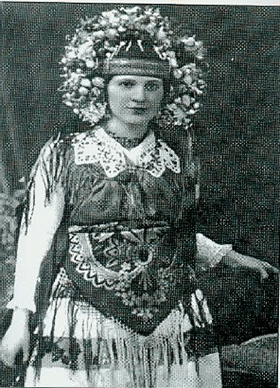
MARIA PAKAJ, ALBANIAN FROM Hrtkovci, Dressed as a bride on her wedding day in 1910
In 1776, military authorities proposed that Don Pal be ordained as a priest in Hrtkovci and Nikinci, but the bishop of Đakovo, Krtica, was not in favor of resolving the matter in this way. The bishop wanted to wait until Antun Maletić had been ordained as a priest.[50] At the end of the 1775/76 school year, Don Pal was forced to leave the Orthodox Seminary in Zagreb.
He took Bishop Božičković’s response as a personal insult. He had written an accusation against him and his seminary to the Main Command in Osijek and, having left Zagreb, went to Hrtkovci.[51] In 1776, Bishop Krtica appointed Don Pal as spiritual assistant in Hrtkovci.[52] At that time, there was never a close cooperation between the regular clergy and the diocesan clergy anywhere…
A whole year, until 25.07.1777, had been spent in disagreement between the sub-prefect, Father Candido from Geneva, and the unwanted chaplain, Don Pal Zogaj.[53]
On 20.11.1777, the retired Archbishop of Skopje, Mikel Summa, died in his house in Osijek. He had lived in Osijek since 1739. After being relieved of his duties by the Archbishopric of Skopje, he became suffragan of the Archbishop of Ostrog, the Primate of Hungary. Bishop Krtica of Đakovo buried him in the Franciscan church in the Osijek Castle on 22.11.1777.[54]
After leaving the mission in Hrtkovci, Don Pali went to Shid, where he stayed in 1778 and 1779 on the property of the Orthodox bishop and sub-prefect Speis.[55] In August 1779, Don Paul was again in Vienna and stayed with Abbot Jozafat Bastašić, superior of the Congregation of St. Barbara.[56] At the beginning of November 1779, the General Command in Osijek wrote for the last time to Bishop Krtica, asking him to appoint Don Paul as parish priest in Hrtkovci and Nikinci, and to appoint Antun Maletić as chaplain, when he finished his studies in Zagreb,[57] but that same year his service was revoked by the Royal Palace in Vienna.[58]
From there he returned to his birthplace and on 22.04.1780 he reported to the Congregation in Rome. The Archbishop of Skopje, Mazrreku, appointed him parish priest in his birthplace of Zogaj, but on 30.07.1781 the archbishop announced in Rome that Don Pali had died.[59]
The mission in Hrtkovci was a very important place of asylum for the hidden Catholics of the Laramans, who had decided to return to the religion of their ancestors and could not do this in Rugova and Peshter without risking their lives. Due to their clear conscience, some families had fled to Srijem with their fellow villagers. This is specifically indicated by the birth and death registers in the parish of Nikinci, in which many Muslim names are noted.[60]
We find information about the Laramans in the documents of the archive of the Congregation for the Propagation of Religion in Rome and in the diocesan archive in Đakovo. As early as 29.05.1767, missionaries from Srijem reported to Rome that two families of secret Catholics had arrived from Turkey.
Here, 6 people were baptized, while 11 others were freed from the sin of apostasy. In the same year, 4 Laraman men had arrived in Nikinci, who had again learned about religion, been freed from sins, confessed and received communion.[61]
On 24.12.1782, Fra Bernardini from Cutigliani requested permission from the bishop of Đakovo to teach religion and to receive into the Church a Laraman family that had moved to Nikinci. These fugitives had brought the recommendation of Don Gjon Berisha, the parish priest of Zym, from 07.10.1781, that the family consisted of three married people and that one person who had not been baptized – a “Turk” – had also come with them. The missionary asked the bishop for permission for such cases, which would occur in the future for other refugees from the territory of Turkey.[62]
In November 1785, the local priest Don Antun Maletić was appointed as an independent chaplain in Nikinci. He stayed there for a full 10 years, while the Italian Franciscans were still in Hrtkovci.[63] With the death of the first priest in Hrtkovci and the last Italian missionary there, Fra Gregorio from Milan, on 02.05.1794, the Kelmendi mission in Srijem also ceased to exist.
Hrtkovci and Nikinci were removed from the administration of the Congregation for the Propagation of Religion in Rome and, with all the characteristics of an ordinary parish, passed under the administration of the Bishopric of Đakovo.[64]
Of the diocesan flock, in addition to the aforementioned Don Antun Maletić (Anton Mala?) 1755-1815, two Kelmendazi from Hrtkovci were particularly distinguished: the canon of the Nikinci parish Petar Mala (Pjetër Mala?) 1807-1835 and Pavao Gjotić (Pal Gjotaj?), priest in Hrtkovci 1836-1855.[65]
Assimilation of the Albanians
Over time, the population structure in Hrtkovci began to change. Around 1810, Croats from Slunj settled there, and in 1871, Germans from Ruma.[66] At the end of the 19th century, a good number of Hungarians from Bačka and Srijem joined them. Over time, the Kelmendazi became Croatized and after 1890 they declared themselves Croats.[67]
However, they have preserved some Albanian customs and clothing, but they have also preserved their characteristic names and surnames and their nicknames. In 1987, on the 250th anniversary of the migration of the Kelmends to Srijem, in Nikinci and Hrtkovci there were about 40 families of Albanian origin.[68]
In 1848, the Kelmends did not want to fight against the Catholic Hungarians and accept Serbian Vojvodina. Patriarch Josif Rajačić and the main committee were particularly indignant with them, who sent 200 border guards with shajkača (the characteristic Serbian hood) and a cannon against the Kelmends.[69]
During the First World War, on 11.09.1914, the Serbian army burned down the parish house in Hrtkovci. On that occasion, the rich archive of the Srijem Mission and the old parish registers were burned. The church was hit by about 50 shells from nearby Drenovci, but miraculously it escaped with minor damage.[70]
During World War II, the Germans were displaced, settling in Germany, and many families from Kelmend, settling in Zagreb and Croatia. The vacated places were colonized by Serbs from the Rajići district. In 1991, during the war, the villages were ethnically cleansed of Croats and Albanians, and the village’s name was changed from Hrtkovci to Srbislavci.
Conclusion
And finally, we should mention that the Albanian priest Pal Gjotaj (Pavao Gjotić) graduated from the gymnasium in Vinkovci with high school diploma.[71] The mother of our two poets Slavko and Miroslav Magjer, born in Hrtkovci from the Kelmend family Prelaj (Prelović), née Curić (Curraj), also lived here in the last years of her life.
We conclude with the words of Franjo Kuhač: “We do not want and do not wish it to be said: ‘this is the last Kelmendasi of his tribe!’ Even if it came to that, that last Kelmendasi would not be able to say that the Croats in Srijem oppressed the Albanians and forcibly extinguished their language.”[72]
References
[1] Mita dr. Kostić, Ustanak Srba i Albanaca …, p. 226.
[2] Slavko Gavrilović, Srem od kraja XVII. do srednja XIX. veka, Novi Sad, 1979, p. 279.
[3] ASCPF, SOCG, vol. 702, p. 37.
[4] ACPF, SC, Servia 1669.-1760., vol.I. pp. 300-301.
[5] Emerik Gašić, Župa Nikinci, manuscript, Biskupski Ordinarijat Đakovo.
[6] Jovan Radonić, Rimska curija…, pg. 564.
[7] Jovan Radonić, Rimska kurija…, pg. 564-565.
[8] ACPF, SC, Servia 1669-1760, vol. 1., pg. 300-301.
[9] ACPF, SC, Servia 1669-1670, vol. 1., pg. .299.
[10] DA Đakovo, Visita tio et Conscriptio Alma e Dioecesis Syrmiensis 1743 peracta, p. 34.
[11] DA Đakovo 1744.
[12] DA Đakovo 28/1745.
[13] E. Laszowski: Arbanasi (Klementinci) u Hrtkovcima i Nikincima i Soganijeva gramatika arbanaškog jezika, Hrv. list, Osijek 1923, p. 44.
[14] DA Đakovo, Visitatio et Conscrpitio Almae Dioecesis Syrmiensis de a. 1746, page 44.
[15] Arhiv Hrvatske, Zagreb, Srijem, županija, Prothocollum congregationum 1745-1764, p. 118.
[16] Arhiv Hrvatske, Zagreb, Srijem, županija, Prothocollum congregationum 1745-1764, p. 118.
[17] DA, Đakovo, 49/1748.
[18] DA, Đakovo, 49/1748.
[19] DA, Đakovo, 49/1748.
[20] DA, Đakovo, 26. IX. 1750.
[21] Mita Kostić, Ustanak Srba i Arbanasa…, Glasnik Skopskog nauchnog društva VII.-VIII., Skopje 1929, pg. 233-234.
[22] DA, Đakovo, 23. VII, 1754. I 1. VII. 1754.
[23] Eusebius Fermendžin: Acta Bosnae potissimum ecclesiastica, Zagreb 1887, p. 555-559.
[24] KA Wien, HKR, 1769., 31.-38.
[25] KA, Wien, HKR, 1769.,31.-32. page 2-6 years
[26] AH, Zagreb, K. 10, 1769. 1-66.
[27] KA, Wien, HKR, Prot. Expedit 1769., pg. 32-38.
[28] KA Wien, 1769, 31.-32, fol. 5-6.
[29] ACPF, SC, Servia, vol. II. page 127.-128.
[30] KA, Wien 1769, 30.-131, fol. 5-15.
[31] KA Wien, 1769, 30-125, fol. 2-3.
[32] KA Wien, HKR, Prot. Expedit 1769, pg. 3, 5, 5 years.
[33] KA Wien, 1769, 30-131, fol. 5-15 years
[34] ACPF, SC, Servia, vol. II. ff. 155-156.
[35] ACPF, SC, Servia, vol. II. page 137.
[36] ACPF, SC, Servia, vol. II. page 599.
[37] ACPF, SC, Servia, vol. II. page 47-48.
[38] ACPF, SC, Servia, vol. II. pp. 47-48.
[39] ACPF, SC, Servia, vol. II. page 81-82.
[40] ACPF, SC, Servia, vol. II. page 127-128.
[41] ACPF, SC, Servia, vol.II. page 147-148.
[42] ACPF, SC, Servia, vol. II. page 191-193.
[43] ACPF, SC, Ungheria, vol. VI, pg. 272.
[44] ACPF, SC, Ungheria, vol. VI, pg. 313-314.
[45] ACPF, SC, Servia, vol. II, pg. 228-229.
[46] ACPF, SC, Servia vol. II. pp. 259.-260.
[47] AH, Zagreb, CRC, no. 218/1775, K 209.
[48] AH, Zagreb, SRC, no. 218/1775, K 209, p. 2-3.
[49] Križevačke Diocese Archives, no. 25/1775.
[50] DA Đakovo, no. 9/1776.
[51] Šimrak dr. Janko, Albanci iz Nikinaca i Hrtkovaca u Zavodu, Spomenica o 250-godžinici grkokatoličkog semenništa u Zagrebu, /Calendar/, Zagreb 1931.
[52] DA Đakovo, Protocollum Literarum Episcopalium Ecclesiarum ab anno 1776 usque ad Finem Anni 1780, p. 48
[53] ACPF, SC, Ungheria, vol. VI. page 408-409.
[54] Protocollum conventus Imaculatae C.B.M.V. Diacovae, Anno Dni 1740. Antiqui cenobii Purissimae absque Nae Vo Virginis, Diacove – usque ad 28. Junni 1806, pg. 50.
[55] DA, Đakovo, no. 16/1778 and no. 15/1779.
[56] DA, Đakovo, no. 16/1778 and no. 15/1779.
[57] DA, Đakovo, no. 99/1779.
[58] ACPF, SC, Servia, vol. II, pg. 365-366.
[59] ACPF, SC, Servia, vol. II, pg. 263. and p. 403-404.
[60] Prothocollum baptistatorum Paroeciae Nikiczi 1770-1808. Liber defunctorum Paroeciae Nikinzensis, vol. VI, pg. 161.
[61] ACPF, SC, Ungheria, vol. VI, pg. 161.
[62] DA, Đakovo, no. 264/1782.
[63] DA Đakovo, Visitatio Misionis Clementinae in Hertkovcze 1787, p. 161-162.
[64] DA Đakovo, Acta Visitationis Canonicae ab 1768 ad 1803.
[65] E. Gašić: Župa Nikinci, manuscript, Biskupski ordinarijat Đakovo.
[66] DA Đakovo, Visitatio Canonica parrochiae Hrtkovci, 20.I.1853.
[67] M. dr. Šenoa: Doseljavanje tuđinaca u Srijem, Rad JAZU, vol. 201, Zagreb. ….
[68] Marko Loš, župnik nikinački, Popis Klementinskih obitelji u Hrtkovcima i Nikincima 1987. godine, manuscript.
[69] S. Gavrilović, Srem u revoluciji 1848. i 1849., Beograd 1963, p. 196.-197.
[70] Hrtkovačke župe diary, manuscript, Biskupski ordinarijat Đakovo.
[71] E. Gašić, Župa Hrtkovci, manuscript, Biskupski ordinaria Đakovo.
[72] Kuhač F. Š., Die Klementiner in Slavonien, Agramer Tagbllat, 24. XII. 1894, Zagreb 1894.
Original article
https://www.drita.info/kulture/shperngulja-e-shqiptareve-kelmendas-ne-srijem-pjesa-ii/

 Balkan Academia