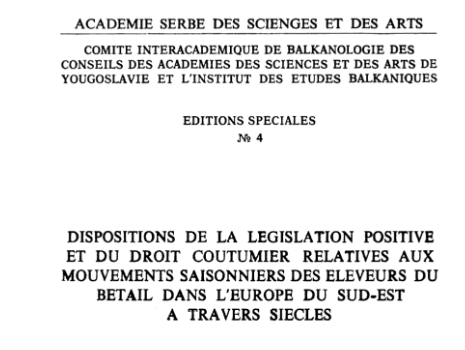

In the book titled “Odredbe pozitivnog zakonodavstva i običajnog prava o sezonskim kretanjima stočara u jugoistočnoj Evropi kroz vekove zbornik radova sa međunarodnog naučnog skupa održanog 6. i 7. novembra 1975. u Beogradu 1976” we can find an interesting passage on the history of the Albanians of Polimje, Grocka, Morava and Sumadija and the Albanian shepherd leader Kushtrim of the Vasojevic. The Serb author tries to slavicize and serbicize the Arnauts (Albanians) mentioned.
In the mountains between today’s Montenegro, Albania, and Serbia, communities of shepherds once moved their flocks across long distances — from the highlands of Gusinje and Polimlje to the lowlands of Morava and Šumadija.
In old documents and folk songs, these people were called “Arnauts” — the common Ottoman-era name for Albanians.
But when Serbian writers in the early 1900s began recording this history, they didn’t describe them as Albanians. Instead, they claimed the Arnauts were actually Serbs who just looked Albanian.
Writers like Tomaš Katanić, Tihomir R. Đorđević, and Andrija Jovićević argued that these shepherds only wore Albanian-style clothing or used Turkish-sounding names to make travel easier through Muslim areas. In their version, even if someone dressed, spoke, and lived like an Albanian, they were still “really” Serbian inside.
This way of writing wasn’t neutral. It was part of a bigger nationalist project — an attempt to erase Albanian identity from regions that had long been mixed and shared. By turning Albanian shepherds into “Serbs in disguise,” Serbian historians and ethnographers could claim that the land, culture, and history of the borderlands were always Serbian, even when local people identified differently.
A good example appears in Katanić’s 1940 article “Song About Kuštrim of Vasojevići.” The folk song he quotes mentions Kuštrim Čobambaša, meaning “Kuštrim, the chief shepherd.” The name Kuštrim comes from Albanian — it means a call to arms or a gathering cry. Yet Katanić presents it as a Serbian tribal name, erasing its Albanian roots.
Other authors repeated the same story. Đorđević, in “Cattle Journeys” (1914), and Jovićević, in “The Region of Plav and Gusinje” (1921), both described Arnaut shepherds traveling to Serbia for trade and pasture — but they too insisted that these were actually ethnic Serbs. The Albanian presence was reduced to a matter of clothing and habit.
By retelling the story this way, Serbian historiography turned a shared cultural space — where Albanians, Slavs, and Ottoman influences met — into a one-nation tale about Serbian endurance and expansion. It’s a clear case of colonial revisionism, where one group’s past is rewritten to fit another group’s national story.
The people once known as Arnauts were not Serbs pretending to be Albanian — they were Albanians living and moving across a borderless Balkan landscape, whose identity was later overwritten by nationalist history.
References
- Tomaš Katanić, Song About and Around the Kuštr of Vasojevići, Bulletin of the Ethnographic Museum, vol. XV, Belgrade, 1940, p. 149.
- Tihomir R. Đorđević, Cattle Journeys, Bulletin of the Serbian Geographical Society, nos. 3–4, Belgrade, 1914, pp. 44, 56.
- Andrija Jovićević, The Region of Plav and Gusinje, Settlements of Serbian Lands, vol. X, Belgrade, 1921, p. 398.
- State Archive of the People’s Republic of Serbia, Collection, vol. III, The Prince’s Office, vol. I, Požega District (1815–1839), letters nos. 90, 100, 124, 508.

 Balkan Academia