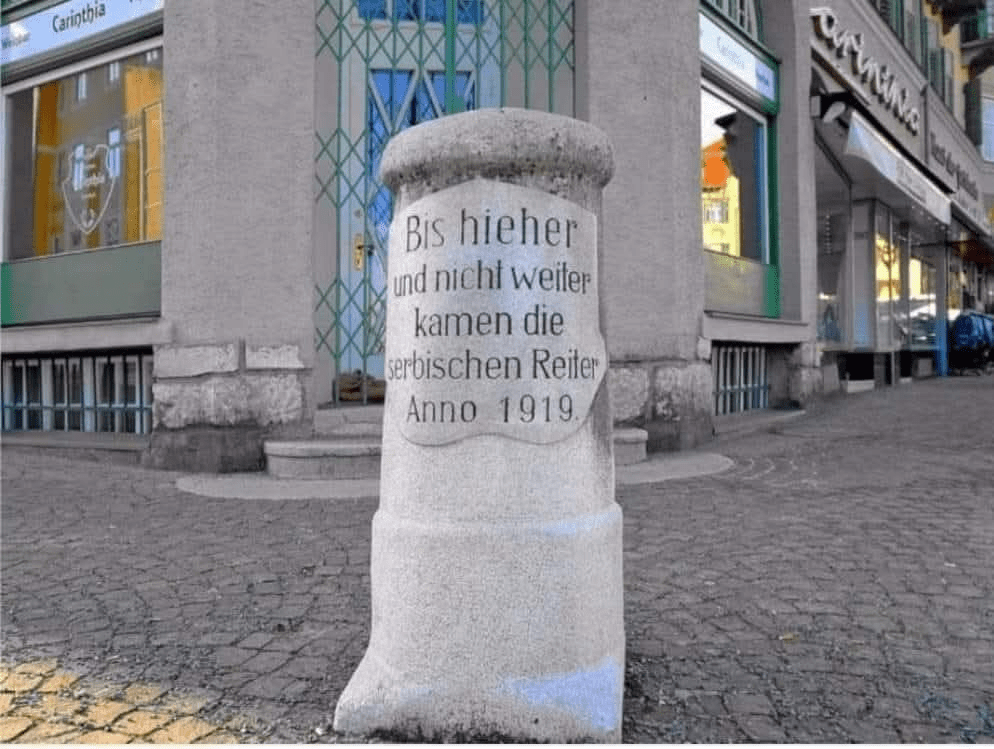

A monument in Vrba, Austrian Carinthia, with the ingraving: “The Serbian cavalry came this far and went no further, 1919”. This is a memorial dedicated to the Austrian troops who stopped by the Serbian invaders.
When the Habsburg Monarchy collapsed in 1918, there was a border dispute in Carinthia. Slovenian and Yugoslav forces entered the area where Slovenes lived, while German/Austrian forces wanted to maintain control. This led to armed clashes in 1918–1919.
Local German-Austrian authorities later erected memorials and inscriptions for having repelled the invading Yugoslav-Serb troops, part of the post-war national memory in Carinthia.
The Carinthian plebiscite of 1920
The formal border issue was later settled through negotiations and a referendum (the Carinthian plebiscite of 1920) in which large parts of Carinthia chose to belong to Austria. It is therefore not uncommon for villages to mark the “border” of enemy advance with a sculpture or text dated 1919.
References
Janko Pleterski (2008). Koroški plebiscit 1920. Ljubljana: Zveza zgodovinskih društev Slovenije.
“The defensive campaign in Carinthia and the plebiscite on 10 October 1920”. In: The Great War – Habsburger Net.
YU “THE QUESTION OF 200.000 YUGOSL.AVS IN AUSTRIA / THE SLOVENE CARINTHIA AND THE BURGENLAND CROATS”. Memorandum of the Government of the Federative People’s Republic of Yugoslavia, Beograd 1947. DPDF. Sistory
“The delayed fights in Carinthia at the start of 1919 … the failed Slovenian offensive in April 1919 … followed by Austrian counter-offensive”. Nyhetsmeddelande från den slovenska regeringen, “Retreat … south of the demarcation line which divided Carinthia”. (1 augusti 2019). Portal GOV.SI
“Slovene Carinthia: The Austro-Yugoslav Frontier Question”. JSTOR-artikel. jstor.org

 Balkan Academia