
by Professor Gjon Frani Ivezaj. Translation Pertrit Latifi
In early historical sources and archival documents where local and foreign historians and chroniclers or personalities of political and social life as researchers, Albanologists and writers, it is said that Gruda was a very important center of ancient Shkodra. Gruda as a tribe is mentioned since the beginning of the 14th century and has Illyrian origins, this has been confirmed and argued by Albanian and foreign historians and researchers.
In written sources we are acquainted with this tribe through the wine and writings of the great Italian missionary Father Domeniko Pazi (1847-1919) who speaks of the first of the tribe Vuksan Gel Gjon Gruda. According to him, the Gruda tribe came from the Basums of Postriba in Northern Albania (Shkodra), who in the 15th-16th centuries settled on the mountain of today’s Gruda, Kreshika, to write a glorious history through the muzzle of the rifle and to make a great name in the highlands and beyond.
The sons of Vuksan Gela worked and built their houses in the form of a tower with a frieze on the Gruda mountain. Thanks to his skills and wisdom, the prominent patriot Vuksan Gela of Gruda became the first of the country (province). Gruda as a tribe at the end of the 15th century was included in the Žablaku district and had 80 houses. Meanwhile, the name of the Gruda district itself was taken in 1485, while in 1497 it is not mentioned in the Ottoman registers as a district.
According to historical sources, the church of Gruda has a legendary history over the centuries. This is also confirmed by the words of the Archbishop of Tivar, Monsignor Vincenc Zmajevic, in the book The Assembly of Arber 1703, p. 35, published by the publishing house “Shpresa” Prishtina 2003.
He describes that in Dinosha e Gruda, in addition to the early urban buildings known as the qiyetza, there is the church of Saint Michael, whose foundations date back to the 5th century. Even the Italian researcher and Albanologist Ermanno Armao, based on an ancient map (of two 17th century cartographers, writes: “… We are dealing with the ancient church of the Gruda tribe dedicated to Saint Martin the Bishop, built by the Franciscan Fathers in 1646 and which was demolished, (translator’s note), in 1671 when Father Gaspari was passing by.”
The church, rebuilt later with a wonderful mastery, is located in a secluded place on the right bank of the Cemi River, in the village of Priften, the center of the Catholics of the tribe, 320 meters above sea level. Also, in a pastoral visit of the Bishop of Shkodra, Pal Kamsi in 1756, it is described that Gruda had 106 houses with 744 adult inhabitants, with 200 riflemen, 68 children confirmed that year, 17 females and 18 males, and 6 marriages.
While a life report on the missions of Shkodra dated August 13, 1758, written by the apostolic prefect, Father Michelangelo da Taranto, underlines the fact that in Gruda, the number of Catholics who marry, according to the rite of the holy church, has increased. All the Arber lands fell under the complete rule of the cruelty of the Ottomans and the soulless Slavs, who went through an unprecedented ordeal of inhuman crimes and massacres for centuries, trying to wipe out the Albanians, their language, their religion, their customs, and traditions, that is, to Slavize everything of pure Albanian identity.
Early historical sources show the letters of the great archbishop, Monsignor Pjetër Bogdani, dated August 28, 1670, where he describes the suffering and torture of the Catholic believers of the Highlands and Shkodra, in which he prays to the Holy Congregation to appoint two missionaries of the Reformed Fathers; one in Rrjoll and the other in Gruda.
Mali, Bajraku or the Tribe of Gruda, has been constantly in the attention of many foreign scholars and Albanologists, who see Gruda as one of the six church assemblies, which were part of the Apostolic Prefecture of Kastrati with 1500 Catholic inhabitants in 1850. For many decades, the church and parish of Gruda have been known under the name of the Illyrian saint Saint Martin.
In the history of the church, It is written that Saint Martin was born to Illyrian parents, where his father had been an officer in the Roman army, and at first Saint Martin himself had participated as a soldier (knight), but without delay he was dedicated to church rules and in the year 370 he was elected bishop of Tours in France. The sermons and contribution to the priestly and evangelical life of Saint Martin were so great in France that they had brought miracles, which were also recognized by the Christian church itself.
The French valued and believed in Saint Martin so much that when he left this earthly life on November 11, 397, they dedicated about 3600 parish churches to him, and 240 villages and cities were identified with his name. The French kings also recognized him as their Patron. At that time, the Franciscans from Grude performed religious services in Hot, Triesh, Koje and everywhere in Greater Malsi. From the year 1638 to in 1903.
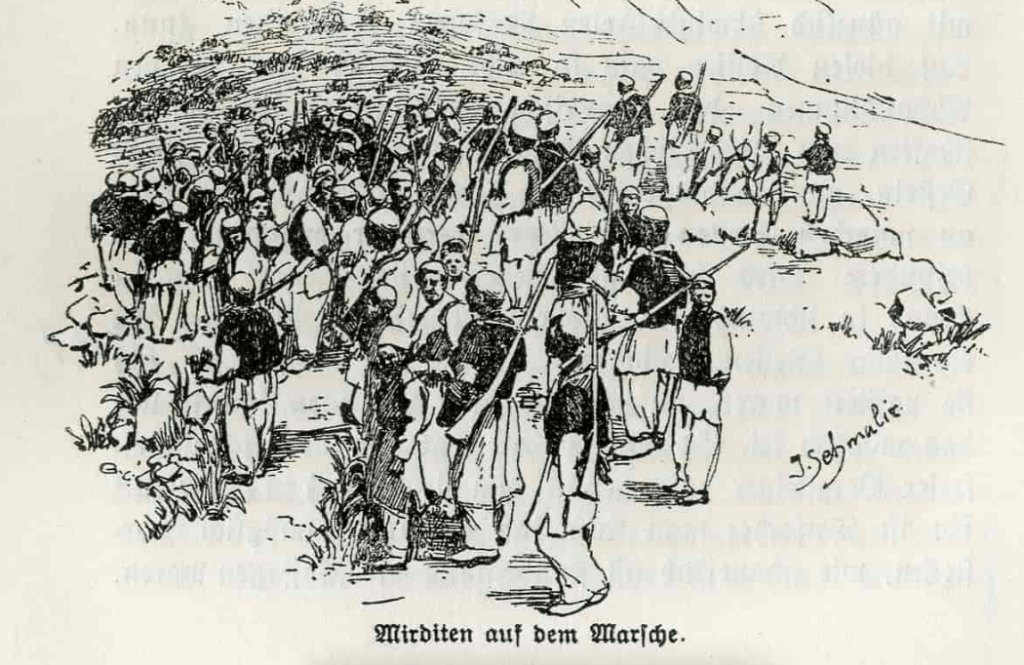
46 Croatian and Italian missionaries have served there. Since 1903 and today, mainly Albanian priests have served. It should be noted that during the historical upheavals In 1911, the church of Gruda was burned by the barbaric Slavic (Montenegrin) and Turkish army, which attacked Malësia, which with unparalleled heroism resisted with stoicism and weapons in hand, not submitting to the cruel invaders. According to Father Anton Harapi O.F.M., who makes a brilliant description of these lands, among other things he says: “With great heroism, the mountaineers of Gruda always guarded their God’s house and their lands.”
Gruda, in the midst of these stormy historical events, wars and efforts for freedom and independence, became the center of all fighters and resistance with weapons in their hands, always showing great heroism and dedication, and inherited ideals for the protection of the lands, religion and Homeland of their ancestors.
The mountaineers of Gruda, historically faced all the barbarian invasion attacks, such as the Turks, Slavs, etc., which aimed to conquer, subjugate and assimilate our ancestral lands over the centuries and historically it is known that the unforgettable brave men of Gruda were the patriots:
Vuksan Gela, Smajl Martini Ivezaj, Nike Martini Ivezaj, Dede Nika Ivezaj, Mat Hasani Ivezaj, Zef Martini Ivezaj, Zef Prel Marashi Ivezaj, Prel Marashi Ivezaj, Smak Deda Ivezaj, Kolë Zefi Ivezaj, Bacë Vuksan Ivezaj, Preç Vuksani Ivezaj, Vuksan Preçi Ivezaj, Sokol Baci Ivezaj, Tringe Smajlja Ivezaj, Mehmet Murati Gjokaj, Baca Kurti Gjokaj, Zef Miliqi Lulgjuraj, Gjeke Gjoni Sinishtaj, Ujkë Mati Ivezaj, Lucë Gjeloshi Lulgjuraj, Mark Gjeku Lulgjuraj, Kolë Marku Lulgjuraj, Maxha Grishi Bojaj, Mirash Luli Bojaj, Paloke Gjoka Vulaj, Ujke Dushi Kalaj, Tomë Kole Gjoni Sinishtaj, Pllum Gjeka Kalaj, Preke Gjon Ruka Ivezaj, Halil Haka Nikaj, Ali Zeku Pepaj, Marash Dashi Kalaj, Pretash Leci Sinishtaj, Selman Juku Dukaj, Nike Smaka Ivezaj, Pjeter Nika Ivezaj etc.,
Just as Gruda men of fame and fortune have visited all the mountains of Malesia, it is also worth mentioning Ule Marku with his son Prekë Uli, who left honor and pride in Gruda and our legendary Malesia. For the brave and fearless highlander Preke Uli Gjokaj, freedom and hospitality, according to the ancient Albanian tradition, were and are today the most precious things.
He and the generations after him continued to walk the path of the fatherland and patriotism of their predecessors. Our Malesia, over the centuries, has been distinguished by bright figures, who have made a good name in the entire region, where they lived and acted, writing glorious histories for the ethnic Albanian lands with weapons in hand.
Due to the successive wars, against the Serbs, Montenegrins and During the Ottoman Islamic Empire, many Christian mountaineers were forced to move from their centuries-old ancestral lands and settle in different places of residence, where there were only Albanians. Thus, Ule Marku Micakaj was forced by the Bekaj of Triesh in Malësia e Madhe to move and settle in Dinoshe i Grudes, in the gorge of Mount Tojeq.
Here, the noble and brave mountaineer Ule Marku found 20-30 mountaineer houses of the Islamic faith. According to the data, which have been transmitted from generation to generation, it is believed that Ule Marku came to Dinoshe around 1850. The Muslim mountaineer brothers of the area loved and always honored his fellow countryman of their village. There he found traditional Albanian warmth, hospitality and generosity. All mountaineers, regardless of religion, fought against the centuries-old Ottoman invaders and Serbo-Montenegrins, who sought to subjugate and defeat the Albanian people.
Ule Marku in Tojeq of Dinoshe found a Catholic family from the Lucaj tribe from the village of Delaj (Triesh) with the name Gjoke, which was later forcibly Islamized by the Turkish invaders. Today they are called the family of Jusuf Gjoka. Many years later they moved to the inhabited areas of Tojeq, Dinoshe, also from Luhari came a Catholic family with the surname Puraj, which was also forcibly Islamized by the Turks.
In this way, a family from the Dukaj tribe of Triesh also came, which was also Islamized. From this family today was the house of Selman Jaku (Dukaj). The same path was followed by a family from the Lulgjuraj tribe of Gruda, who were also Islamized, like the others before. So, as can be seen, these families change only their names and never the surnames, thus preserving the continuity of the Christian roots of their families.
The tower of Ulë Marku has been well-known for centuries for its wisdom, hospitality, faith, and patriotism. The brave men of the tower have always been at the forefront of the struggles for freedom and independence of the Albanian ethnic lands.
In a new Albanian environment, Ulë Marku began to work and live without pay, among his Albanian Muslim brothers. After a few years, he married and started his own family. There, Ulë Marku had two sons and several daughters. The first son, Gjoni, was born in 1858, while the second son, Preke Uli, was born in 1860. Throughout the Great Highlands, this young family among the Albanians of The good was always honored and respected and deserved.
They fought generation after generation with rifle in hand against the invading invaders, who from time to time touched the Albanian lands. Ulê Marku, 21 years old, was a brave young man as brave as a fairy, and took part in the anti-Ottoman uprising and against the predatory intentions of the Montenegrins. He was a tireless worker, where with his golden hands he built a two-story stone tower with a battlement, which resembled a military fortress of the time, to protect himself from the Ottoman and Serbian-Montenegrin invaders.
Uli, was a handsome man, tall as the oaks of our mountains, intelligent by nature, wise and prudent in conversations with the mountaineers, taciturn, a trustworthy man, brave as a fairy, generous in spirit and heart, and as always a door known for Albanian hospitality, etc.
He participated in many freedom-loving wars that Malesia waged over the centuries, such as in the wars of Dinosha, Shkodra, Gruda, etc., when at that time Gruda was led by legendary braves such as the famous brave Smail Martini of Gruda.
In the years 1880-1881, Ule Marku had joined other mountaineer braves and had come to the forefront of the war of Dinosha and Gruda against the Serbian-Montenegrin army. There, for hours, a bloody war took place, where many soldiers and military weapons were lost. The leader and chieftain of the Kreshnik mountaineers was the legendary brave Smajl Martini Ivezaj.
The war lasted until evening. Smajl Martini with the sons of Gruda put the Montenegrin soldiers to flight. In the late evening hours, the Bannerman of Gruda, Smajl Martini, ordered the warriors of Gruda to all unite, taking with them the dead and the seriously wounded, to send them to the church of Saint Michael in Dinoshe. In that bloody war, the brave mountaineer Ule Marku was buried in the place called Stigje, where the war was taking place.
He had been hit by an enemy bullet, which had broken his leg. Ule Marku was very tired. He was crawling from his bloody wounds. Halfway through the road, he stopped to rest because he could not move any further. Ule Marku had been bleeding profusely for the whole hour. He stopped near a rock with a rifle in his hand.
The army of mountain warriors of Gruda, retreating down there, finds the brave soldier Ule Marku very seriously wounded, who is losing blood from a serious wound. The brave Murat Mehu Gjokaj from Milesh approaches him. Murat, since it is dark, asks him what he is doing here. He replies that I am wounded (buried), my rifle has fallen and broken my leg and I cannot move.
The brave Ule Marku says to Murat Mehu: “Go to your friends, because I have a rifle and plenty of cartridges. If the skirmishes return, I will pay for it myself.” The brave Murat Mehu of the Gjokajs of Milesh, came from a large gate well-known throughout the mountainous region for its rifles and hospitality. Murat, seeing the serious condition of his comrade Ule Marku, who was continuing to lose a lot of blood, tells him that he cannot leave and that he wants to stay here with you.
He takes his seriously wounded comrade in his arms and, rifle in hand, slowly and slowly leads him to his house. The warrior and brave as a fairy Murat Mehu, immediately turns around and goes to the church of Saint Michael, where the army of the highlanders, the wounded and the killed had gathered. He tells them about the serious injury of the brave Ule Marku.
The bannerman of Gruda, Smajl Martini, immediately gets up and thanks from the heart the buried brave Ule Marku and the manhood and bravery of Murat Mehu. Early in the morning, the bajraktari Smajl Martini, together with the brave warrior Murat Mehu and 12 other warriors of Gruda, immediately goes to the tower of the brave warrior Ule Marku.
The bajraktari of Gruda, during the meeting, congratulates Uli, for his bravery in war and the blood shed for Albanian lands and freedom, and wishes him a long life and a speedy recovery. From historical sources, we learn that from this door his famous son Preke Uli was also born, who has always shown unparalleled heroism for the national cause. Preke, participated in the wars with the highlanders and the Malesi, against the centuries-old enemies of the Serbs and Montenegrins and the Asian Turkish army, for freedom and independence and the existence of the Albanian ethnic lands.
His word spreads everywhere in the Albanian ethnic lands up to Kosovo. By researching more carefully about this important figure of Albanian history, we learn that for Preke Uli from Dinosha, we were able to find interesting articles, where among others the reconciler of blood, the symbol of peace and goodness among Albanians Prof. Anton Çeta wrote, where he among other things evaluates: “Preke Uli was. a symbol of brotherly coexistence between Catholics and Muslims of Gruda.
In order not to destroy the village, he risks his life from Montenegrin soldiers, who one day, when they find Preke herding sheep together with the shepherdess Bibe Keqja, say to him: “Where are you from?” And Preke answers from Dinosha. The Montenegrins ask him if he is a Muslim or Catholic!? I am Catholic, Preka says.
The soldiers really wanted this and told him if he is Catholic, make a cross! Prekë Uli says: “You don’t need this, make me make a cross!” They (Montenegrins) say again: “Either make a cross or we will kill you, since you have not told us the truth, because maybe you are not Catholic!” And the three soldiers return the rifle to him. The villager Bibe Keqja says to him: Make a cross or we will kill you, because you make a cross several times a day. But he says let them kill me. I do not make a cross so that they do not say that we made a Muslim make a cross (since in Dinosha there are mostly Muslims, with the exception of a few Catholic houses).
The three Montenegrin soldiers saw that they could not force this guy to make a cross, so they lowered their weapons and left.” (Anton Cetta, “Nga folklori yne”, Volumi III, Prishtina, 1995, p. 151- 152). Prekë Uli was a member of the uprising of the red and black flag, in Malësia on April 6, 1911 at the Deçiqi fortress. The tower of Prekë Uli was burned twice in 1918 and 1921 by the Montenegrin army, because it was a legendary tower with brave warriors. At the time of the formation of the federal state of Yugoslavia, the Albanian people’s houses were burned, innocent people were rounded up, people were killed without any fault. Prekë Uli kept the surname Micakaj until 1921 in Tojeq in Dinosha. Thus, on March 12, 1921, due to the severe tortures that the Montenegrin army inflicted on the Albanian people, those houses that had come from other areas and a meeting was held to unite all 6 or 7 houses and form a tribe, which later began to be called Gjokaj, after Gjoka, who had first arrived in these areas in Tojeq of Dinosha. Thus was created the new Gjokaj tribe, which today, like Muslim and Catholic Albanians, keep this surname with respect. This was done to catch the eye of the enemies, because they are a large tribe, etc. Preke Uli, throughout his life has shown heroism, honor and respect, honoring and respecting all of Malesia, remaining in the annals of our national history. The door of Preke Uli Gjokaj, has been historically known by the inhabitants of the city, as people of the rifle, honor, loyalty, bravery, the chamber of men’s assemblies, the lute and the çiftelisi, in which the glorious stories of Hoti and Gruda, in the war against the centuries-old Turkish invaders. The well-known patriot and warrior Preke Uli Gjokaj, was a strong and vocal voice throughout the region in question. He was also distinguished by his generosity and hospitality towards various local and foreign friends and passers-by. There they immediately found traditional mountain warmth and generosity, trust and generosity, help and rapid integration into the new environment, where these new friends of Gruda settled. With the invasion of our lands in 1571, according to historical chronicles, almost all the tribes (breznites) of Northern Malissia, made movements (migrations), through many places during the time, when the northern city of Shkodra was going through bitter moments from the attacks of foreigners. Albanians and especially the mountaineers of Gruda, always hold the rifle in defense of their ancestral lands, being a serious obstacle to the Turkish invaders. Often their families were increased by sons, which according to the concept of the mountaineers meant at that time that they had a rifle with them, to face the Ottoman invaders, who in the mountains always found the fiercest resistance with weapons in hand, dissatisfaction and a high sense of resistance and non-submission to the foreign yoke. Over the centuries, for the mountaineers, freedom was always the most precious thing.
The pride of the mountaineers survived over the centuries. This gratitude was always recognized with nobility by the first leader of Gruda, Vuksan Gela, with his four sons.
The great patriotism shown with concrete examples by Vuksan Gela of Gruda and the brave Sokols of other tribes, was expressed in the resolute defense that they made of the homeland and the religion of their ancestors, over the centuries, in such a way that our churches Albanians should not turn into minarets of Turkish mosques.
From the Micakaj (Triesh) gate, today Gjokaj and Tojeqit (Gruda), over the centuries, men with a voice in the entire outer region have emerged, who have traditionally been distinguished for the early Albanian virtues, such as: faith, bravery, patriotism, meticulous implementation of the canon, wisdom, the men’s ode, warm hospitality and generosity, for all friends and simple passers-by, who have stayed in this noble tower full of honest and generous people.
The brave and noble mountaineers Ule Marku, and Preke Uli, were and remain great figures of the Albanian nation, who, all their lives, fought with weapons in hand in defense of the Albanian ethnic lands.
Ule Marku, joined the distinguished patriots, who at that time summered in the ancient city of Shkodra and The lands of the Great Highlands. Ule Marku enjoyed respect in all the places he went, because he had faith, manliness, bravery, generosity, and kindness.
i, was a man of his word, honor, respected the canon of our mountains, was a wise and very wise man in solving the problems of his territory, fought tirelessly for the awareness of the mountaineers for freedom and independence against the Sublime Porte of the Ottoman Islamic Empire.
The bloodshed was and remained a wound, which helped the Turkish invader to live longer in our lands, because the mountaineers and many Albanian regions in general, instead of fighting the Turks, had turned the muzzles of their weapons against their homes in hostility. Ulë Marku, was a contemporary of the legendary brave Smajl Martin, who was the Bajraktari of Gruda, of Çun Mula of Hoti, Pec Petani of Shkreli and the Bad Turk of Kelmendi, etc.
He, with his weapon drawn, participated in the bloodiest wars of the Albanian people, in the one-sided uprisings that took place in Malesia, such as: the Spushi War, against the cruel Turkish camps, he distinguished himself as a true lion in the Battle of Deçiqi in 1890, in the War of Plavë and Gucise, etc. The famous house of Preke Uli Gjokaj of Tojeqit (Triesh), Gruda produced men of fame, voice and faith, honor, word, brave and fierce, who with personal example write the history of the region through the flame and gunpowder of their rifles, being always the honor and eternal pride for Malesia and the ethnic Albanian lands.
Reference
https://gazetadielli.com/preke-uli-gjokaj-nje-jete-ne-sherbim-te-atdheut/


 Balkan Academia