
by Artur Vrekaj. Translation Petrit Latifi. 03.02.2014. 09.28 am.

The continuity of the Pelasgian-Illyrian-Albanian resistance is clearly visible with these religious and administrative organizations: the Oracle and temple of Dodona, the Hittite empire, the kingdom of Troy, the empire of the Brigians (Phrygians), the united Illyrian kingdom, the Epirote League, the Assembly of Lezha, the League of Prizren and the Assembly of Vlora.
The Albanian resistance as a people and as a nation has taken on more meaning with the worship of the double-headed eagle several thousand years before Christ, because Zeus was also the worshipped god of the Pelasgian-Illyrian line. “Zeus chose the eagle as the king of birds, which has always been an excellent symbol of imperial power and authority everywhere.”1)
The eagle symbol also implied Zeus himself as a divine symbol. It was used in the temple of Dodona, which was also the first religious center of Pelasgia, where the heroes of Pelasgia who fought in Troy were honored, such as: Achilles, Odysseus, Agamemnon, Orestes, etc.
Later, Scamander (Hellen), the Trojan prince who founded the city of Buthrotum (Butrint) or the Troy of Albania, came to Dodona. The specification as “Pellagian Dodona” was first made by Homer in the Iliad. Since ancient times, peace has been a sign of pure faith among the Pelasgian peoples, so the Pelasgian time was a time of peace.
“Perhaps it is a complaint of the surviving Pelasgians that this was a “golden time” for them until the Greeks came on the scene. The national oracle of the Pelasgians with the oaks of Dodona in Epirus has preserved their prestige in Greek times. From the persistent features of tombs and architecture in Illyria and Albania, in recent years, the suggestion has been made that the Albanians are the surviving Pelasgians.” 2)
From Pelasgian times to the present day we have been martyred as a people and as a nation by the most powerful empires. Unbending as on a battlefield on our native soil we never lost either the spoken and written Pelasgian-Illyrian-Albanian language or the symbol of the double-headed eagle.
The worship of this motif and divine bird also inspired the Pelasgian and Illyrian kings who were identified with God and respected by the people as Zeus. The double-headed eagle was the most preferred symbol as a royal insignia for the Hittite kings, the Illyrian kings of Troy or especially in Illyricum of Alexander the Great, Alexander of Molossia and Pyrrhus of Epirus, as well as Skanderbeg in Albania where Albania in his time was also known as Epirus.
The double-headed eagle first appears in Hittite reliefs in Mesopotamia.3)
The repeated source of motifs in Egyptian, Mesopotamian and Minoan art certainly did not originate from these civilizations. The Hittites were the source of motifs from the capitals at Kadesh and Carchemish; Western Asia and the Aegean, which were controlled by them. The double-headed eagle presents the idea of supernatural control. The two heads indicate the ability to gather all the experience of the past and to foresee the best future in a bright vision. 4)
The Hittites, for almost a thousand years in a row together with other Pelasgian and Illyrian allies managed to maintain military balances with the greatest powers of the time: the Egyptians, Babylonians and Assyrians. That is why the Dardanian kingdom with Troy and the reign of the Brigians in Anatolia shone more.
What do studies say about the use of the double-headed eagle by the Hittites based on archaeological findings?
The Hittites used the extraordinary motif of the double-headed eagle.5)
This is the third century that objects of historical value for humanity have come to light when it comes to the Hittite civilization. These archaeological findings have also made the Old Bible, which refers to the Hittites, more reliable.
In 1906-1907, the German archaeologist Hugo Winckler discovered thousands of clay tablets written in Bogazkoy (Turkey), identifying the capital of the Hittites. Furthermore, he discovered that the Hittites were a great civilization ruling from approximately 1900-1200 BC and extending from Asia Minor to the Tigris and Euphrates rivers. The Bible was true in its statements about the Hittite civilization.6)
Cesare de Cara has published a scholarly work entitled “Gli Hethei-Pelasgi”, which contributes to the proposal of a new theory of Hittite origin. His statement is that the Hittites and Pelasgians, the ancient inhabitants of the Greek lands, were one and the same people.
He finds in the Hittite civilization and in the culture of Asia Minor the fountainhead of the civilization of the Greco-Latin races of Southern Europe and together as classical nations of antiquity, Greece and Rome built a foundation according to the origin of Semitic and Asiatic culture and this civilization of these two nations of antiquity was not their original, but was borrowed from the East, not yet directly, but through the Pelasgian Middle, through the original inhabitants of the countries of Southern Europe who had come by past the Dardanelles.
This enigmatic race of antiquity (the Hittites), whose existence has been demonstrated to the satisfaction of historians only by the evidence that it gives us in recent times (according to this edition of 1896, my note AV) from what archaeologists have observed and studied, now becomes a major factor in the civilization of the ancient world, since the Hittites and the Pelasgians are declared to be of the same identity, the same. The origin of the Hittite civilization dates back to the second millennium before the birth of Christ and was transplanted to Europe in prehistoric times.7)
Below this line of thought as above is connected with the attention of the archaeologist Salomon Reinach even before the publication of the theory of Cesare de Cara, only that Reinach had constructed the order of development and did not derive the Pelasgians from the Hittites, but the Hittites from the Pelasgians.
He saw the migration of these Pelasgian peoples not from East to West, but from West to East. Even the enthusiastic professor of the Orient Sauce, head of the English Oxford scholars on the Hittite problem, with the study “The Academi” declared himself to favor the theory of Cesare de Cara.8)
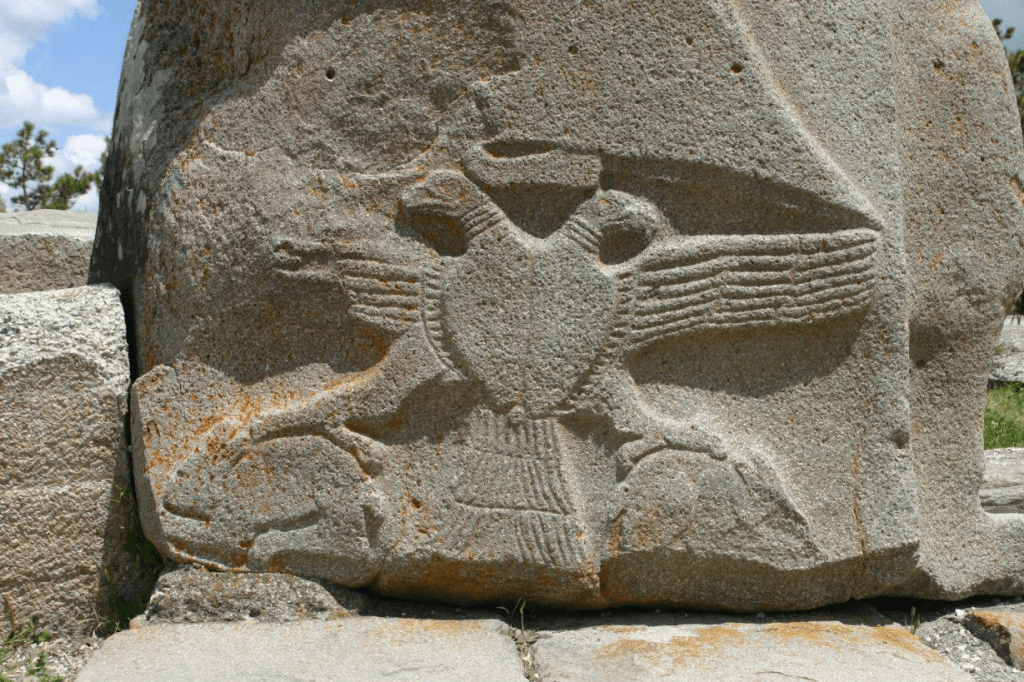
The double-headed eagle was widely used by the Hittites as a royal emblem. It is clearly seen on the usual round or cylindrical seals, made of precious metals according to the imperial rank: gold, silver or bronze, in reliefs or carved in stone, in temples, etc.
Also, the double-headed eagle was used by the Hittites as an expression of worship for the god and his protection because of the flight of this bird over the highest peaks of the mountains, as a bird that presupposes and inspires freedom. This is clearly seen in a royal seal from the Hittite Empire from 1400 BC, where the head of a double-headed eagle is placed on a human body.
In the catalogue of the Ashmolean Collection, in the British Museum, which compiles objects found before 1894 in ancient tombs by the inhabitants of the Sajur Valley of modern-day Turkey, there is also a seal with the number 192 with a picture of a double-headed eagle, purchased in Izmir. The object with the number 193, which is also a seal, also shows an eagle reflected on the left wing.
The origin of seals 192 and 193 deserves to be assessed. Both are from Asia Minor and possibly originating from Cappadocia. Since the double-headed eagle appears at Eyuk and Yasili Kaia and on no known Syrian monument, it is possible that such an eagle depicted with one or two heads is sufficient to prove the Hittite origin of the seal. 9)
A relief at Bogaz Koy (a former Hittite capital), in Asia Minor, shows two attendants of an ancient chief god standing with a double-headed eagle. 10)
One face of a stone block (on the forehead which is carved as a huge bird) at Eyuk appears to be a cut-out of a figure of a double-headed eagle. 11)
On the two inner sides of the southern part of the Sphinx Gate at the Hittite settlement (Ankuwa) of Alaca Hoyuk … are created forms of the Great King and the Queen, where they have a double-headed eagle, the emblem of Hittite power.12)
The seals of the Old and New Hittites found at Alaca Hoyuk, Kultepe and Bogazkoy depict both single-headed and double-headed eagles. This is also reflected in the study of Nimet Ozguç “Two Hittite Seal”, Atribus Asiae , 10, no. 3, 1947. 13)
These are some of the archaeological findings that express the diversity of the use of the double-headed eagle motif as a symbol of the Hittites’ land, divine and administrative, also reflected in their art. The unbroken Pelasgian-Illyrian line, in our case Hittite-Dardanian, Hittite-Brigje is also the path of the inheritance of this symbol to this day by the Albanians. Let us not forget that the Hittites called their homeland “the land of Hati” as we say today “the Albanian lands”.
Finally, the worship and flourishing of the symbol of the double-headed eagle by the Pelasgian Hittites and the continuity of being our national and state symbol is a source of pride for all Albanians wherever they are, because we see the double-headed eagle on the national flag as a unifying symbol of the nation.
References
1) Birdscapes: Birds in Our Imagination and Experience, Jeremy Mynott, page 273
2) New Light On The Old Testament, Second Edition, Allen Howard Godbay
1935, page 87
3) The Mythical Zoo: An Encyclopedia of Animals in World Myth, Legend, and literature, Boria Sax, page 102
4) The Encyclopedia Americana: A Library of Universal Knowledge, Volume 2, 1918, page 178
5) Lost Cities of Atlantis, Ancient Europe & the Mediterranean, David Hatcher Childress, page 58
6) Approaching God: Daily Reflections for Growing Christians, Paul Enns, page 13
7) The American Journal of Archeology and the history of the fine arts, vol XI, v. 1896, page 410
8) ibid 411
9) Hittite seals: with particular reference to the Ashmolean collection, David George Hogarth, v. 1920, page 73
10) The Numismatic Chronicle and Journal of the Royal Numismatic Society, Vol 13-14,faqe 384
11)po aty faqe 385
12)The Hutchinson Dictionary of Ancient & Medieval Warfare
Matthew Bennett, Chapter 8
13) Material Matters: Archaeology, Numismatics, and Religion in Early Historic Punjab, Daniel Merton Michon, faqe 137
Original article
https://www.voal-online.ch/index.php?mod=article&cat=INTERVIST%C3%8BPRESS&article=42171


 Balkan Academia