

by Shefqet Cakiqi-Llapashtica. Translation Petrit Latifi
In 1805, a publication with maps of Kotor and Dalmatia was published titled “Cattaro Haupstadt Albaniens”. It shows the fortress of Kotor (Cattaro). The publication was written by Maximilian de Traux (1765-1817) and published in 1805. De Traux was a Colonel of the Austrian army and personally visited these areas in 1803.
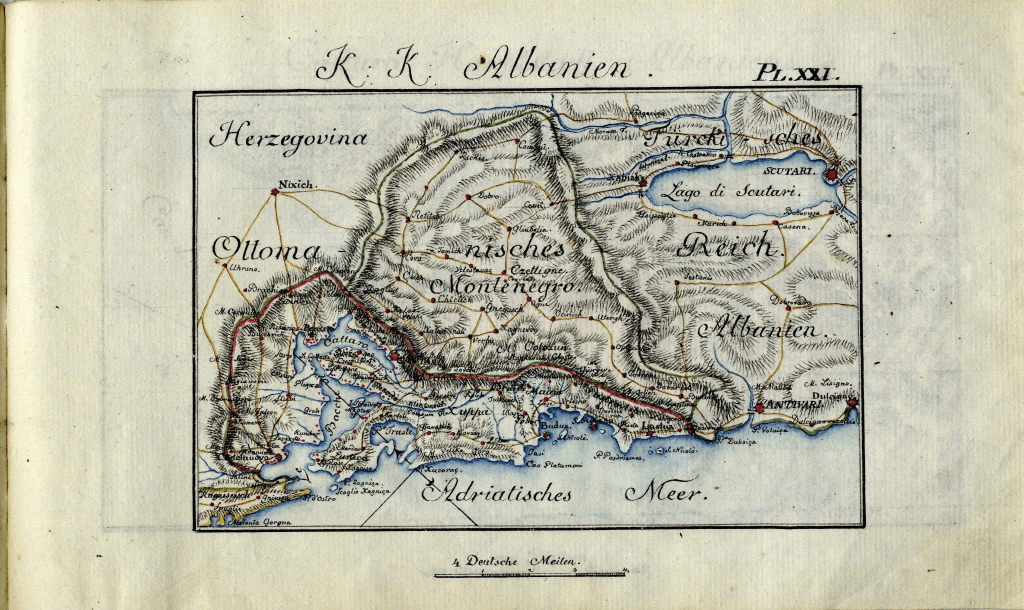
“It is the only fortified city in all of Albania, as well as the capital of the country and the seat of government. On one side it is located near the sea, namely on the shore of the channel or bay of Kotor. The other part is located on a bare rock that emerges from Mount Sella or Stela, which is inaccessible from all sides.
Its fortification consists of a wall built on the edge of this rock, which follows its natural shape and forms several corners and defensive terraces. At the very top is a very narrow castle; in general it can be said that it is in a bad condition, because even there the Venetians, out of the greatest carelessness, have done nothing to repair it for a very long time, so that some rocks and walls are covered with moss and dust, etc.
Despite its constructional defects, it enjoys extraordinary advantages due to its natural position. Because of the bare Mount Sella that dominates it from above, it is extremely difficult to get any artillery up there, and even if this were possible with great effort, one would have to approach from afar without cover and then scale the steep rocky wall.
The front of Fiumera is dominated by a height called “degli Orti”; but as the batteries of the mountain fortification control this height, and as the terrain is rocky and without ditches, there are almost insurmountable obstacles there too. And if the terrain in front of them is rocky and unsuitable for trenches, then there are almost insurmountable obstacles there too.”
“…almost insurmountable obstacles exist there too; the same is true of the front opposite the Gordichio Gate. It cannot be attacked from the sea, and in 1538, during a truce, the famous Barbarossa came with a large fleet before him, threatened it, but a few cannon shots immediately forced it to retreat.
None of the military buildings, except for two gunpowder stores, are unprotected against bombardment; two casemates can accommodate up to 500 men, but in general the city is very difficult to bombard. It has about 2,000 inhabitants. With 2,000 soldiers the city would have a sufficient garrison; fewer people would not be suitable because of the size and importance of the place.
To undertake an attack from the sea, it is necessary first to occupy the entire surrounding country, then to attack from the land. But to surround it is impossible because of the very bad roads, which make the transportation of artillery completely unsuitable. Therefore, it can be said that the city is inaccessible only because of its position. In the event of an attack from our side, it would serve only as a warehouse.
In 1378, when the famous Venetian Victor Pisani returned from Zara (Zadar) with his fleet, he thought that, in order to ensure a safe retreat in any case, he should also take possession of Kotor (Cattaro). Therefore, he appeared with his fleet before him…”
“Kotor, which at that time belonged to the King of Hungary, was demanded to surrender; the garrison refused to surrender. Therefore, Pisani attacked the city, took it by storm, and the garrison retreated to the castle. Pisani, who did not want to waste time making defensive preparations, attacked the castle himself three times in a row, finally took it by storm and plundered the city.
It should, however, be noted here that at that time the fortifications did not yet have cannons, since it was only in 1376, that is, only two years earlier, during the siege of Quero in Treviso, that cannons were first used, which in their beginnings were still very imperfect and fired stones instead of iron cores. The fortification was also not as durable then as it is today, since bastions were invented much later.
Today, such a fortress would certainly not be so easily taken, and as has already been said, this truth was confirmed already in 1538, to the great detriment of the one who had become so famous for the great harm to Christians – the Turk called Admiral Barbarossa.
In 1563, almost the whole of Kotor was destroyed by an earthquake. Two-thirds of the inhabitants lost their lives. The walls of the citadel and its other parts were badly damaged. It was then rebuilt and was better fortified, because the Venetians considered it a very important, though lonely, outpost on the border.”
“In 1570, a Turkish fleet under the command of Admiral Pertev entered the Kotor Channel without hindrance, demanded the surrender of the fortress, but in response received a few cannon shots; then he withdrew without achieving anything. The following year, when the plague hit Venice and the Venetians were busy defending the island of Cyprus, the Turks besieged Kotor from the land side.
The Venetian Admiral Soranzo, however, came with 25 galleys to Ulcinj, stormed a Turkish fort at the entrance to the channel, blew it up, then sailed to Kotor and strengthened and supplied the garrison to such an extent that the Turks were forced to lift the siege.
In 1667, Kotor was again struck by such earthquakes that half of the inhabitants were buried under the rubble of their houses. The defensive works of the castle also suffered great damage. Also, in 1687, the Pasha of Shkodra besieged the city for two months with more than 21,000 men.
Through extremely cruel treatment of the Montenegrins, they managed to bring the cannons there, set up batteries near Spigliare and caused part of the castle walls to collapse. But, since the sea side was open, the siege was broken by a Venetian fleet.
Kotor was built in the 6th century, for a long time it was an independent republic, then it belonged to the kings of Hungary, and from 1420 onwards, always to the Venetians.”

Evlia Celebi visits Kotor in 1664
139 years before Maximilian de Traux, in 1664 Kotor was also visited and described by the Ottoman chronicler Evlia Celebi (1611- 1682) in his “Travelogues of Evliya Çelebi – Journey from Bileca to Kotor and Perast 1664” writes:
“On the shore of the Bay of Novski, on a road it is described in the form of a Castle with many hills that dominate the city. The area of this city is made up of territories ten konaks of travel (ten days of travel) so that it is surrounded on both sides by the Adriatic Sea.
On the western side is the Bay of Novski.
The space between the two bays is ten paces, thus representing a very large cape that forms mountainous and rocky mountains, high and barren like the Cape of Manya in More.
Half of these mountains are called Montenegro and the other half the Kelmendi Mountains. In those mountains live forty-seven thousand armed and brave Arnauts (Albanians), who previously belonged to the Sanjak of Shkodra.
Since the Cretan war they have been subject to the Venetians. They offer assistance to the city of Candia. On a cape of Kelmendi there are seven (7) castles and all have been submitted (united) to the Venetians, so that the Venetians have the captain while the soldiers are the Arnauts (Albanians). In those mountains there are other interesting discoveries. Rising from Podgorica and heading south, carefully through rocky places, ready and armed, we reached the city of Budva.”

Reference
Maximilian (Max) de Traux, (1765 – 1817.) Colonel, military writer and cartographer. FESTUNGEN DALMATIENS UND ALBANIENS NEBST VERLIEGENDEN INSELN, UND BESCHREIBUNG – ZADAR 1805″ (FORTS IN DALMATIA AND ALBANIA TOGETHER, ISLANDS AND CURRENT DESCRIPTION – ZADAR 1805).

 Balkan Academia