
Authored by Petrit Latifi, November 4, 2025.
Abstract: A Spanish-language report dated 1776 records a letter from Mustafa, son of the late Pasha Mahmud (Bushati) of Scutari, addressed to the Ottoman Sultan. In it, Mustafa declares: “Los Albaneses me estiman mucho y respetan tanto la memoria de mi padre que desean no ser gobernados por otros que por su hijo.”
This passage, meaning “The Albanians hold me in great esteem and so respect my father’s memory that they wish to be ruled by none but his son,” is one of the earliest known instances in which the ethnonym Albanians (Albaneses) is used in a political and ethnic sense. This in comparison “Arnaut“. The document gives us insight into the Albanian self-designation in 18th century Ottoman Empire.
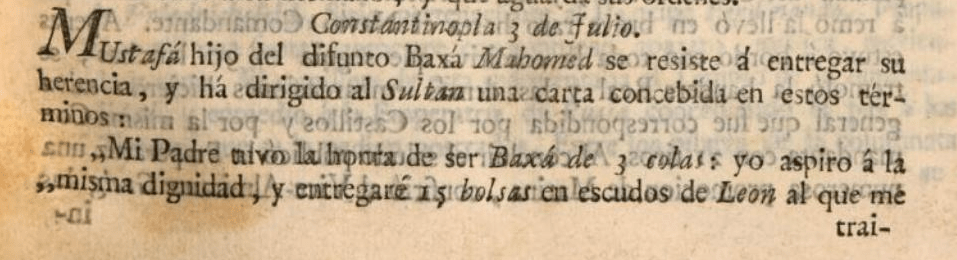

The 1776 Letter
A Spanish diplomatic summary, likely transmitted from the Adriatic port of Ancona or Zara (Zadar), includes Mustafa’s appeal to the Sultan:
“Mi Padre aivo la fronta de ser Baxá de 3 colas, yo aspiro á la misma dignidad… Los Albaneses me estiman mucho y respetan tanto la memoria de mi padre que desean no ser gobernados por otros que por su hijo…”
Translated:
“My father attained the honor of being a pasha of three tails; I aspire to the same dignity… The Albanians hold me in high esteem and, respecting my father’s memory, wish to be governed by none other than his son.”
The letter combines filial loyalty, Ottoman rhetoric of obedience, and an explicit appeal to ethnic legitimacy. Mustafa presents himself not merely as a provincial official but as the chosen ruler of the Albanians.
The Ethnonym “Albanians” vs. “Arnauts”
In most 17th- and 18th-century Ottoman and Venetian documents, Albanians appear under the exonym Arnaut (from Turkish Arnavut), a term designating Albanian soldiers serving in Ottoman armies across the Balkans. By contrast, the 1776 document employs the Romance-language ethnonym “Albaneses,” directly derived from Albania, implying an identity tied to an Albanian culture.
This is significant because It demonstrates that European observers recognized “the Albanians” as a people, not only as Ottoman troops. The text shows that Albanians shared a sentiment (“they wish to be governed by none but his son”) — a type of national loyalty. It shows that the Bushati family desired to represent the local Albanian population vis-à-vis the central Ottoman power.
Politics
Mustafa’s letter was written amid a delicate balance between provincial autonomy and imperial loyalty. His invocation of the Albanians served a dual purpose:
- To reassure the Sultan that he could govern effectively thanks to local support.
- To assert local sovereignty, portraying himself as the natural leader of a distinct people who would resist outside interference.
The phrase “Los Albaneses me estiman mucho” thus marks a moment when ethnic and political self-identification began to intersect — a precursor to the later Albanian national awakening (Rilindja) of the 19th century.
Linguistic and historiographical significance
The 1776 text challenges the assumption that the ethnonym Arnaut dominated all pre-modern references to Albanians. In diplomatic Spanish, Italian, and French sources of the late 18th century, Albanais / Albanesi / Albaneses already appears as a distinct ethnic term.
This letter provides documentary evidence that by the 1770s, “Albanians” could denote a people with political coherence and local identity — at least in the perception of both local elites and European observers.
Conclusion
The Bushati correspondence of 1776 reveals an early articulation of “Albanian” identity within Ottoman provincial politics. Mustafa Bushati’s appeal to the Sultan, grounded in the esteem of “the Albanians”, is not merely rhetorical flattery. It marks the intersection of dynastic ambition, provincial autonomy, and emerging ethnic consciousness. In this sense, the phrase “Los Albaneses me estiman mucho” stands as a rare 18th-century testament to how the term Albanian evolved from an external label into an expression of internal legitimacy and proto-national solidarity.
Bibliographic Note
Primary source: Spanish diplomatic correspondence (prob. Archivo General de Simancas, Estado, ca. 1776).
Secondary references:
- Frashëri, Kristo. The History of Albania: A Brief Survey. Tirana, 1964.
- Gawrych, George. The Crescent and the Eagle: Ottoman Rule, Islam and the Albanians, 1874–1913. London, 2006.
- Valentini, Giuseppe. Acta Albaniae Veneta. Vatican City, 1956–1971.
- Core.ac.uk (Dissertation): Between Rebellion and Obedience: The Rise and Fall of Bushatli Mahmud Pasha of Shkodra (1752-1796).
Authored by Petrit Latifi. November 4, 2025.

 Balkan Academia