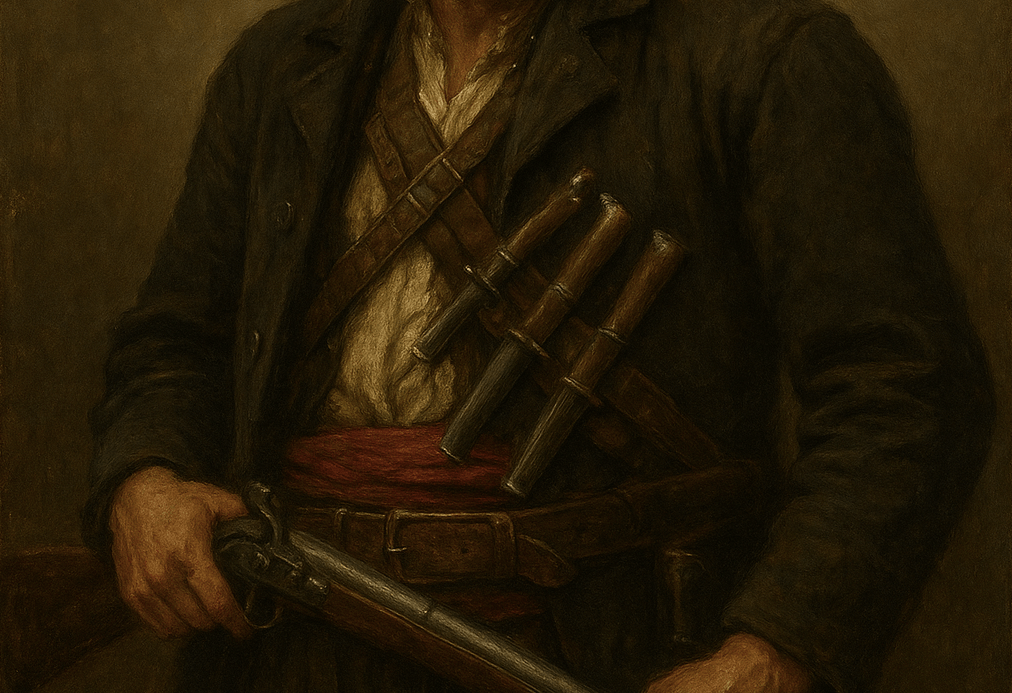

In the 19th century various European newspapers published various articles based on reports of Serbian bandits. The following article publishes reported accounts of Serbian banditry in the 1800s.
Serbian robbers torture a rich landowner in Cacak in 1897
“Serbian robbers in the village of Grdlica near Cacak, where many robbers were found, attacked a rich landowner. Eight robbers tortured him cruelly with red-hot chains until he handed over the money, and then killed him.”1
Serbian bandits attack the Dekani Belgrade Monastery in 1886
“Serbian Robbers: Horrifying details are reported of the plundering of the Dekani Belgrade Monastery by 50 brigands. Twelve monks were killed with axe blows; others were tortured with red-hot iron bars because they refused to reveal the location of the monastery’s treasures. After the robbers had gathered all the valuables, they threw the surviving monks into the monastery cellar and set the monastery on fire. They then fled into the mountains. Only five monks managed to escape.”2
Bride theft in Serbia in 1854
“Girl Abduction in Serbia: The Rape of the Sabine Women is one of those events that history and art cannot forget its perpetrators. The driest historian of antiquity devotes passionate attention to this act of violence and cannot part with it without telling asides to then and now. On a thousand frescoes and bas-reliefs, the beautiful, despairing victims writhe in the anguished arms of their conquerors.
The philologist overflows with learned notes, and hope and courage overcome the reader/viewer. This is almost how it is today. We waste sympathy, desire, and foreboding on the ills of bygone days, while we can walk in close proximity or after a few days’ journey on the ground where they still flourish with the most vigor. Girls are still abducted in Serbia today.
Serbian youths are very fond of abducting girls and urge one another on with the words, “Listen, come on, how shall we abduct this or that girl?” When abducting girls, they are fully armed, just like in war. Sometimes the girl-abductors lie in wait for the girl near the flocks or when she goes to fetch water, and capture and abduct her. Sometimes they go to the house where the girl lives, break down the door, tie up the girl’s father and brothers, and search for her until they find her and abduct her.
Not infrequently, a fierce fight breaks out between the girl’s relatives and the abductors. In such a fight in 1805 in the village of Klupczina in the Jadar region, the girl’s brother and one of the girl-abductors, who had not been able to abduct the girl at all, were killed. Therefore, the girl-abductors do not easily attack a house where they know that the girl has several male relatives, and especially where the village is united, because in such a case, as soon as they hear the shooting and the noise, all the inhabitants rush to help with their rifles.
It is a disgrace to the entire village when a girl is abducted from it, but to the girl-abductors a much greater one if they To return empty-handed: If the kidnappers have already caught the girl, they would rather let her be killed than let her go; but if the girl refuses to go with them, they pull her by the hair and beat her.
The girl-stealers must not go directly to the young man’s house with the girl, for the villagers often follow them with the girl’s relatives. Instead, they lead her into a forest and copulate with the young man there in a hut or somewhere in a bush. The priest must copulate with the abducted girl even if he doesn’t want to, for otherwise he would be acting improperly. When the pursuers come to the village from which the girl-stealers come, everyone from that village greets them friendly and demands peace. If they reconcile, then all is well and the matter is settled”.3
In 1848 Serbian bandits near the Danube attacked the border guards in Wallachia
“These days, 150 Serbian bandits crossed the Danube near Alt Sopot and advanced as far as the Wallachian border town of Prigor Krassóer Comitat. Two detachments of border guards were deployed against them, but they refused to shoot on command. Fortunately, the bandits were attacked and repulsed at the same time by the Dalbosez border guards. “4
Serbian robber sects hide in Hungarian soil in 1889
“Daily Report At the Hungarian Ministry, the report arrived that 4 Serbian robber sects, armed with soldiers, had crossed the Danube and were hiding on Hungarian soil”.5
Serbian gendarmeries captured Ceda Boskovic in 1891
“Serbian Robbers: The Serbian Gendarmerie recently managed to capture a dangerous Hajduk. His name is Ceda Boskovic, and he was extremely feared for his boundless cruelty. Much human blood clings to his hands. A bounty of 2500 dinars was placed on his head, but despite this, the hunt for him had been fruitless for years.
This time, they finally succeeded in tracking him down in the village of Stopary above Uzice. The capable Kreisches of Uzice, Vale Vukovic, strictly following the minister’s instructions, placed himself at the head of the Gendarmerie detachment that set out to pursue the robber.
The house in which the robber was hiding was tightly surrounded, and soon a gunfight broke out between the robber and the gendarmes. It ended with the former falling into the hands of the authorities, severely wounded and gasping for breath, even before he was taken to Uzice. He breathed his last.”6
Serbian bandits in the village of Kijevo in 1889
“Serbian Bandits: Not long ago, two bandits were captured in the village of Kijevo in the house of Nadivoj Georgievic. They were the feared Haiduks Stamat Aksentyeac from Kyevo and Stephan Beron from Herzegovina. The inhabitants of Kijevo had already learned of the bandits’ presence; it is said that Georgievic, out of fear, had himself reported the bandits to the local council.
The house in which the bandits were staying was surrounded by gendarmes and fifty to sixty villagers, and a lively firefight soon ensued. When the bandits, armed with Martini rifles, realized that they could not overcome the superior numbers, they surrendered. Besides many good weapons, 650 francs in Serbian banknotes and two passports bearing foreign names were found on the prisoners.
During questioning, the two bandits stated that they had two accomplices, one of whom had fled to Bulgaria. Others fled to their relatives in the Semendria area because they were being relentlessly pursued by the gendarmerie. They further testified that in June they murdered their own gang leader, Jovan Zdravkovic, in Dolni Komariza over the division of the loot, and then in September they also killed their second leader in the Crni Vrh mountains near the village of Gorni Komariza.
The robber Adam Charsic renounced their company because of these murders and was therefore killed by them and a forester from the Josanica monastery. The members of the gang who committed their robberies and murders, especially in the Crni Vrh mountain range and its surroundings, have now either been killed, captured, or have fled.”7
Serbian robbers dressed as gendarmeries cross the Hungarian border of Bazias
“1894: From Hungary: Recently, Serbian robbers, disguised as gendarmes, crossed the Hungarian border near Bazias and went to Zatony, where they introduced themselves to the local judge, claiming they had been sent by their commando to locate a Serbian robber gang that had made its way into Hungary.
The judge was misled by the uniform and led the robbers into the village, where they searched every house. Finally, in the apartment of the wealthy merchant Weiß, they found what they were looking for. The merchant and his family were locked in a room, and the looting began. In the presence of the judge, all valuables, the cash box with its rich contents, and many personal effects were packed into bundles, with which the robbers made off.
The Szeged Gendarmerie District Command only learned of the incident two days later and immediately initiated a manhunt in the Logma Mountains, where the robbers had fled. However, the investigations remained fruitless, as the The uniformed crooks had an 86-hour head start. Therefore, there was nothing left to do but file a complaint with the Serbian authorities. To prevent future invasions by robbers, the Szeged Gendarmerie has ordered that patrols on the Serbian border be reinforced.”8
Serbian bandits encounter Hungarian troops in 1851
“Official letter from the Government Commissioner Eugen Beöthy to the National Defense Committee of October 11th, by poster Announced on October 15th: Yesterday, when a 12-horsepower cannon battery was dispatched to Groß Becskerek, the accompanying commander received word via Feketehegy that the Sz Tamás Serbs intended to attack him. When the commander sent reinforcements back to Feketehegy, the Szekler soldiers who subsequently arrived, on foot and horseback, immediately encountered 70 wagons loaded with Serbian bandits in a roadside barracks. Our troops were met with gunfire, but after an exchange of fire, 25 Serbs were killed and 4 captured and brought here. Only one horse fell on our side.”9
Serbian bandits steal cattle in Austrian territory in 1808
“It was in the year 1808, around the time when a well-known violent change of power in Istanbul had made the situation in the Turkish Empire extremely precarious, that an officer of the Wallachian-Illyrian Regiment received orders to cross the Danube with his troops and punish Serbia for a raid that the insurgent Serbs had carried out on Austrian territory.
At that time, the Gospodar Georg Czerny, the infamous Black Georg, ruled Serbia, having risen from a robber captain to the absolute ruler of the entire country. It is known how this remarkable man, armed with 60,000 men and although secretly supported by Russia with money and weapons, instilled such powerful respect in the Turks that the Porte had already recognized him as Hospodar of Serbia in 1803.
The commander of the Austrian detachment had some men from the border region with him who were familiar with the roads in the foreign land. Among them were some of the damaged Cottagers whose cattle had been driven away by the foreign band of robbers conspired to identify the men among the thousands who had committed the deed. In the light boats, the small group soon crossed the Danube.
They landed near a small village, and the officer summoned the local magistrate. He explained the purpose of his presence, stating that they had seen from the other side how the Serbian flat-bottomed boats had moved towards this village with the stolen cattle, and finally demanded that he give the name and whereabouts of the robbers.
The old Serb’s answer, as usual in such cases, was evasive and incomplete. They made short work of it by ordering the man to leave with his hands tied behind his back. Such a scourge was necessary because, due to the troops’ numerical weakness, they could not divide them, and there was great fear that if they penetrated further into the interior of the country, their way back would be cut off unless they resorted to such moral coercion.
In a country which at that time had at least no tracks of those being pursued were clearly visible in the trampled grass along the roads. It wasn’t long before the Imperial troops, hearing the bellowing of countless cattle, realized they were close to the robbers. And indeed, upon stepping out into a forest clearing, they saw the gang with their stolen loot encamped there.
The officer ordered them, in Serbian, to return the oxen and provide two hostages as a guarantee of their future good behavior. Instead of any answer, several rifles rang out at the vanguard sent to parley. Immediately, the officer ordered his men to prepare and launched an attack. But at the familiar crack of the rifles, the forest in the background ejected a considerable number of armed men who defended themselves against the Imperial troops, while some of the Serbs were busy driving the oxen away.”10
Serbian robber Joseovac with 10 thugs enter the village of Kozellovo
“Serbian Robbers: Reports from Belgrade: The notorious robber Josovac, with a gang of ten thugs, entered the village of Kozellovo, captured four respected residents, demanded ransom, and abducted them into the mountains. The audacious attack took place at 3 p.m. in front of the local population, who, gripped by panic, allowed the prisoners to be taken without resistance.”11
Serbian bandits in the village of Granje in Bosnia in 1890
“1890: Serbian bandits in Bosnia: Report from Sarajevo: On May 15th, armed Serbian bandits invaded the Bosnian village of Granje. They had cap guns like the Serbian militias. The gang was driven off by the gendarmerie.”12
The Serbian gang of Soldatovic in 1887
“1887: Serbian Robbers: As reported from Belgrade, the Soldatovic brothers, who led a robber gang that had been disturbing various parts of Serbia for some time, have been captured. The elder Soldatovic was killed during the capture, and the younger was wounded. Now that the other members of the gang are also in the hands of the authorities, further disturbances to the population due to robbery are no longer to be feared. The body of the slain robber, Stanko Soldatovic, lies in state in the city hospital. The crowds of people seeking his presence are enormous. The robber was shot seven times. In the fighting with the robbers, three gendarmes are said to have been killed and several others wounded, some seriously, some slightly.”13
Serbian robbers Petronije and Kalisevic in 1890
“1890: (Serbian robbers – cruelty.) Belgrade newspapers constantly report on the rampage of robbers, which is now encroaching on the city’s vicinity and committing acts of the most unbelievable barbarity. For example, the robbers Petronije and Kalisevitsch, a quarter of an hour from the district town of Ušcize, actually shod a woman from Buare with horseshoes because she had allegedly denounced Petronije’s brother as a receiver of stolen goods.”14
References
- Aussiger Anzeiger Volume 41. 1897 ↩︎
- Lienzer Zeitung 1886 – 1919 Osttiroler Wochenblatt · Volume 10. 1895 ↩︎
- Fürther Tagblatt 1854 ↩︎
- Der Ungar. Zeitschriftliches Organ magyarische Interessen (usw.) von Herman Klein 1848 ↩︎
- Salzburger Chronik 1889 ↩︎
- Karntner Landbote ein katholisches Wochenblatt fer das Volk. Volume 8. 1891 ↩︎
- “Die” Heimat Wien, 1876 – 1901 illustriertes Familienblatt · Volume 14 1889 ↩︎
- “Die” Neue Zeit Olmazer politische Zeitung · Volume 47. 1894 ↩︎
- Archiv des ungarischen ministeriums und landesvertheidigungs ausschusses Volume 3 by Johann Janotyckh von Adlerstein . 1851 ↩︎
- Der Abendstern. Eine Zeitschrift zur angenehmen Unterhaltung fer Leser aus allen Standen Volume 1858. ↩︎
- “Der” Pilger Familienblatt fur alle Stande 1890 ↩︎
- Neuigkeits Welt Blatt 1890 ↩︎
- Sankt Palltner Wochenblatt Volume 17. 1887 ↩︎
- Rottaler Bote Pfarrkirchener Tag- und Anzeigeblatt. 1890 ↩︎

 Balkan Academia