
Summary:
The article describes the Albanian regions of Antivari (Tivar) and the surrounding communities of Zubci, Erkovich, Sciusciani (Šušanj), and Spizza (Sutomore) in the early 1850s. The population numbered about 7,300, comprising Catholics, Greeks (Orthodox), and a small number of Muslims, with Albanian (“Illyrian”) noted as the dominant language.
Local administration was led by Selim Bey, both civil commander and toll collector under the Vizier of Scutari, Osman Malsar. Due to widespread poverty and low revenues, Selim Bey appealed to the Ottoman authorities for financial support. Other officials included Judge Hassan Effendi and his son Shaqir Effendi, as well as Commander Bylykbash Plaku and Curto Bey (Kurt Begu), who oversaw 16 local guards responsible for policing and irrigation management.
The report details a complex system of taxes—including the Maktum (the main exemption-from-conscription tax), the Harac, tithes on agricultural products, and local levies funding the newly established civil guard. Some communities (such as Spizza) were exempted from several taxes due to older privileges.
Taxes in the Albanian regions of Antivari, Zubce, Spizza and Shushanjë
Cited:
“According to a report by the Austrian consular agent in Antivari: The district of Antivari in the Turkish province of Albania consists of the town of Antivari with its suburbs and the four villages of Erkovich, Subci, Sciusciani, and Spizza. The population of the entire area numbers 7300 souls, of which 1870 are Catholics, 820 Greeks, and the few Muslims.
The dominant language is Illyrian, but Turkish is also spoken. The authorities residing in Antivari are the civil commander Selym Bey, who is also the toll collector and is subordinate to the Vizier of Scutari, Osman Malsar. Until 1851, this position, along with the toll revenue of Antivari, was leased for an annual sum of 120 bags (5454 florins). Currently, however, both offices are administered by Selym Bey on behalf of the Vizier of Scutari.
Due to the small population and their mostly impoverished conditions, Selym Bey obtained a certificate bearing numerous signatures from local Turks, stating that the meager income of the commander of Antivari was completely disproportionate to his own expenses. Based on this certificate, Selym Bey requested financial support from Port.
Furthermore, in Antivari there is a Kadi, Judge Hassan Effendi, who is assisted by his son Sciahir Effendi (Shaqir Effendi). He alternates his judicial duties in Antivari and Dulcigno. These two Kadiqs are leased annually for 8 bags 363 shillings. Furthermore, there is a Kuluk Basci Plak Commandant (Commander Bylykbash Plaku) Curto Bey (Kurt Begu) under whose command are 16 Kuluk or civil guards.
One part of these guards is to monitor the town and suburbs, the other part the fields, so that the cattle do not cause damage on foreign property and no fruit is stolen. It is also their duty to regulate the flow of water with which the land is irrigated in the summer.
This guard body was only established at the beginning of 1852 and costs 9000 Pstr annually, the expenses of which are covered by a recently introduced levy of 50 Pstr annually, which the foreign Nahja trading in Antivari must pay from each stall, through those fines which are for the the damage caused by livestock on someone else’s land is to be recouped through the proceeds of water sold for irrigation of the fields, by means of a levy which is to be paid approximately 1% of the harvest of olives, grain, flaxseed, etc.
The remainder not covered by the aforementioned payments is brought in by means of a small tax distributed among all houses, whether Christian or Turkish, in the city and suburbs, as well as in the communities of Sciusciani and Subci.
The district of Antivari is subject to the following regular levies:
1. The so-called Maktum, the most important tax which, divided into different classes, exempts the inhabitants of Antivari from conscription. The highest amount is up to 60 Pstr, the lowest 7 Pstr 20 Para. The truly poor pay nothing. The yield of this levy, payable every six months, amounts to 17,000 Pstr for the entire area.
2. The Harac tax, to which only the Nahja are subject. Formerly, every male Nahja from the age of 12 had to pay 25 Pstr 20 Pa to Harac payable, which yielded an annual sum of 11,000 Pstr. A deputation of Catholic inhabitants from Scutari, who recently petitioned the Porte for a reduction of taxes, also obtained for the district of Antivari that the Harac is now levied at 30 and 15 Pstr annually, depending on the financial circumstances of those liable, which yields an annual income of 8,600 Pstr.
3. The tithe on agricultural products is paid in kind and on the basis of annual cuts only by the municipality of Merkovich. That of Sciusciane pays an Aversuale of 2,000 Pstr annually as a result of an old Turkish privilege. The town and suburb of Antivari are exempt from this tax. The municipality of Spizza, finally, is not subject to any of the aforementioned taxes and pays only 200 Pstr annually.”
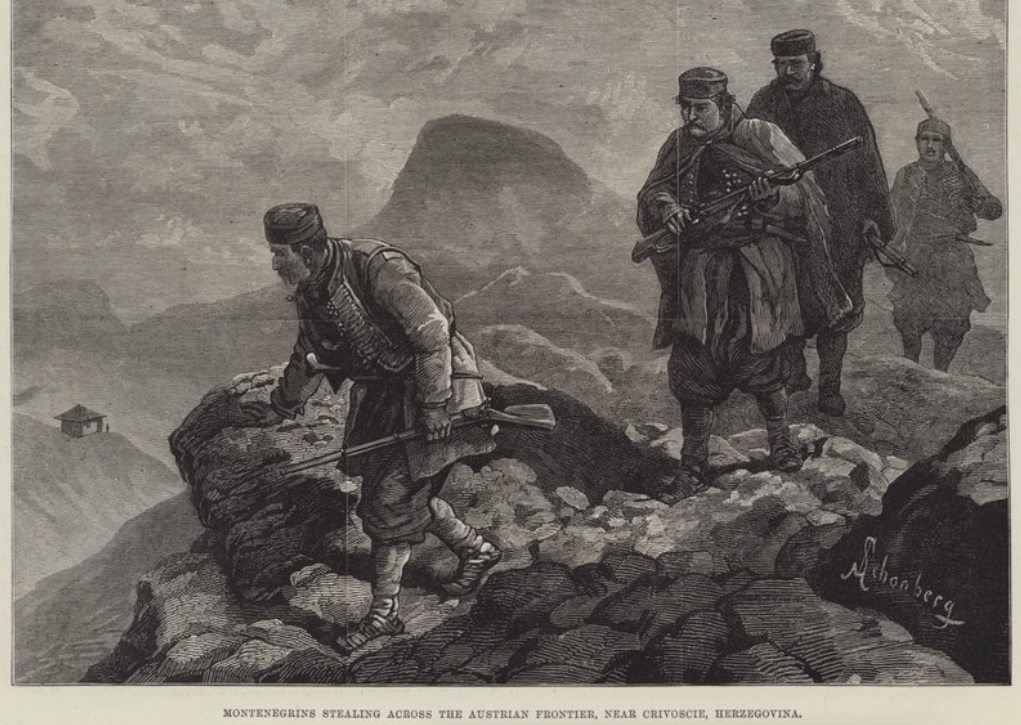
The Montenegrin attack on Albanian territories in 1852 and the Albanian commander Selim Nexhi of the Zhablak fortress.
Summary:
A report from December 1852 recounts the conflict between Montenegrin forces and Ottoman-Albanian defenders. The fortress of Zabiak (Zhablak) fell to Montenegro despite being officially funded for proper garrisoning; its commander, Selym Nedji, escaped but was later imprisoned in Scutari. Ammunition shortages left Antivari poorly prepared, with outdated Venetian-era gunpowder and lead supplies having to be reworked by hand.
Selim Bey assembled around 900 men and a cannon to counterattack, while Curto Bey (Kurt Begu) mobilized approximately 100 fighters from Markovic and Spizza. However, facing overwhelming Montenegrin numbers and experiencing desertion among their own troops, the Albanian commanders were forced to retreat to Turgemille. A renewed attack planned for December 3rd failed due to low morale and refusal of locals to march once more.
Cited from the article:
“Vienna, December 21. Direct news from Turkish Albania, reaching to 6th day, reports that the Montenegrins still hold the fortress of Zabiak, which is besieged by the Visir of Scutari. Several minor skirmishes that took place between the Montenegrins and Albanians in that area were won by the former. Selym Nedji, commander of Zabiak, escaped the Montenegrins but was imprisoned in Scutari.
However, the loss of Zabiak can hardly be held against him, as the fortress was completely deserted, although the Visir of Scutari had received payment from the government for adequate garrisoning. Podgorizza would have suffered the same fate as Zabiak if its inhabitants had not provided brave support to the small garrison. In Antivari, there was a lack of ammunition.
Although cannon powder was found in the fortress, it dated from the Venetian period and had to be loosened with iron hammers. Likewise Approximately 200,000 pounds of old lead were found, from which shotgun bullets were cast. On the 1st of the month, ammunition finally arrived from Scutari with orders to attack the Montenegrins. Commander Selm Bey (Selim Begu) marched against the enemy that same day with about 900 armed men and one cannon.
Kurto Bey (Kurt Begu) gathered about 100 men from Markovich and Spizza under his banner and led them against Montenegro, but had to yield to the enemy’s superior numbers. Meanwhile, Selm Bey, deserted by the majority of his troops, was forced to retreat to Turgemille. On the 3rd, the inhabitants of Antivari were supposed to launch a new attack against Montenegro, but they marched reluctantly, and few would likely obey the order a third time.”
Reference
Digitialized newspaper “Austria Archiv fer Gesetzgebung und Statistik auf den Gebieten der Gewerbe, des Handels und der Schiffahrt. Beitung für Handel und Gewerbe öffentliche Panten und Verkehrsmittel. No 276 Montag den 29 November. 1852. Antivari”.

 Balkan Academia