
Summary: The passage from Luigi Pennazzi’s La Grecia moderna (1879) describes a solemn encounter during the Epirote uprising, where Pennazzi meets two Albanian leaders from the Llapi tribe, Fazul Agà and Mahomed Abassi Agà. The scene unfolds near a fortress, with soldiers positioned in silence and the landscape marked by both sunlight and the bodies of the fallen. The Albanian leaders approach with dignity and courage, expressing neither arrogance nor fear. After formal greetings and the traditional offering of coffee, both sides sit together to begin negotiations for surrender.
Cited:
“The nizam, however, whom we had comforted with kind words, who from my uniform and that of Conturbia had noticed that we were Europeans and who probably knew the customs of our armies, did so much that Fazul Agà and his assistant, whose name, I believe, was Mahomed Abassi Agà, the head of the Liapi clan, decided to come in person to the parliament.
Our men were lined up about two hundred paces from the konak, our flags were waving on the mountain tops where we had already set up outposts, a warm and sunny sun that irradiated the surrounding hills and the sad plain that we had crossed with so much difficulty and, in contrast to the smiling picture, some corpses lying on the ground that divided us from the fortress, such was the spectacle we admired when the two Albanian leaders moved towards us.
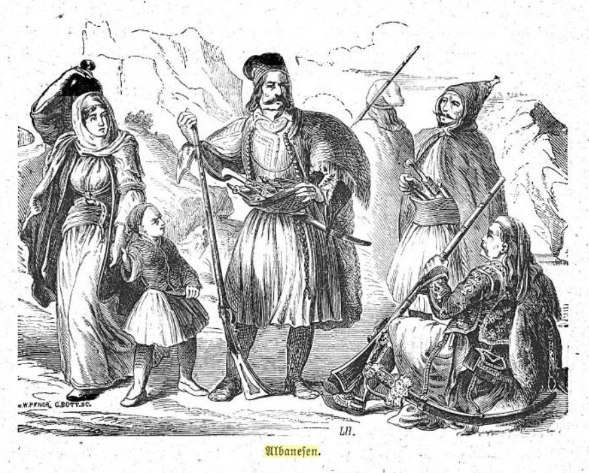
Both were pale with emotion but not with fear. Their bearing was proud without being arrogant. They carried on their faces the awareness of duty fulfilled and the impassivity of men of courage in the face of danger. Both wore the Albanian dress and were splendid types of that strong race. Fazul Agà was of medium height but admirably proportioned. Born a man of about 35 years of age, he had blond hair and moustache and eyes of that dark blue that seems to send out flashes but can be softened at will.
His very regular features, the elegance of his manners, the sweetness of his physiognomy denoted the gentleman from a mile away. His companion, about ten years older than him, although no less elegant and pleasant, had more of a soldier’s appearance. He was tall and stocky. His thick moustache, the masculine pride of his gaze, the way he wore his cape denoted the mountaineer more accustomed to sleeping on the rocks of his native mountains.
We were waiting for the two characters about fifty paces in front of the front of the column to which I had ordered the most rigorous silence. When they were a few paces away they bowed, saluting us in the oriental way without arrogance, just as without cowardice we saluted in turn and we extended them our right hand.
They remained for a moment as if confused and undecided, they looked us in the face as if to see if we were not hiding a betrayal under polite appearances and probably reassured by their rapid examination they cordially shook our hand which we extended. They sat on a rock next to us Nikolaki appeared with the obligatory cups of coffee without which preamble nothing is done in the East, cigarettes were lit with the desired gravity and we moved on to negotiating the surrender.”
Reference
https://www.google.se/books/edition/La_Grecia_moderna/HRRK4tP80gUC?hl=sv&gbpv=0

 Balkan Academia