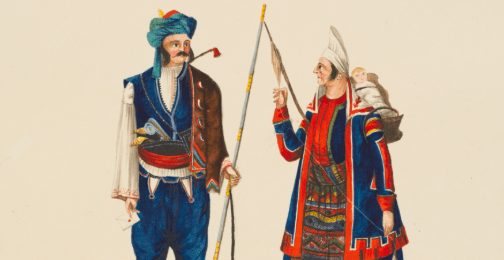

Summary:
The document describes Venetian colonization policies in Istria during the 17th century, focusing on the resettlement of Morlach and Albanian families from Ottoman-controlled territories. After the island of Ivari fell to the Turks in 1571, the Captain of Raspo granted lands near Poreč and Umag to military leaders who were required to populate them with displaced families, many arriving from Zeta, Scutari, Albania, and Dalmatia.
Additional settlements followed through land grants between 1604 and 1623, including the foundation of villages such as Seghetto, Giuba, and Monghebbo. These lands passed through Venetian noble families, including Valier and de Franceschi. Archival lists document the origin and names of the settler families, many recorded as Montenegrin but showing onomastic characteristics of Slavicized Albanians. The document also includes later records from the 18th century detailing Greek, Albanian, Montenegrin, and other migrant families established on these estates.
Timeline
Early settlement after 1571
The island of Ivari, which had fallen into Turkish hands, was granted by the Captain of Raspo with land in the districts of Fontane Aquadizza, Monte Pighera, and Scoglio Riviera near Poreč. 47 Morlach families from Zeta in Albania were transported to these lands.
Land concessions and colonization
February 15, 1604
Captain Alessandro Zorzi, Captain of Raspo, invested Captain Vincenzo Cuchich of Sebenico with a body of uncultivated land (approx. 4 miles in circumference) in the territory of Umag. 30 families from Turkish lands were settled there.
1623
Cuchich sold the estate, now known as Seghetto and Giuba, to the Valier family of Venice. It was later purchased by the noble de Franceschi family, current owners, who emigrated from the island of Candia after its conquest by the Turks in 1669.
Poreč egion
October 28, 1610
The Convent of St. Francis in Poreč granted a 29-year renewable lease to Zuane and Pietro Mircovich for woodland in the Monterosso district above Molinderio, with the obligation to build houses.
March 13, 1611
Captain Pietro Bondulmier, Captain of Raspo, granted 1239 fields of uncultivated land in the Monghebbo district of Poreč to Chief Luca Duimo and 18 Albanian families from Scutari, requiring them to found a village.
March 8, 1621
At the request of Marco Juro, Albanian zupano of Monghebbo, Captain Pietro Emo granted an additional 100 fields in the district.
1612
Other Morlach families were transported from Dalmatia to Istria, Orcevano near Medulin.
Footnotes
Names of families transported to Giuba and Seghetto
Among those recorded (examples from archival lists):
- Petre Dupila and family — 6 Montenegrins
- Zuane Zucovich and family — 4 Montenegrins
- Dimitri Lublutina and family — 8 Montenegrins
- Cristo Zaffiri and family — 6 (from Arta)
- Giani Miliotti and family — 2 (from the Archipelago)
- Giovo Popovich and family — 2 (from Bosnia)
- Michiel de Giovo and family — 5 Montenegrins
- Marin Lupatin, Simon Dubaz, Antonio Drignan (origins uncertain, Lupatini known from Albona)
Also Greek families such as Carciotti and Stradiotti, and likely foreigners such as Melisana Atica and Chitriza.
Albanian families in Monghebbo
From archival documents:
Luca Duimo, Andrea Pulco, Piero Moro de Marco, Luca de Zuane, Zuane de Perazzo/Peracich, Paolo de Nicolò, Sercondo de Antivari, Marco Jerez, Ivo de Andrea, Nicolò de Marco de Susani, Rado de Zorzi de Susani, etc.
18th-century settlers in Seghetto (record dated April 30, 1764)
- Toderin Capelogiani — family of 6, from Coron
- Panioti Popadochi — family of 4, from Naples of Malvasia
- Apostoli Malaco — family of 11, from Naples of Romania
- Spiro Crona — family of 4, from Coron
- Zorzi Sulvagassi — family of 3, from Naples of Malvasia
- Stefano Petrovich — family of 4, Montenegrins
- Rode Radosovich — family of 6, Montenegrins
- And others
Onomastic analysis of the names identified as Montenegrin in the source
- Petre Dupila
- Zuane Zucovich
- Dimitri Lublutina
- Stippe Lublutina
- Cristo Zaffiri
- Michiel de Giovo
- Marin Lupatin
- Simon Dubaz
- Antonio Drignan
- Pietro Alessich
- Stefano Petrovich
- Rode Radosovich
| Name | Onomastic evaluation | Possible Albanian origin? |
|---|---|---|
| Petre Dupila | Petre can be both Slavic (Petar) and Albanian (Pjetër). Dupila is not typical Slavic morphology; could be Albanian or Romance. | Likely |
| Zuane Zucovich | Zuane is Venetian for Giovanni. Zucovich contains the Slavic patronymic -vich, but Zuko / Zuka is a well-attested Albanian surname/root. | Highly probable |
| Dimitri / Stippe Lublutina | Dimitri occurs in Slavic and Albanian Orthodox communities. Lublutina does not conform to Slavic surname patterns (no -ić, -ov, -ev). Possibly Albanian root form adapted to Slavic system. | Probable |
| Cristo Zaffiri | Cristo used by Greeks, Albanians, Venetians. Zaffiri / Zefiri corresponds to Albanian Zefiri (from Zef = Joseph). | Clearly Albanian |
| Michiel de Giovo | Michiel is Venetian. Giovo resembles Albanian forms Gjova / Gjon / Gjovalin. | Likely |
| Marin Lupatin | Marin common across Dalmatian–Albanian–Montenegrin coast. Lupatin resembles Albanian Lup- roots (e.g., Lupi, Lupa). | Possible–likely |
| Simon Dubaz | Simon general Christian usage. Dubaz not typical Slavic construction; may derive from Albanian or Romance roots. | Possible |
| Antonio Drignan | Antonio Venetian form. Drignan not Slavic structure; could indicate further assimilation. | Possible Albanian background |
| Pietro Alessich | Pietro Venetian/Italian. Alessich ends in -ich (Slavicization), but root Ales / Aleks / Lekë aligns with common Albanian Christian name Lekë. | Likely Slavicized Albanian |
| Stefano Petrovich | Follows standard Slavic naming (Petrovich = son of Petar), could be fully Slavic, but Petar/Stefan were common adoption names among Albanian Orthodox. | Uncertain, but possible |
| Rode Radosovich | Clearly Slavic patronymic formation. Could be fully Slavic, though conversion to Slavic identity occurred frequently in Montenegro borderlands. | Less likely Albanian |
Overall conclusion
Based on onomastics alone: Strong evidence of Slavicized Albanian origin
- Zuane Zucovich
- Cristo Zaffiri
- Pietro Alessich
- Dimitri / Stippe Lublutina
- Petre Dupila
- Michiel de Giovo
Possible but less certain
- Marin Lupatin
- Simon Dubaz
- Antonio Drignan
- Stefano Petrovich (ambiguous case)
Likely genuinely Slavic
- Rode Radosovich (though assimilation cannot be ruled out)
Historical Sources
- Provincial Archive of Istria
- Kandler Annals and La Provincia newspaper, 1873
- Records from Count Bernardo Borisi
- Documents provided by Giambattista de Franceschi, Deputy of the Imperial Council

 Balkan Academia