
Summary
The Albanian–Chetnik War (1941–1944) was a violent series of military operations, massacres, and ethnic attacks carried out primarily by Serbian and Montenegrin Chetnik forces against Albanian-populated regions of Kosovo, Sandžak, and Montenegro during World War II. The Chetniks aimed to destabilize Albanian control, expand Serbian influence, and expel the local population as part of broader plans for ethnic cleansing and the creation of a Greater Serbia.
In response, Albanian political and military leaders—including Shaban Polluzha, Xhafer Deva, Sak Faslia, and Mehmet Gradica—organized local resistance movements such as the League of the Albanian People (Lidhja e Popullit Shqiptar) and mobilized thousands of volunteers from Drenica, Rugova, Llap, and Dukagjini.
Fighting was intense across 1941–1944, with major battles occurring in Artakoll, Rugova Gorge, Novi Pazar, Cerajë, the Ibar Valley, and the Kosovo–Montenegro borderlands. Both sides suffered heavy losses, and widespread atrocities were committed, including the burning of villages and mass killings of civilians.
Although the Chetniks were supported at different times by the Serbian State Guard, Italy, Bulgaria, and later Nazi Germany, they failed to maintain lasting control in Kosovo. Albanian forces succeeded in repelling multiple offensives, securing key territories, and forming the Second League of Prizren in 1943 to protect Albanian lands and pursue unification with Albania.
By 1944, Chetnik presence had collapsed, and the region became the scene of new fighting as Yugoslav and Albanian partisans expelled retreating German forces. The aftermath left deep ethnic scars and shaped the political landscape of postwar Kosovo and Yugoslavia.
Background
The region, including Kosovo, the Sandzak, and parts of Albania, was under heavy pressure from Chetnik forces. These forces, along with their collaborators in the Serbian State Guard, aimed to push Albanian influence into the region, especially in Kosovo and parts of the Dukagjini Plain. The Chetniks, led by Draža Mihailović, had already made their intentions known, aiming to annex Albanian-inhabited territories into a Greater Serbia.
To respond to these threats, Albanian political and military leaders such as Xhafer Deva and Ibrahim Lutfiu began organizing defensive efforts. At the same time, volunteers were mobilized from Albanian territories, especially from Drenica, Rugova, Llapusha, Dukagjini, and the Peja district, forming the League of the Albanian People. One of the early agreements, which aimed to prevent a full-scale conflict between Albanian and Serbian forces, was reached in October 1941, during talks between Xhafer Deva and Košta Pecanci.
The agreement provided for a ceasefire and a mutual understanding on territorial borders. However, this agreement was quickly violated by Chetnik forces. The Chetniks, supported by the Serbian State Guard, launched a major offensive towards Slatina in the Ibar Valley, easily destroying Albanian defenses in the region. This marked the beginning of full-scale military operations in the area, which would last for years.[3]
Formation of the Albanian People’s League
In the autumn of 1941, large Chetnik forces gathered in the Kopaonik region and at the mouth of the Ibar River, posing a direct threat to Novi Pazar, Llapi, and Drenica. To respond to this growing threat, Xhafer Deva founded the Albanian People’s League, mobilizing Albanian volunteers from the threatened areas.
Their efforts focused on equipping, organizing, and arming these forces with weapons and ammunition. Meanwhile, other volunteers from Rugova, Podguri, Drenica, and Llapusha were mobilized to defend Novi Pazar. These forces took up strategic positions in the Mokna hills, the hills surrounding the city, and in the Shaplavica area.[3][8]
War of 1941
In April and May 1941, local Albanian resistance groups engaged in defensive operations against Chetnik forces led by Draža Mihajlović and Serbian gendarmerie units from the Mitrovica garrison. The battles took place around the villages of Bečuk Mihalić, Prilluzhe, and Druar in Kosovo. The Albanians managed to thwart the attacks, preventing Chetnik forces from establishing control in these areas.[9]
In July 1941, Albanian forces launched an attack on Gjorgevo-Stuba, a strategic hill in the Sandžak region that controlled the approach to Novi Pazar. Despite limited resources and ammunition, the position was captured, securing the area and preventing the enemy advance.[10]
In 1941, Chetnik forces attempted to enter the Artakoll area, targeting villages including Bivelak, Strofc, Mihalic, Dërvar, Beçuk Shipitulle, Sibovc, Kollë, Žilivode, and Pestovë. They arrived by train at the village of Prelluzhe, where the residents of Artakoll and Drenica organized a coordinated defense. During the fighting, many Chetnik fighters were killed at the Glavotin Bridge and along the Sitnica River, which was flooded at the time. The fighting lasted all day. Local leaders such as Mehmet Gradica and Sadri Klinaku participated in the defense.[11]
After the events in Artakoll, Chetnik units attempted to enter northern Drenica and parts of Istog, including Suhogërlë, Banjë, Cerkolez, Uçë, Rakoš, Kotor, Radiševo and Runik. The local population organized armed resistance and clashes occurred between the Chetniks and local fighters. Both sides suffered heavy casualties, and the Chetnik forces withdrew from the area.[12]
On 10 June 1941, Chetnik forces led by Živko Devergjiq from Radiševo, Zarie Ruishić, Radivoje Galak, etc., attacked the Albanian villages in the Ibar valley, Koštovë and Çabra. At this time, Chetnik detachments were concentrated in the villages of Zubin-Potok, intensifying their efforts to unite with the Serb-inhabited villages of the Skënderaj sub-prefecture that had remained in the Italian occupation zone.[13]
In 1941, in Peja, at the end of June, Albanian forces led by Major Rexhep Gilani and Kole Bibe Mirakaj met with the aim of defending the Albanian border against Montenegrin Chetnik forces. They soon deployed forces under the command of Sak Faslia on the Morina border line. Montenegrin forces attacked Velika Morina, Zhanica, Pepaj, and Nikšić.
The Montenegrin offensive was stopped by Albanian forces, and Kenić Vukosava, the Montenegrin commander, unsuccessfully attempted to assassinate Sak Faslia. The Albanian forces numbered 3,000 and forced the Montenegrins to retreat.[14][15]
On July 22, Albanian volunteer forces continued their attack on Montenegrin troops to expel them from the part of Albanian territory they occupied.
had previously occupied. The Yugoslav Communist Party Committee for the districts of Andrijevica, Berani and Kolašin faced strong resistance from Albanian volunteers. For this reason, the Committee ordered its forces to withdraw to the Albanian–Montenegrin border of 1912. It also sent a delegation led by Bogdan Šoškić and Milutin Igići to meet with the Albanian commanders Demë Ali Pozhar, Ali Bajraktar and Selim Shabani. Both sides agreed to stop fighting.
However, the agreement did not last long. The leaders of the Yugoslav Communist Party Committee for the district of Andrijevica violated it. On 26 July, while peace talks were ongoing, the Committee ordered two Partisan–Chetnik battalions and an artillery unit, led by Đorđe Lašić and Andrija Vesković, to assemble in the Maslenica Morina and prepare for battle.[3]
As a result, numerous battles took place in Morinë, Zhanicë, Nokšić and along the roads to Çakorr and from Morinë to the village of Pepaj. The heaviest fighting took place on 25 and 27 July 1941, in Zhanicë and Morinë. Due to this situation, the Kosovar communists and the leaders of the Albanian forces decided to take a united position.
As a result, Xhevdet Doda and Bedri Pejani, chairman of the Kosovo Committee, asked the Montenegrin leaders not to expand military operations into ethnic Albanian areas, explaining that they would not be able to stop the mobilization of Albanian volunteers to defend their lands.
Based on this understanding, in August 1941 a non-aggression agreement was reached between the Serbian–Montenegrin partisan units active in the regions of Raška and Pazar i Ri and Aqif Blyta, who coordinated the Albanian patriotic forces along the border with Serbia and Montenegro.
However, this agreement was quickly violated by the Serbian Partisans and Chetniks. Their attacks were focused on Novi Pazar, the Ibar Valley, and especially the Shala region. In Cerajë, Koštovo, and Bistrica, Chetnik forces began burning houses and committing massacres of women, children, and the elderly.[3]
In August 1941, Chetnik forces led by Mašan Đurić, Žika Marković, and Vojslav Llukačević launched an attack on the village of Cerajë in Kosovo, aiming to ethnically cleanse the area and expand their control. However, they faced strong resistance from Albanian volunteer forces under the leadership of Ahmet Selaci, along with gendarmerie from Shala and Mitrovica. The Chetniks were forced to retreat towards Raška after the battle.[16]
“When you began your path of destiny, I knew what plans you had for our south. I believe that in the Sandzak, in Dukagjin and in Fushë-Kosovo, there will be no more fields left for planting. For two months, Llapi and Sitnica will hold the heads of Albanians.”
— A letter sent to Kosta Pecanac by Lubo Novaković on September 12, 1941[3]
On October 15, 1941, Chetnik forces from Suva Planina attacked the Volnetari militia, initially causing heavy losses and forcing them to retreat across the Ceranje River. However, the Volnetari regrouped and then defeated the Chetniks. After that, the Chetniks entered Ceranje, burning Albanian houses. That evening, strong reinforcements arrived from Šalja, forcing the Chetniks to retreat during the night.
On October 16, the Chetniks launched another attack, forcing the Volnetari to retreat again across the Ceranje River. After battles on 14 and 15 October, the Chetniks were forced to retreat completely, burning all Serbian houses between Slatinë and Leshak during the retreat.[17][18]
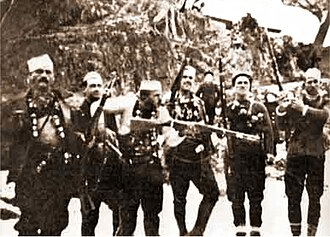
Albanian soldiers under the command of Shaban Polluzha in Novi Pazar
On 14 November 1941, Albanian forces launched an offensive against Chetnik positions in the Raška region, forcing Serbian forces to retreat. Despite heavy losses on both sides, the Chetniks failed to regain control of the region, and their advance was temporarily halted. On 21 November 1941, Albanian forces managed to drive the Chetniks out of Novi Pazar, after a series of clashes in the area of the Stupca Church.[3][19]
1942
On May 6, 1942, based on the instructions of Draza Mihailovic, the 1st Kosovo Chetnik Corps was formed, which would operate in the areas of Shan, Nerodim, Gracanica, Vushtni and Llapi. The instructions of the General Command provided that in each division two brigades would be formed in action and in reserve. These were the Mitrovica Brigade, the Nerodim Brigade, the Gjilan Brigade and the Sharr Brigade.
At the same time, talks were held near the Mokna Tower, which were attended by Novica Popovic, Vuksan Kenic, Blagoje Babic, Novaku and Kolludra representatives of the Montenegrin side and representatives of the Albanian side Zhuje Keri, Sak Fazlia, Sali Rama, Zhuke Haxhia, Rize Zymeri.
During the meeting, the Montenegrin delegation demanded a halt to the developing conflicts and proposed a joint campaign against the communist forces. They also sought to establish closer ties and be allowed to cross the border through the Rugova Gorge towards the Dukagjin Valley.
However, the talks failed. Albanian representatives rejected the proposals, considering them an attempt to compromise Rugova’s leadership and create conditions for Montenegrin forces to penetrate the Dukagjin region.
In June 1942, during a visit to Peja, Prime Minister Mustafa Kruja praised and decorated Sak Fasli for his actions during the war.[3]
In June 1942, Montenegrin Chetnik forces, now coordinated under the command of Pavle Gjurishić, launched a concentrated attack on the Rugova Gorge, a vital crossing connecting the Dukagjin Valley with Kosovo and the rest of Albania.
The Montenegrin Chetniks focused on taking control of the Mokna region and the Little Tower, where the Albanian flag was flying.
The Chetnik attack on Mokna began on 20 June 1942 and was met with Albanian resistance. The Albanians, led by Sak Faslia and Sali Rama, managed to halt the Chetnik advance in a series of battles that lasted until 20 July, despite heavy losses.[3]
On 20 July 1942, Montenegrin forces attacked a Rugova group near the Mokna Tower, triggering a six-hour battle. The Chetniks, despite their numbers, were unable to break through the defenses, and the Rugovas continued to supply the front line, aided by reinforcements from Riza Zymeri and Zhuke Haxhina.[3]
On 21 July 1942, the Chetniks launched another attack in the area of Qafë i Sekirica, hoping to capture the Albanian positions.
During the summer of 1942, tensions rose between Italian and Bulgarian forces over border disputes in the Prizren region, leading to a deterioration in their relations. Chetnik leaders attempted to maneuver between the two sides to their advantage. On the one hand, the Bulgarians sought to win them over by presenting themselves as liberators of the Serbs from Albanian control, and on the other hand, the Italians pressured the Chetniks to join forces militarily, a demand that the Chetnik leaders sought to exploit for their own ambitions.
The Chetnik commander-in-chief, Draža Mihailović, ordered his field leaders not to make “any agreements to the detriment of the Italians.” He ordered that Italian arms be accepted only “without compromising national policy” and emphasized that the Albanians, who were described as “against us,” should not arm themselves. The demands of the Serbian Chetniks did not go unanswered.
At the time, the Italians secretly supplied the Chetniks with weapons in exchange for information on the activities of the Anti-Fascist Movement.
In December 1942, Captain Živojin “Žika” Marković was tasked with forming the Second Kosovo Chetnik Corps, which would operate along the border between Kosovo and Serbia, particularly in the districts of Mitrovica, Vushtrri and Llapi.[3]
1943
In 1943, the city of Novi Pazar was attacked by Chetnik forces, who reportedly targeted the local Albanian and Bosniak population. The attack included acts of violence, looting and destruction of property. The operation was reportedly led by Chetnik commanders Vana Drekanović, Žika Marković and Kosta Peqanci. The defending forces reportedly faced the Chetnik units for about seven weeks, and Albanian forces are reported to have killed 163 Chetnik fighters during the conflict.[20]
In early 1943, Chetnik forces, under the strategic direction of Draža Mihailović, aimed to crush Albanian resistance once and for all. The strategy was to sever Albania’s connection to the Dukagjin Plain and to stifle Albanian national sentiment through systematic violence. This period saw the Chetniks attempt to exploit the Italo-Bulgarian rivalry and Nazi-Soviet tension, attempting to secure weapons and information from the Axis powers.
Volunteer forces, led by Sak Fazlia, Shaban Polluzha, Pajazit Boletini, and Bislim Bajgora, waged a guerrilla campaign that disrupted Chetnik operations. Sekullar, Ostrijel, and other strategic locations were contested in battles, with the Albanians winning against the Chetnik forces in the region.[3]
In early 1943, the Chetniks under Draža Mihailović, after a series of defeats and setbacks in the Balkans, focused on a final, all-out offensive against Albanian strongholds. They understood the importance of Kosovo, Rugova, and the Dukagjini Plain as key to re-establishing Serbian control over Albanian-inhabited territories.
At the same time, Montenegrin forces, under Pavle Gjurishić and supported by the Serbian State Guard, launched coordinated attacks on Plav, Guci, Rožaje, and other border areas, with the aim of destabilizing Albanian control and expelling the local population.[3]
One of these attempts to crush Albanian resistance occurred at the Rugova Gorge. The gorge, a narrow and rugged road connecting Kosovo with Albania, became the focal point of the Chetnik-Montenegrin offensive. They attempted to surround Rugova, a strategic and symbolic location for Albanian fighters, hoping to break their spirit and secure control of the Albanian border.[3]
The Albanian defense, led by commanders such as Sak Fazlia, Shaban Polluzha, and Sali Rama, was particularly determined. They knew that the loss of Rugova would mean the fall of the entire Dukagjini Plain and would provide the enemy with a free passage into Albania. The Battle for Rugova between January and March 1943 saw fierce fighting,[3]
As the Chetnik-Montenegrin forces advanced deeper into Albanian territory, Albanian volunteers employed guerrilla tactics. The harsh terrain of the Rugova Gorge, Plavë, and Gucië was ideal for hit-and-run operations.
The Albanians used the narrow valleys, dense forests, and high hills to their advantage. Small, mobile units of Albanian resistance attacked Chetnik patrols, laid ambushes, and carried out surprise attacks on supply lines, making it difficult for the enemy to hold any significant positions in the region.[3]
The Chetnik forces received support from the Serbian State Guard and several factions within the Italian army. The Italians, who had initially been involved in the invasion of Albania, began to shift their focus as Nazi Germany began to gain greater control over the Balkans. Despite the changing geopolitical dynamics, the Albanian resistance continued to receive indirect support from Italian fascists, who, despite their alliance with the Axis powers, were concerned about the growing influence of German forces in the Balkans. In some cases, local Italian commanders provided limited support to Albanian forces, although this was more the result of local politics than a consistent policy from Rome.
However, as the Italian occupation collapsed by September 1943 and after Italy’s surrender to the Allies, the Chetniks intensified their cooperation with Nazi Germany, becoming more closely aligned with the Axis powers in the region.[3]
Another attack occurred in late 1943, when a large coalition of Albanian guerrilla forces, including units from Kosovo, Drenica, and Rugova, were attacked by a Chetnik offensive in the Dukagjini Plain. This operation, which took place in December 1943, marked the end of significant Chetnik influence in the region and forced the forces into a defensive retreat.[3]
In November 1943, Chetniks from Montenegro attacked a large number of villages near Peje.[21]
1944
In early 1944, Chetnik and Royalist formations advanced again along the Ibar valley towards the mining areas of Boletin and Mažić. Local forces from Shala and Bajgora were mobilized to defend the region, engaging in several skirmishes on the slopes of Kopaonik and the roads to Mitrovica. The fighting forced the Chetnik groups to retreat northwards, preventing attacks on Albanian villages and maintaining control over the key line of communication between Boletin and Bajgora.[22]
In early 1944, the Albanian People’s League, together with local civilian militias and some support from the partisan movement, consolidated control over the border areas. The Chetniks were now in retreat.[3]
Formation of the Second League of Prizren
In September 1943, the Second League of Prizren was founded in Prizren by Bedri Pejani and other individuals, as a reaction to the developing conflict with the Chetniks, Partisans, and Bulgarians. The League’s founding was motivated by a desire to protect Albanian territories, especially in Kosovo. The League took its name from the First League of Prizren (1878), which had similarly aimed to protect Albanian territories from foreign expansion.[1]
Goals of the Second League of Prizren
Protection of Albanian Territories: The League aimed to protect Albanian-majority regions, especially Kosovo and parts of Macedonia, from Serbian and Axis occupation. This included resisting the Chetnik movement and other Serbian nationalist forces, which were attempting to displace the Albanian population.
Unification with Albania: One of the League’s main goals was the unification of Kosovo and other Albanian-inhabited areas with Albania. This idea of creating a Greater Albania was rooted in the Albanian nationalist movements of the late 19th and early 20th centuries, and the League aimed to achieve this through military and political means.
Opposition to Serbian Nationalism: The League opposed the Chetnik goal of creating a Greater Serbia, which would involve the expulsion or subjugation of Albanians in Kosovo and surrounding areas. The League considered the Chetnik movement a direct threat to Albanian identity and territorial integrity.
Establishment of Albanian Independence
The League worked to secure Albanian Independence within the broader political context of the Balkans. In areas such as Kosovo, the League aimed to create local government structures that would guarantee the protection of of Albanian interests and culture.
Aftermath
The Kosovo Operation was a joint World War II campaign by Yugoslav Partisans and Albanian Partisans to drive out German forces retreating from Greece through Kosovo and Montenegro. The fighting involved the German 21st Mountain Division and the Albanian National Forces Balli Kombëtar. The Allies captured key cities, and Kosovo was placed under the control of the LANC and later Yugoslavia. The offensive was followed by unrest, as local Albanians opposed integration into Yugoslavia.[23]
References
- https://memorie.al/en/the-government-of-rexhep-mitrovica-had-proclaimed-albanian-independence-and-neutrality-on-the-condition-that-it-not-give-aid-to-the-germans-bahri-omars-deposition-in-the-special-court/
- Shatri, Bajram; Salihu, Ramadan M.; Hashani, Nijazi; Sejdiu, Nexhimje; Hajrullaaga, Edmond (1999). History of the Albanian People for Secondary Schools. SIPRINT. p. 313.
- Taken from Dr. Muhamet Shatri, “DEFENSE OF KOSOVO AND OTHER ALBANIAN TERRITORIES FROM SERBIAN-MONTEGRANITE CHETNIK ATTACKS (May 1941 – October 1944)
- Bataković, Dušan T. Kosovo: la spirale de la haine … (in Serbian).
- Antonijević, Nenad. Arhivska građa … (in Serbian).
- Malcolm, Noel. Kosovo: A Short History (in English). p. 312.
- Malcolm, Noel. Kosovo: A Short History (in English). p. 312.
- Malcolm, Noel (1998). Kosovo a short history (in English). macmillan. p. 249. ISBN 9780333666135.
- Bedri, Tahiri (2002). Drenica: a century bravery. Lena. p. 53. ISBN 9789951273787.
- Bedri, Tahiri (2002). Drenica: a century of bravery. Lena. p. 55–56. ISBN 9789951273787.
- https://www.albaniapress.com/lajme/17854/SHABAN-POLLUZHA-DHE-LUFTA-E-DRENICES-I.html
- https://www.albaniapress.com/lajme/17854/SHABAN-POLLUZHA-DHE-LUFTA-E-DRENICES-I.html
- https://balkanacademia.com/2025/04/04/albanian-ballists-defended-albanian-civilians-against-decades-long-serbian-atrocities/
14.http://www.kosova.com/artikulli/18811 - https://books.google.se/books/about/Q%C3%ABndresa_rugovase_dhe_sak_faslia.html?id=30iioAEACAAJ&redir_esc=y
- https://inforculture.info/2021/02/21/kadri-bistrica-gardian-i-kufirit-verior-te-tokave-alhxiptare/
- Bošković, Branko N. (1968). Narodnooskobodilačka borba u Ibarskom basenu (in Serbian). Zajednica šaučnih ustauna Kosova i Metohija. p. 101. Retrieved 30 August 2012.
- https://dardaniapress.net/histori/si-e-shihte-bedri-pejani-ne-vitin-1941-ceshtjen-e-kollashinit-dhe-mbrojtjen-e-pazarit-te-ri/
- .Ćuković, Mirko (1964). Sandžak. Nolit-Prosveta
- https://kujtimdemiri.wordpress.com/2016/12/10/bislim-bajgora-gjate-luftes-se-dyte-boterore/
- Malcolm, Noel (1998). Kosovo a short history (in English). macmillan. p. 299. ISBN 9780333666135.
- https://web.archive.org/web/20150602162436/http://www.ballikombetar.info/shalaebajgores.php
23.CIA-RDP82-00457R014500140002-8_250421_224751.pdf

 Balkan Academia