
Summary Since 2009, multiple Albanian media outlets, investigative journalists, and regulatory agencies have raised concerns regarding the quality and safety of wheat and flour imported from Serbia and distributed in the Albanian market.
Several reports allege that certain imported consignments contain contaminants such as aflatoxins, heavy metals, and other substances that may pose risks to public health. These investigations also suggest persistent weaknesses in market oversight, customs control, and licensing practices within the domestic flour and bakery sector. The following text summarizes findings and statements published over recent years.
Investigations Into Contaminated Flour Imports
Journalist Përparim Halili has reported on the widespread use of substandard or contaminated flour imported from Serbia and other countries, claiming that a large number of Albanian bakeries—particularly those operating without proper licensing or supervision—use flour unsuitable for human consumption.
According to his reporting, the National Food Authority (AKU) initiated several inspection campaigns, temporarily blocking shipments of Serbian wheat for laboratory analyses. Halili notes that some industry actors reportedly attempted to downplay or dismiss concerns related to contaminants and carcinogenic substances allegedly present in the imported products.
Halili’s reporting also highlights structural problems in the Albanian bread-production chain. A significant portion of bakeries, especially small and informal ones, reportedly operate outside hygienic, technical, and safety standards. Confidential assessments by the Ministry of Agriculture have suggested that hundreds of such bakeries throughout the country function without appropriate licensing or sanitary conditions, potentially exacerbating risks associated with contaminated raw materials.
Market Distortions and Industry Decline
Journalist Blerina Hoxha has examined how Serbian flour imports—often entering Albania through Kosovo and allegedly priced well below domestic production costs—have destabilized the Albanian milling industry. Major producers such as Atlas, Bloja, and Miell Tirana report that their facilities operate at a fraction of capacity, despite tens of millions of euros invested in modern milling technology.
According to industry representatives, much of the imported flour does not meet minimum protein standards, is often misdeclared (for example, as biscuit flour, which is subject to different regulations), and in some cases may evade full customs procedures.
These issues have contributed to significant financial losses across the sector, reduced factory utilization, and increased reliance on cheaper imports. At the same time, UNICEF and other international organizations have warned that low-quality flour lacking essential micronutrients may contribute to malnutrition, anemia, and developmental issues among children—concerns especially relevant in countries where bread remains a dietary staple.
Regional Concerns About Aflatoxin Contamination
The problem is not limited to Albania. Reports from Kosovo indicate that wheat, corn, and flour imported from Serbia have repeatedly been subjected to increased scrutiny due to suspected contamination with aflatoxins or heavy metals. Kosovo’s Food and Veterinary Agency confirms that multiple shipments have been held at border checkpoints pending laboratory analyses, and several consignments with excessive aflatoxin levels have been returned to Serbia.
European media, including German outlets such as Der Spiegel and Welt, have likewise reported on contaminated Serbian corn detected in Germany, where thousands of tons imported for animal feed were found to contain elevated levels of aflatoxin. These cases further intensified concerns about the quality controls applied to agricultural exports from Serbia.
Documented Case: EUROFOOD Import Attempt
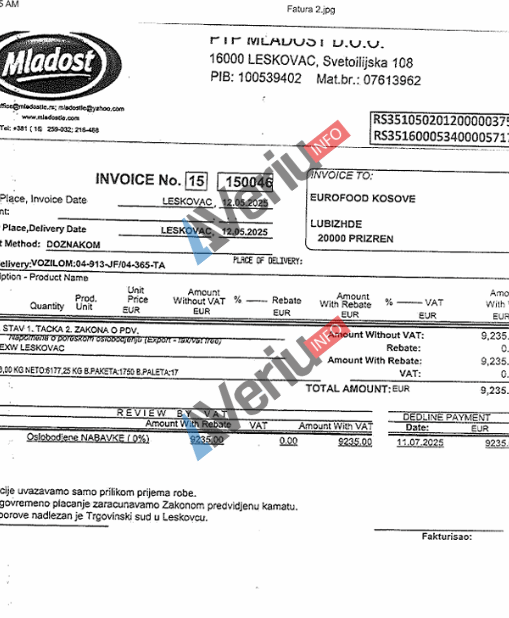
Recent documentation obtained by Veriu.info shows that the Kosovo company EUROFOOD attempted to import approximately 1,300 kg of corn flour from Serbia containing aflatoxin B1 above the permitted limit.
Following analysis by the Kosovo FVA, authorities issued a formal decision prohibiting the sale and distribution of the product. Aflatoxin B1 is classified by the International Agency for Research on Cancer (IARC) as a Group 1 carcinogen and is associated with severe health risks, including liver cancer, impaired immune function, and developmental issues in children.
Political, Economic, and Institutional Factors
Several analysts and civil society representatives argue that systemic problems in regulatory enforcement, customs oversight, and political influence contribute to the continued presence of low-quality imported flour in Albania and Kosovo.
They contend that certain business groups benefit from preferential treatment and exploit gaps in institutional coordination. Critics further assert that the lack of bilateral trade agreements and insufficient alignment with EU food-safety practices expose local consumers to additional risks.
Members of the Kosovo Assembly and consumer-protection organizations have repeatedly called for stricter controls, more transparent inspections, and stronger enforcement of standards related to wheat, flour, and food imports in general. They also emphasize the need to support domestic agricultural production and ensure that flour used for bread meets established nutritional and safety criteria.
Summary of Toxic Wheat Concerns in Serbia
Mycotoxins and Wheat Contamination
Mycotoxins are naturally occurring toxins produced by fungi such as Fusarium and Aspergillus species, which can infest wheat during growth, harvesting, or storage.
The Fusarium genus is a common cause of DON (deoxynivalenol) contamination, also known as vomitoxin, which can affect wheat quality and safety.
Aflatoxins, another class of mycotoxins, are produced by the Aspergillus mold and are a significant concern, especially in warmer, humid conditions, which are often present in regions like Serbia.
Impact on Health and Safety
Mycotoxin contamination poses health risks to both humans and animals, causing issues such as digestive problems, immune suppression, and potential carcinogenic effects. DON contamination specifically can cause vomiting, diarrhea, and other gastrointestinal symptoms in humans and animals.Wheat with high levels of mycotoxins can be deemed unsafe for consumption and is often rejected by importing countries or subjected to strict quality control measures.
Agricultural Practices and Risk Factors
Climate change has exacerbated the conditions for fungal growth, increasing the risk of contamination, especially during periods of wet weather during the growing or harvesting seasons. Poor storage practices can also allow for the proliferation of mold and mycotoxins, which is a risk in some areas where agricultural infrastructure is less advanced.
Regulatory Measures and Mitigation Efforts
The Serbian government and local agricultural bodies monitor and regulate wheat for contamination levels, particularly for mycotoxins and pesticide residues.European Union standards and regulations govern the levels of contaminants in wheat imports from Serbia. If contamination exceeds safe limits, shipments can be rejected, and this impacts Serbia’s reputation as an exporter of quality wheat.
Prevention strategies include crop rotation, proper drying and storage practices, use of fungicides, and choosing wheat varieties less prone to fungal infections.
Conclusion
While Serbia’s wheat industry remains a major agricultural asset, the risk of contamination by toxic substances like mycotoxins presents an ongoing challenge. Ongoing attention to climate factors, agricultural practices, and effective regulatory oversight are essential to mitigate these risks and ensure wheat safety for both domestic consumption and export markets.
References
https://telegrafi.com/miell-e-grure-i-kontaminuar-nga-serbia/
https://www.ekonomia.info/sq/bujqesi/miell-e-grure-i-kontaminuar-nga-serbia
Perparim Halili. https://telegraf.al/aktualitet/1000-furrat-buke-ne-shqiperi-qe-perdorin-perdorin-miellin-e-kontaminuar-serb-qe-konsumojne-kafshet/
https://tvklan.al/aku-bllokon-55-ton-miell-gruri-qe-vinte-nga-kosova-dhe-serbia

 Balkan Academia