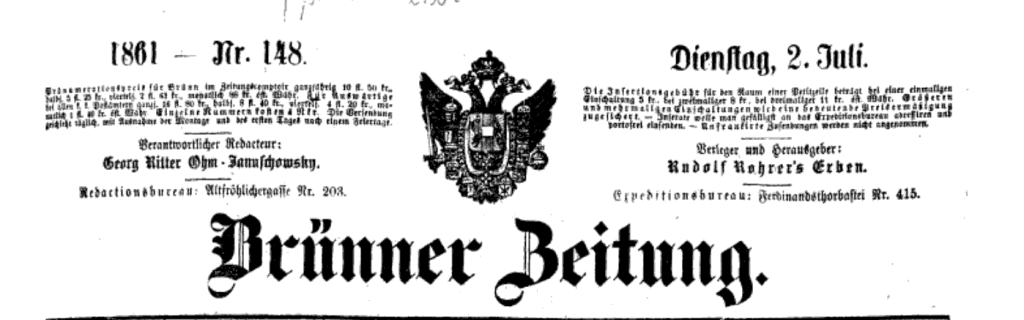

These articles were cited from the newspaper “Brunner Zeitung der K.K. Privilegirten Mahrischen Lehnbank” by Joseph Cölestin Lauer, from 1861. The content covers reports of Montenegrin attacks on Albanian territories in 1861.
Montenegrin atrocities against the Albanians of Blazza (Bllacë)
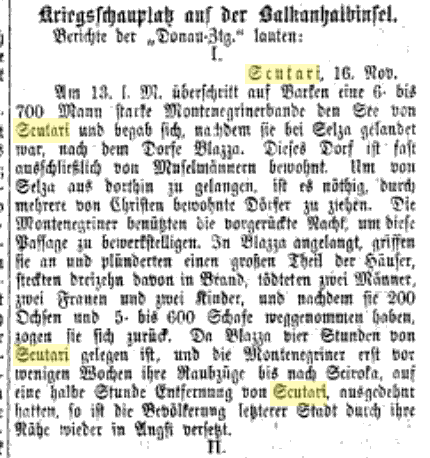
Translated:
“Scutari, 16. Nov. On the 13th of May, a Montenegrin band of 600 to 700 men crossed the Sentari River in barges and, after landing near Selza, headed for the village of Blazza. This village is inhabited almost exclusively by Muslims. To reach it from Selza, it is necessary to pass through several villages inhabited by Christians. The Montenegrins needed the late night to complete this crossing.
Upon arriving in Blazza, they attacked and plundered a large number of the houses, setting fire to thirteen of them, killing two men, two women, and two children, and after taking 200 oxen and 500 to 600 sheep, they withdrew. Since Blazza is located four hours from Scutari, and the Montenegrins had only recently extended their raides to Sciroka (Shirokë) half an hour away from Scutari, the population of Blazza is once again filled with anxiety due to its proximity.”
The Montenegrins attack the village of Bllacë again on November 17th
“Antivari, November 17th. On the 14th of this month, the Montenegrins attacked Blazza, a village situated on Lake Scutari. They murdered several inhabitants there, including children. They carried away all the property they found in the 16 houses that comprise the village of Blazza and then set the houses on fire. The Ottoman commander, Giandet Effendi, arrived here yesterday from Scutari and is going today to the fortress of Nehai, after which he will continue his journey in the direction of Corfu and Constantinople by means of the frigate Geivan. III.”
The Albanians of Shestan fight back against the Montenegrin invaders who burned down Rupci
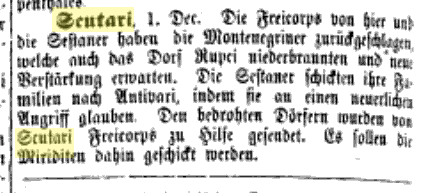
“Scutari, December 1. The volunteer corps from here and the Sestanians have repelled the Montenegrins, who also burned down Rupci and are expecting new reinforcements. The Sestanians sent their militia to Antivari, believing another attack to be imminent. Scutari sent volunteer corps to aid the threatened villages. The Miridites are to be sent there.”
Montenegrins attack the Albanians of Spiç (Spizzari) and Shkodër as well as the Austrians in Sutorina
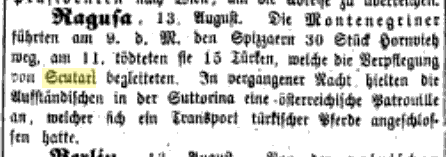
“Ragusa, August 13. The Montenegrins on the 9th of this month, they carried off 30 thorn bushels from the Spizzari; on the 11th, they killed 15 Turks who were escorting the supply train to Scutari. In the past, the insurgents stopped an Austrian patrol in the Suttorina, which had been joined by a transport of Turkish horses”
Govern of Shkodër Abdi Pasha defends the Albanian regions of Spiç (Spizza), Fort Nehaj, Pappani and Sagragie from the Montenegrin attackers, according to the Donau Ztg newspaper
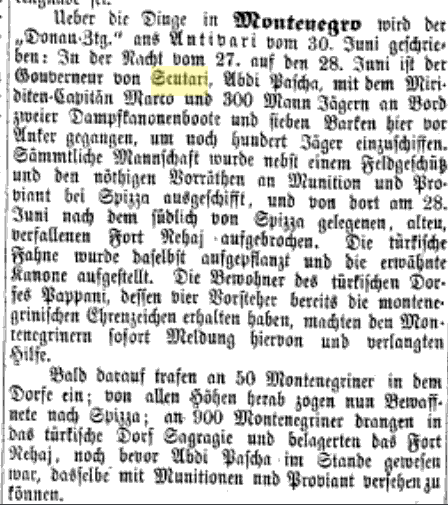
“On the night of June 27th to 28th, Governor Abdi Pasha of Scutari, along with Captain Marco and 300 riflemen on two steam gunboats and seven barques, anchored here (Donau Ztg an Antivari of June 30th). Another hundred riflemen were also present. The entire crew, along with the necessary supplies of ammunition and provisions, was disembarked at Spizza and from there set sail on June 1st for the ruined Fort Nehaj, located south of Spizza.
The flag was planted there and the cannon was set up. The inhabitants of the Turkish village of Pappani, whose four leaders had already received Greek decorations, immediately informed the Montenegrins of this and offered assistance. Soon after, about 50 Montenegrins arrived in the village. From all the heights, about 900 Montenegrins now marched towards Spizza.
They invaded the Turkish village of Sagragie and besieged the Nehaj before Abdi Pasha was able to supply it with ammunition and provisions. Thus pressured by the Montenegrins, he ordered the Turkish frigate and the two gunboats to shell the enemy. Despite the fire from the three ships, which was opened and continued, the Montenegrins did not abandon their siege.
When Abdi Pasha, thus pressured, saw provisions and ammunition, he sent for Antivari with instructions that the local population and the battalion garrisoned there should come to their aid. The citadel of Antivari gave the signal with three cannon shots to march to Spizza. Everyone, including the battalion, complied with the order and arrived on the spot at 6 p.m., but that same evening they dared to attack the besieging Montenegrins.
The Montenegrins all retreated into the village of Pappani, where they are still currently located, was sent back by the Prince of Montenegro, the chiefs of this village, and also several of its inhabitants, because they feared Abdi would punish them for their submission to Montenegro.
However, when they realized on the night of the 28th that the number of armed Turks was increasing and when they began to fear encirclement, they withdrew from Sagragie, taking everything with them, including everything that was not nailed down, from the houses of the Catholic villagers.
Without this retreat and without the help that arrived in time, Fort Nehaj, with all its inhabitants, including Abdi Pasha, would have fallen into the hands of the Montenegrins. Abdi Pasha immediately had the fortress equipped with all masons and carpenters to make it habitable and had three cannons placed on its ramparts. On June 30th, the Montenegrins, on the back of their prince, also withdrew from Pappani to Montenegrin territory. The four chiefs of the village deemed it advisable. Abdi Pasha remained in Fort Nehaj to join them; he had trees felled to fortify the fort with palisades. He kept the regular troops with him and sent the armed population who had joined him back home.”
Montenegrins invade the region of Vranjskë near Podgorica and Malesia e Madhe
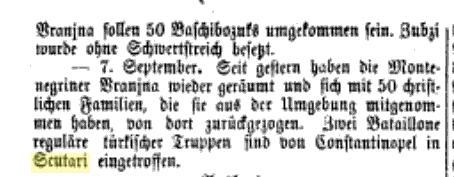
“Ragusa, September 6. Fifty Bashibozuks are reported to have died during the capture of Vranjska. Subhi was handed over without a sword fragment. September 7. Since yesterday, the Montenegrins have again evacuated Vranjska and withdrawn with 50 Christian families whom they brought from the surrounding area. Two battalions of regular Turkish troops have arrived in Scutari from Constantinople.”
Montenegrins attack a boat on Lake Shkodër
“Ragusa, November 22nd. On the night of the 19th, 40 Montenegrin barges attacked a Turkish steamer on Lake Scutari. After several hours of fighting, the Montenegrins were repulsed with significant losses.”
Montenegrins violate the border and attack Albanian transports
“September 12th. After the failed alliance between the Prince of Montenegro and Omer Pasha, the Legate, as is well known, issued the directive to prevent any crossing of the border, if necessary by force of arms. The Montenegrins, however, did not hesitate to break through the border by force and to begin their usual raids along the entire border. Their activity was not limited to driving off the cattle herds, but they also engaged in combined operations, led by the captains themselves, against Turkish transports by land and water on Lake Scutari. The Turks, for their part, carried out an incursion into Montenegro near Podgorizza, in which 30 Montenegrins were killed.”
Montenegrins invade Vranina and the Albanians from Zogaj (Zogalinë) defending it blew up the towers in order not to surrender
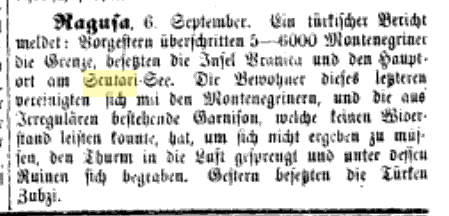
“A Turkish report states: The day before yesterday, 5–6000 Montenegrins crossed the border, occupied the island of Vranina and the main settlement on Lake Scutari. The inhabitants of the latter united with the Montenegrins, and the garrison from Zergalina (Zogaj/Zogalinë), which could offer no resistance, in order not to have to surrender, blew the tower into the air and placed themselves beneath its ruins. Yesterday the Turks occupied Subi (Subhi).”
Montenegrins attack the Albanians of Podgorica and the Albanian retaliate
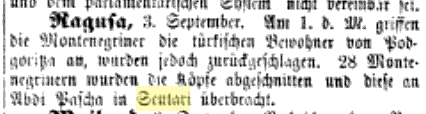
“Ragusa, September 3rd. On the 1st of the week, the Montenegrins attacked the Turkish inhabitants of Podgoriza but were repulsed. 28 Montenegrins had their heads cut off and delivered to Abdi Pasha in Scutari.”
Montenegrins continue to harrass the Albanians of Spiç
“Your account, prepared for all possibilities, regarding the situation in and around Montenegro, the Danube 3rd day, from well-informed Ter Onelle, sends the following report to Cattaro, July 6th:
Since the 30th of May, peace has returned to our Turkish border. The clash between Turks and Montenegrins at Spitsa can be attributed to the following facts: Spitsa notes, especially the Catholic inhabitants, have often complained to Governor Abdi Pasha of Scutari that the Montenegrins are disturbing them and, with the well-known intention, are threatening to pave the way for the annexation of the port and Spitsa to Montenegro.
It is now that Omer Pasha himself, immediately after his arrival in Herzegovina, convened a council and issued orders, according to which Abdi Pasha, by land and sea, reoccupied and fortified the old Venetian fort of Nehai and drove back the invading Montenegrins from this side. At the urging of the foreign consuls, especially the French Hecquard, the Prince Nicholas disapproved of the invasion of his people and recalled them.
However, since friction on various sides is recurring, with two Montenegrins again murdered by Turks in Zhablak on the southern border of the Black Mountains (Montenegro), and the rebels on this side of Trebigne steadily increasing in number and strength, it is to be expected what success the mediation between Prince Nicholas and Serdar, mediated by the European consuls, would have.”
Montenegrins attack the Albanians of Shestan, Kiepi, Bursti and Zugemite
“Antivari (Albania), 7 December. (Fighting with the Montenegrins — the heroic Catholic inhabitants of Lower Shestan.)
Although the Prince of Montenegro had declared his much-vaunted neutrality to the Sublime Porte, bloody fighting nevertheless broke out between the Turks and the Montenegrins.
The Turkish village of Kiepi was attacked by the Montenegrins; the men, women, and children were slaughtered, and the village was plundered.
In another village, Bursti, only a few houses were burned, but the Montenegrins were driven back by the Turks.
To retaliate for these two incursions, a strong group of Montenegrins climbed the heights above the Turkish village of Zugemite, in order to burn the homes of the most prominent inhabitants. They attempted to break through, but could not, and four Montenegriners were killed.
The village of Upper Shestan, according to the treaty concluded with them, allowed the Montenegrins to pass through its territory. Lower Shestan, on the other hand, refused them passage, as did Duchadj.
The Catholic inhabitants of Lower Shestan, although under arrest, drove out a band of Montenegrins who had entrenched themselves in the churchyard, killed ten of them, captured one prisoner, and seized a flag.
When only thirty Montenegrins remained, they abandoned their weapons, and the Christian inhabitants of the village handed these over to the Turks.
The Catholic priest, the women, and the children fled to Antivari.
But the Montenegrins did not dare to attack the people of Shestan in their improvised fortifications and withdrew, swearing to take revenge another time.
The Pasha of Scutari has sent 300 Bashi-Bozuks to protect these localities. Strangely enough, under these circumstances, not a single Turkish warship is present in this harbor.”
Source
Brunner Zeitung der K.K. Privilegirten Mahrischen Lehnbank. Joseph Cölestin Lauer, K.K. Privilegirte Mahrische Lehnbank, 1861

 Balkan Academia