
by Prof. Dr. Musa Ahmeti. Translation Petrit Latifi
The diploma of Balsha II issued on April 24, 1385, issued in Tuz, is original and is preserved in the Dubrovnik State Archives, in the collection: Wiena 1027 [1019; no. 123, an. 1385, N. 20 del Pach VII]. – This diploma has a special importance because for the first and only time we find the title “Duke of Durrës” for Balshaj.
The original diplomas of the well-known Albanian dynasty of the Bashajs, which are today preserved in the Dubrovnik State Archives, are part of those archival-documentary sources of Old Slavonic that have not been published or partially published so far, without critical editions, unaccompanied by facsimiles, untranscribed, which have often been sources of misinterpretation or misinformation for both scholars, historians and the general reader, who do not know medieval Slavonic.
Publishing according to contemporary methods, with a critical edition, accompanied by facsimiles, transcribed into Old Slavonic, translated into Albanian and accompanied by relevant comments as comprehensive as possible, avoiding as much as possible the “tedious details” of diplomacy, sphragistics, heraldry, sigillography and paleography, is a way for these source documents for the late 14th century Albanian medieval history to be accurate and usable for all interested parties.
The diploma that we are publishing on this occasion is well-known by scholars and historians, but for the first time it is published together with quality facsimiles that specialists in medieval studies and Old Slavonic paleography can easily read (see illustration no. 1).
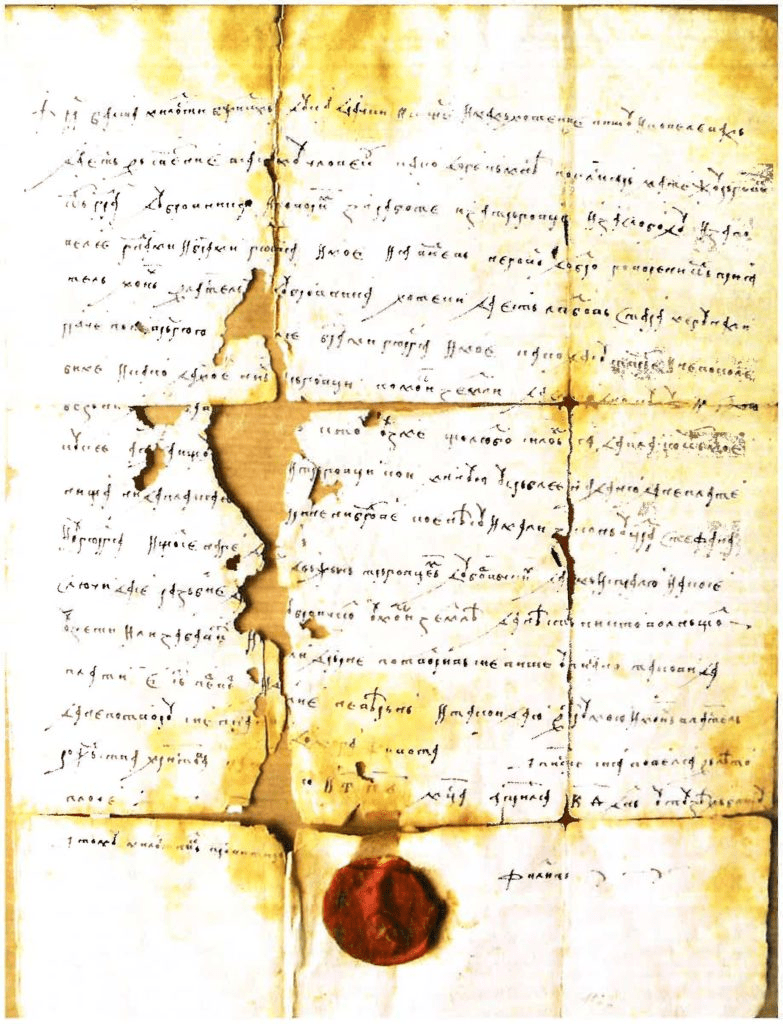
In addition, the publication is also accompanied by a critical apparatus, translation into Albanian, transcription and transliteration. The logic of the accompanying study based on all these scientific elements can be easily followed not only by researchers, but also by amateurs interested in this field and history lovers.
The Balshaj dynasty was one of the most famous Albanian dynasties in the 14th–15th centuries, which extended its possession and rule from the north to the south of the medieval Albanian territories.
Documents in several languages of the time were issued from the chancellery of this dynasty, but on this occasion we are publishing the diploma that is written in Old Slavonic, with the Cyrillic alphabet of the lowercase type.
The Slavic language with the Cyrillic alphabet was practiced by the chancelleries of the medieval Albanian nobility alongside other languages, thus demonstrating diplomatic communication skills with various European and neighboring centers. The diplomas of the Balshaj dynasty that are in the Dubrovnik State Archives, written in Cyrillic graphemes, are 15 in total and belong to the period January 7, 1368 – November 3, 1395.
All these diplomas are written on high-quality half-cardboard paper and are all sealed. The ink used needs no comment, because it has withstood the past 636 years without any damage.
While we are on the seals, we must emphasize that by publishing their facsimiles in their current state, we think that we bring a special contribution to the knowledge of the sigils of the Albanian nobility, even though they are in a serious condition and very damaged, broken and with missing parts.
When talking about seals, we must emphasize that there is a very significant difference: the fifteen diplomas that we have in our hands are sealed with nine different types of seals, it is also important to emphasize that all the seals are printed on paper and are made of wax. None of the seals are made of lead, metal or gold, which is common for the time, but we emphasize again: they are all made of wax.
The fact that only from the Dubrovnik State Archive can we identify nine different types of seals used by the Balshaj chancellery for the period in question is very significant for the importance that medieval Ragusa had for the Balshaj in particular and for medieval Albanian politics in general. We will provide more details about the types of seals when we deal with their examination, their types, dimensions, the content of the texts, heraldic signs and other accompanying elements.
This time we will publish the diploma of April 24, 1385, issued in Tuz. This diploma is presented for the first time in this complete form to Albanian scholars, historians and specialists, but also to the general reader, in facsimile, with transcription [transliteration] in the Cyrillic alphabet, (see illustrations 2 and 3) translated into Albanian, commented on and accompanied by a relevant study.
To date, it has been published by these Slavic scholars: P. Karano-Tvrtković, Srpski spomenici, 87-88; F. Miklosich, Monumenta Serbica, 202-203; Lj. Stojanović, Povelje i pisma I–1, 109–110; B. Šekularac, Dukljansko–zetske povelje, 166-173; where in all these publications there are omissions and errors of various natures. We have tried to correct them, always relying on the original diploma and not on a description.
description. We have not noted any Albanian author or publication, even partially, because all the citations made, not only of this diploma but also of others, are full of errors, since these Albanian authors did not know the Slavic language, and even more so they did not have knowledge of medieval Slavic paleography and Cyrillic reading.
The diploma of Balsha II issued on April 24, 1385, issued in Tuz, is original and is kept in the State Archives of Dubrovnik, in the collection: Wiena 1027 [1019; no. 123, an. 1385, N. 20 del Pach VII]. The text of the diploma is written in 18 lines. The diploma is written in Old Slavonic, with Cyrillic graphemes with elements of Glagolitic, in black, in small writing, in cursive, which is difficult to read in places, as can be seen from the illustrations we are publishing [see illustrations: 1 and 2].
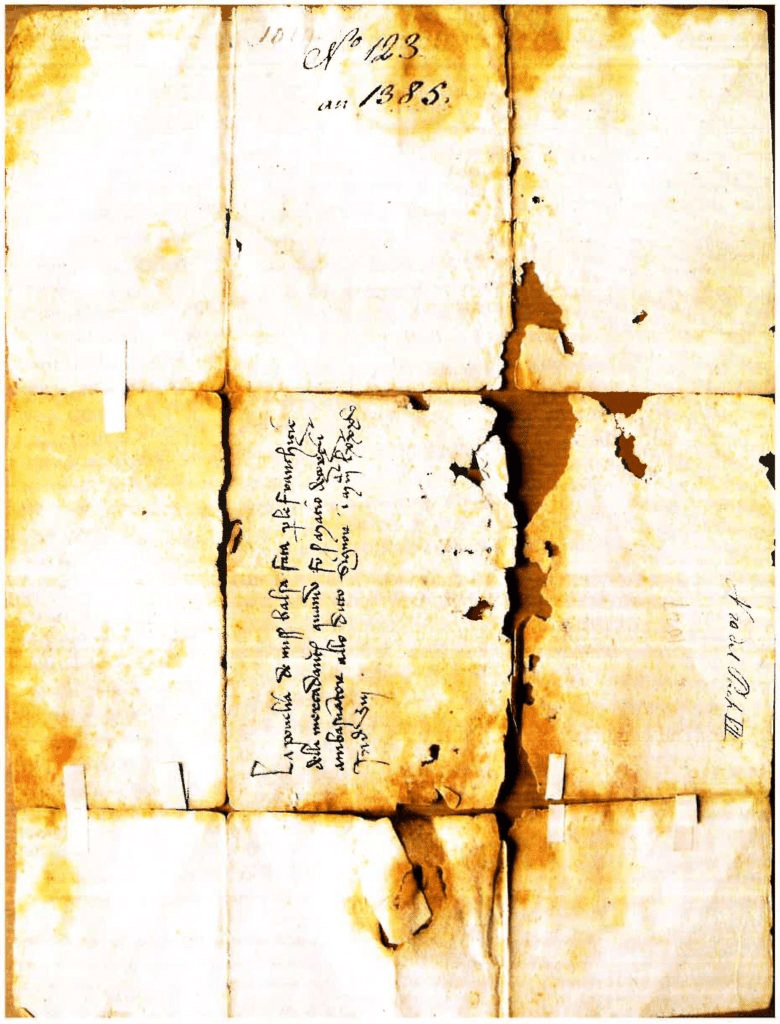
It has been folded horizontally into three parts, and vertically also into three equal parts. It is damaged by the folding, but fortunately the text can be read without any problems, although lines 2 to 17 are damaged in the first fold vertically and horizontally. There are also small, insignificant damages in the first and second folds, both vertically and horizontally. While on the back (verso) of the diploma is marked this text in Italian:
“La pouelia de miser Balsa fata per le franchiçie delli mercadanti, quando fo ser Matio de Çorçi ambasiatore allo ditto signor MCCCLXXXV, ind. VIIpactorum comitis Ragusii cum domino Georgio de Balsa fatia in MCCLXXIII.” (See illustration no. 2).
A very significant element is that all the diplomas issued by the Balshaj chancellery for Ragusa /Dubronvik/, that we know of, are written on paper-half cardboard. If we analyze this fact, then we can draw a conclusion that from the middle of the 14th century (1360) to the beginning of the 15th century (1405) in all the chancelleries of the Albanian nobles, but also those of neighboring states, diplomas were written on paper, that is, not on parchment, although we do not exclude the possibility of using parchment in special cases. If we also look at the diplomas of the Kastriots (John of George-Skenderbeg), the Dukagjins and Alexander of Kanina, etc., from the period in question, they are all written on half-cardboard paper.
As for the writing, as was the custom of the time, it has numerous abbreviations, which we have broken down in transcription [transliteration]. In small brackets “()” we have put the graphemes that are missing in the relevant words according to today’s reading of Slavic, while in large square brackets “[]” we have put the graphemes of abbreviations of words that was the practice of the time, while in straight brackets “||” we have put the number of the beginning of the line of the diploma text.
In transcription [transliteration] we have preserved all the punctuation marks of the time. No intervention or improvement of any grapheme or word has been made: everything has been left as it is in the original.
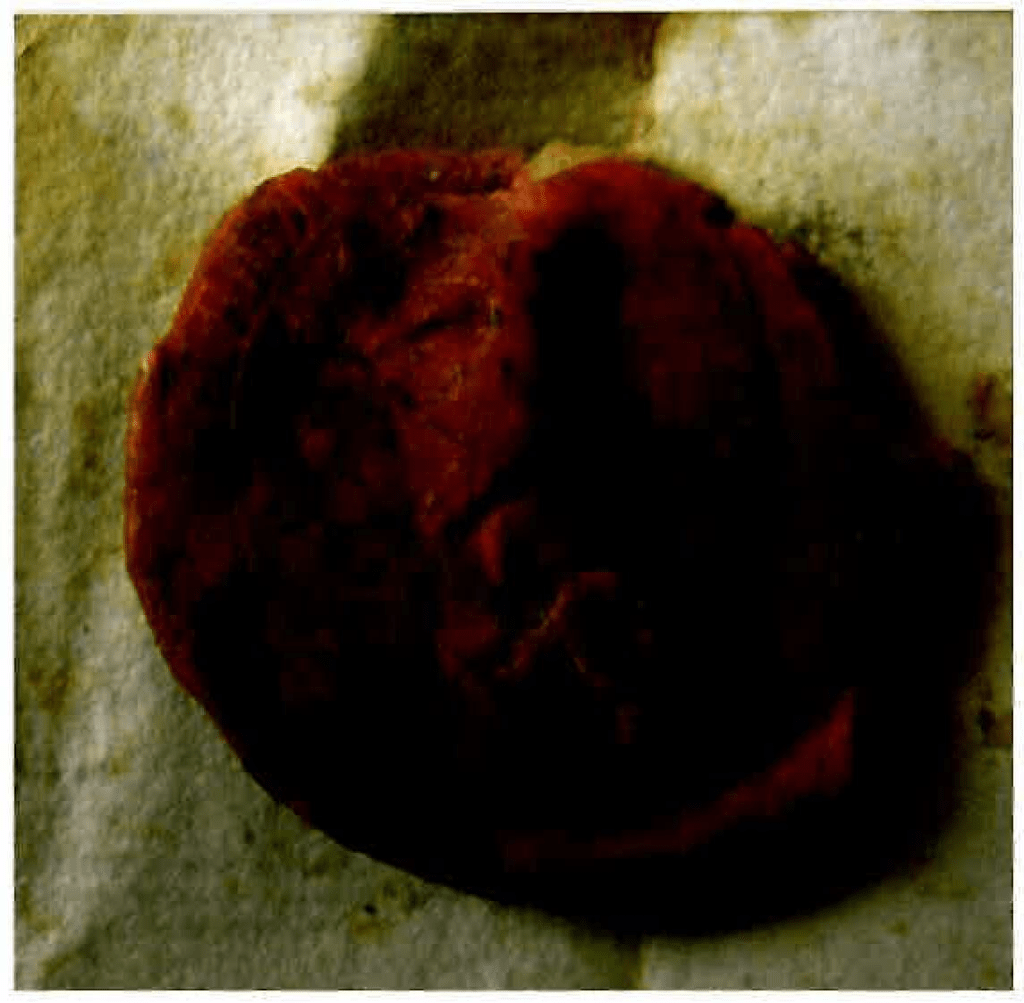
At the end of the 19th century, a simple restoration of this diploma was made, where 5 short strips of white paper were placed so that the diploma would not be torn or damaged even more. The diploma is certified with a red, round wax seal, which is attached to a strong cardboard strip attached to the paper, this very special case and which was used intentionally by Filip Barelli so that no one else could write anything else below the text he wrote.
The seal is at the end of the text written in the middle of the paper. The seal is half damaged. In the middle of the seal, the figure of a wolf is visible, while on the left side of the circle there are some graphemes that are not easily read.
The original seal has dimensions: 3.6cm x 3.4cm and a thickness of 0.5cm. [See illustration no. 3]. The cause of the damage to the seal is the frequent movement of this document in the relations: Dubrovnik-Vienna-Belgrade-Dubrovnik. This document was written by the protovestiari (the person who kept the finances of the Balsha family) Filip Bareli.
For the first time, this diploma was published in 1840. It has known several reprints, but never correctly and with numerous errors. The transcription [transcription] of the original diploma with the signature: Wiena 1027 [1019; no. 123, an. 1385, N. 20 del Pach VII], is very difficult not only for researchers and historians, who are not specialists in Slavic paleography, especially Cyrillic and Glagolitic, but also for those who have long experience in transcriptions [transcriptions] of this type of writing.
The numerous abbreviations and the fine handwriting and in some cases, the special signs of the scribe Filip Bareli, make the transcription [transcription] even more difficult. This diploma, which has the character of a public document, bears within itself all the characteristics of documents of this historical era.
At the beginning is the symbolic invocation, followed by the verbal invocation and the date. The symbolic invocation, represented by the sign of the cross, indicates the submission to the power the real allegiance of the Balshajs to the church, showing absolute loyalty to the church.
The verbal invocation, which is used in this document, is a frequent characteristic of such Slavic documents. With this, the value of the document was increased by wishing that the purpose for its destination would be achieved. In this case, it is expressed in the form: “I Balsha, by the grace of God, Duke of Durrës…”
Immediately following is the intitulation which in this case is long and extends to 4 lines in the original: “I Balsha, by the grace of God, Duke of Durrës and further, write and order that it be known to everyone, that the envoy of the city of Dubrovnik Mate Zhurgoviqi has come to me and spoke to me about work and about merchants and about freedom and about the diploma of my brother Gjergji and mine.”
So on this occasion Balsha II confirms the diploma issued by him and his brother Gjergji in 1379 for the citizens and merchants of Dubrovnik. The reason for issuing this new diploma is the fact that Balsha II had brought new territories under his rule, but at the same time there were complaints from the Dubrovnik citizens that the previous diploma was not respected and that they were being robbed, chased and killed by the citizens of Balsha II, as were the most serious cases in Vreg at the mouth of the Shkumbini, in Shën Sirgj i Bunës, in Shkodër, Tivar, etc.
This diploma has a special importance because for the first and only time we find the title “Duke of Durrës” for the Balshajs in the diplomas that came out of their chancellery and that we know to this day. In fact, we find this title once again but in a diploma in Greek from the same year. 1385.
Usually, at this time, the date is noted at the end of the text (which in our case is also noted in this diploma) in the form: April 24, 1385 from the birth of Christ. In the dating, we have two interesting moments that should be highlighted: a) Filip Barelli has marked only the year one thousand with letters as a whole, while he marks the other numbers with graphemes according to the practice of the time, this form of dating is characteristic of all diplomas issued by the Balshaj chancellery in the Slavic language, and the second moment b) the graphemes which are equivalent to the numbers of the dates, the scribe has marked with an “X” above each grapheme.
Whereas the disposition, as the most important part of the diplomatic act, which in itself encompasses the moral and material object, which is dedicated to the recipient, is presented to us in the form where Balsha II states:
“I, seeing his true words from the friend and nobility of the city of Dubrovnik and wishing that there will be old love between us, confirm the diploma of my brother Gjergji and mine, affirming the invariability and that their merchants who pass through my properties, freely sell and buy without any obstacle.
To continue then with a very interesting and very special statement that is almost never found in similar diplomas of the time: if any of them lose something in my territory or under my rule, I Balsha II, if I cannot find the culprit to hand over to the Dubrovnik nobility, I will pay the damage, and in the last part of the provision Balsha II claims that this diploma is valid “for my lifetime” which represents an interesting moment where an Albanian nobleman does not oblige his descendants with what he has promised himself for his lifetime.
Meanwhile, in the exposition (narration) the actual circumstances for the decision to write such a diplomatic act are explained: “I confirm the diploma of my brother Gjergji and mine by affirming the invariances” so the purpose of issuing the diploma is emphatically affirmed. The reinforcement usually begins with a symbol, which in this case we do not have, but we only have the name and signature of Filip Barelli.
Here too, there is a special moment, because at this time it was practiced to have more than one witness. The diploma does not have the autograph signature of Gjergj Balsha, but it does have his seal. We do not have a signature on any of the 15 diplomas we have under review. The seal was sufficient as evidence of the authority issuing it and as such in the Dubrovnik chancellery it had a considerable weight.
In addition to the elements mentioned, this diplomatic act also lacks some standard or cliché parts, which are found in similar diplomas from the same period. These absences do not diminish the importance and authenticity of this diploma.
Translation:
The diploma of the Duke of Durrës Balsha II to Dubrovnik
“Tuz, April 24, 1385
I Balsha, by the grace of God, Duke of Durres and beyond, write and order that it be known to everyone, that the envoy of the city of Dubrovnik, Mate Žurgović, has come to me and spoke to me about work and about merchants and about freedom and about the diploma of my lord brother Gjergj and mine.
I, seeing his true words from the friend and nobility of the city of Dubrovnik and wishing that there be old love between us, confirm the diploma of my brother Gjergj and mine by affirm the invariances and that their merchants who pass through my possessions, freely sell and buy without any hindrance.
If anyone takes anything from them by force, I will pay from my house and I will seek the guilty.
The merchants who go to Serbia through Danja will not pay anything and will not pay customs and river crossings that were not established by law in the time of Emperors Stefan and George.
That the Dubrovnik merchants be paid what they think I owe them.
If a Dubrovnik ship happens to be wrecked on my land, no one will dare to take anything or hinder them.
Whoever dares to act contrary to what is written above, I will pay 500 perper and will be a traitor.
And thus I testify my loyalty and my nobility so that this [diploma, m.a.] written for my lifetime may not be broken.
This diploma was written on April 24, 1385 from the birth of Christ, in Tuz near Ploče.
For this, with love, the protovestiari Filip.”
Referemce
https://gazetadielli.com/diploma-e-dukes-se-durresit-balshes-ii-nga-viti-1385-per-dubrovnikasit/

 Balkan Academia