

In 1862, the Allgemeine Zeitung Munchen published an article about the Montenegrin attacks, denounced as “barbaric”, on the Albanian villages in and around Shestan and Krajë.
Cited:
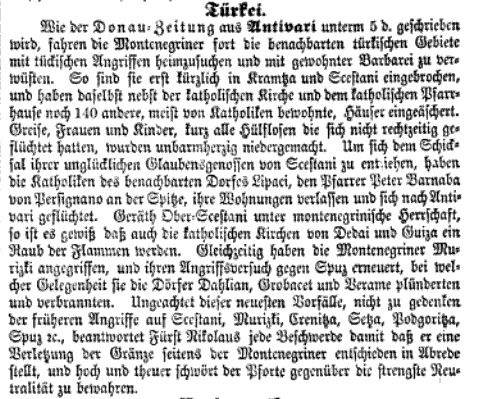
“As the Donau-Zeitung reports from Antivari under the 5th, the Montenegrins continue to raid the neighboring Turkish territories with their attacks and to devastate them with the utmost barbarity. Most recently they broke into Krniza and Sceslani (Shestan), and there they burned down the Catholic church and the Catholic rectory, along with 140 other houses, mostly inhabited by Catholics. Elderly people, women, and children who could not reach safety in the hills in time were inhumanely slaughtered.
To escape the fate of their unfortunate co-religionists in Sceslani, the Catholics of the neighboring village of Sguica, led by the priest Peter Baranka of Persjana, left their homes and fled to Antivari. Since Upper Sceslani has fallen under Montenegrin control, it is certain that the Catholic churches of Sedai and Sguica will also be reduced to ashes.
At the same time, the Montenegrins attacked Murziit (Muiqi), and renewed their assault on Suga, during which they plundered and burned the villages of Poliana, Groduan, and Bearta.
We can scarcely believe it, but it is further reported that, regarding earlier attacks on Sceslani, Murziit, Semika, Seca, Bogodriza, Stya, etc., Prince Nichita has rejected every complaint, denying that any border exists which could restrict Montenegrin incursions — while on our side we are required by the Porte to observe strict neutrality.”
Correction of distorted names
| Historical name (in newspaper) | Modern name | Notes / Location |
|---|---|---|
| Krniza | Kërnica / Kernicë | Still exists. A village in the Krajë (Shestan) region, Albania. |
| Sceslani / Ober-Sceslani | Upper Shestan (Shestani i Epërm) | Catholic Albanian mountain settlement above Lake Skadar. |
| Unter-Sceslani | Lower Shestan (Shestani i Poshtëm) | Lower part of the historic Shestan community. |
| Sguica | Shgjejkë / Shgjeq | Small settlement in Krajë–Rumija region. Appears as Sguica or Sguizza on 19th-c. maps. |
| Sedai | Sedaj / Sedajë | A Shestan-area locality; appears in Ottoman tax records as Sedaj. |
| Murziit | Muriq / Muriqi | Still exists today on the southern shore of Lake Skadar. |
| Suga | Shuq / Shuk / Shuga (disappeared site) | A lost or reduced hamlet in Shestan/Krajë, often mentioned in 19th-c sources but no longer inhabited. |
| Poliana | Poljan / Poljana | Located on the Montenegrin side near Rumija/Plavnicë. |
| Groduan | Grodua / Groduanë | Historically attested Shestan-area hamlet; now abandoned. |
| Bearta | Beratë / Berata | Another vanished Shestan locality, recorded in several Austrian reports. |
| Bogodriza | Bogëdricë / Bogodricë | Appears in multiple 19th-century reports; likely reduced/abandoned today. |
| Stya | Stjaj / Stja / Stije | A Rumija/Shestan-area hamlet; historical, likely no longer active. |
| Semika | Modern equivalent: very likely Cemikë / Çemikë | Appears as Chemike, Cemike, Cemikë on Habsburg military maps (Franziszeische Karten). |
| Seca | Modern equivalent: Sekë / Seka A known Shestan locality. | Appears as Seka, Seke, Secha in Austrian and Italian records. Usually paired with neighboring hamlets like Bogodriza and Stja/Stye. |
Reference
Allgemeine Zeitung Munchen 1862

 Balkan Academia