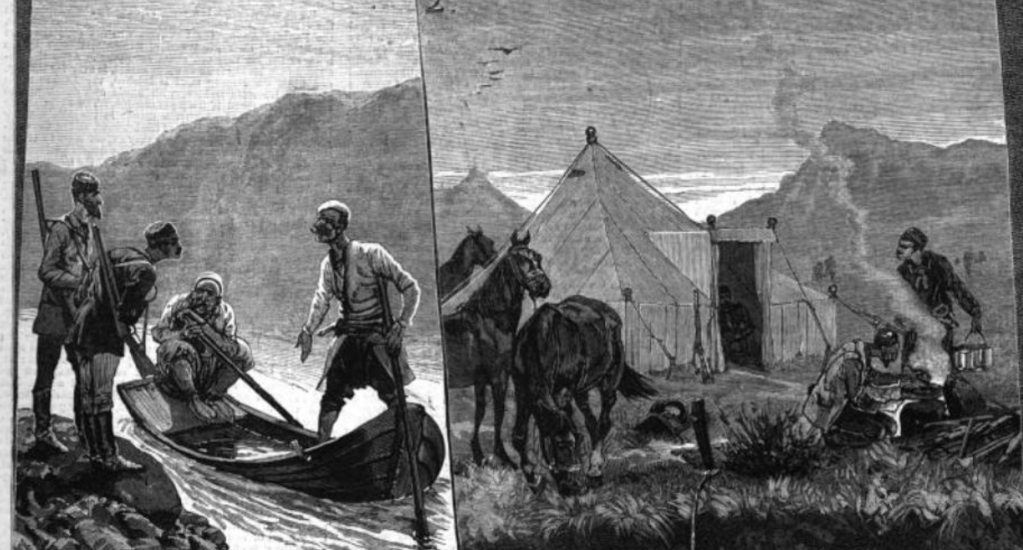

Summary: The Montenegrin attempt to capture Antivari (Tivari) in July 1876 failed. Although some local Montenegrin reports claimed victory, independent European newspapers and modern historians agree that Ottoman forces repelled the attack at the Sutorman Pass and held the city. Antivari remained under Ottoman control until the Treaty of Berlin in 1878. The exaggerated Montenegrin reports are considered wartime propaganda rather than reliable accounts.
Background
When the Montenegrin–Ottoman War began in July 1876, Antivari (today Tivari) was one of the most important coastal strongholds in the southern Adriatic. Montenegro hoped to break through the mountain passes above the city and reach the sea for the first time in its history. But although the Montenegrins won battles elsewhere, especially inland, they did not manage to take Antivari.
The fighting near antivari
In late July 1876 Montenegrin forces tried to advance through the Sutorman Pass, the steep route running down toward Antivari. According to European newspapers of the time—especially those from Vienna and Paris—Ottoman forces successfully repelled the Montenegrin attacks and pushed them back into the mountains.[1]
Some Montenegrin commanders wrote highly optimistic reports claiming large victories, often describing heavy Ottoman losses with almost no Montenegrin casualties. These reports were printed in local newspapers, but they were not confirmed by any foreign observers or governments. Modern historians generally describe them as morale-boosting propaganda rather than reliable accounts.[2]
Outcome
Despite the claims in some local reports, Antivari remained firmly under Ottoman control throughout 1876 and 1877.[3] The city did not come under Montenegrin rule until 1878, when the Treaty of Berlin awarded it to Montenegro after the larger Russo–Turkish War changed the balance of power.[4]
The failure to take Antivari in 1876 shows the limits of Montenegrin military strength at the time: although brave and determined, their small forces could not break through well-defended Ottoman positions along the coast.
Signifance
Antivari was crucial for Montenegro because it represented the country’s long-desired access to the sea. But they needed major international changes—specifically Russia’s victories against the Ottoman Empire—to finally gain the port in 1878. Because of this, the overly triumphant Montenegrin reports from 1876 are considered unreliable today.
Footnotes
- Contemporary European newspaper summaries from Vienna, Paris and London consistently reported Ottoman success near Antivari and described Montenegrin withdrawals.
Sources used: European press summaries - Historians note that Montenegrin commanders often issued exaggerated battlefield bulletins during 1876, especially compared to foreign diplomatic reports.
Sources used: Stillman, Herzegovina and the Late Uprising. modern war overviews - Regional historical studies of Stari Bar confirm that Antivari/Bar remained under Ottoman rule until 1878.
Source used: Ottoman Times: The Story of Stari Bar - The Treaty of Berlin (1878) formally transferred Antivari/Bar to Montenegro, showing that Montenegro did not control the port earlier.
Sources used: Britannica summary of San Stefano/Berlin negotiations

 Balkan Academia