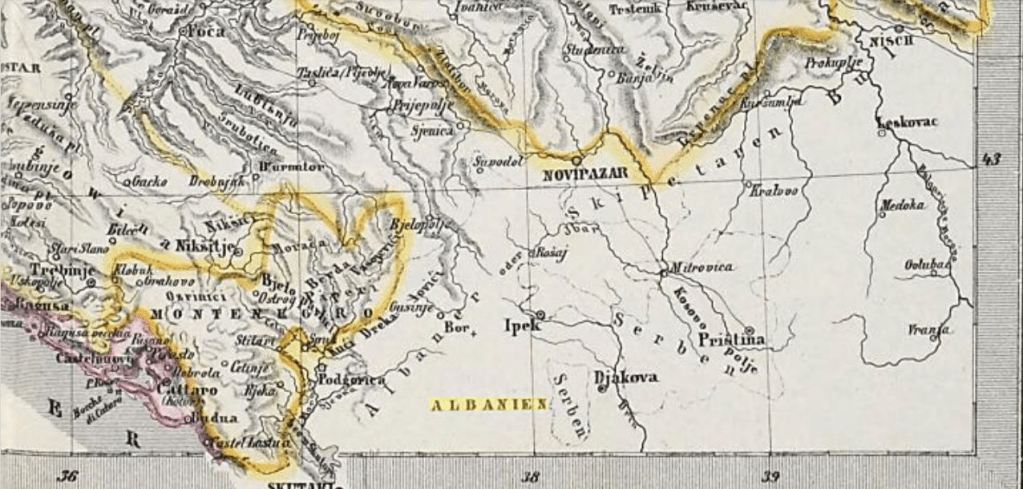

In the publication “Dal Montenegro al golfo di Ambracia” by Italian ethnologist and geographer Antonio Baldacci, written in the 1900s, we can read that the Montenegrins (former Albanians) of Orahovo, Duje, Kuci, Koci, Medun and Fundina all spoke Albanian just 50 years ago, which constitutes roughly the 1850s.
Cited:
“The Montenegrins of Orahovo, Duje, Medun, and Fundina spoke Albanian fifty years ago, but they were Eastern Greek, as in other Kuci villages in much earlier times. Today, almost all of them speak Serbian, but they still have many Albanian customs and habits, including, in part, the style of dress, and they intermarry with the Albanians of Trijepsi, Gruda, and the surrounding tribes beyond the border. And that is why this remarkable island of Kujei, like perhaps almost all of the Nahija, is still highly worthy of study.”
“The generic name of Malissori or mountain dwellers refers to the tribes located between the Adriatic Sea, Montenegro, the western edge of the Metoja plateau between Ipek, Djakova, Prizren, and the Orino. Two of them passed under the dominion of Montenegro with the Treaty of Berlin, and are the characteristic tribes of the Trijepci (Zatrijebac), to which the second and very small tribe of the Koci is very similar.
The first (1,300 Catholics and 15 Mohammedans) extends between the territory of Orahovo (Cafa Cvotdeca and Korita), the mountains Hum Orahovski and Soko, the river Cem (Cijevna) up to the peak of Kukbué, and finally the territory of Fundina; the tribe of the Koci (7,000 Catholics) occupies a few villages between Orahovo, the Trijepci, Fundina, and Medun.”

 Balkan Academia