
Abstract: The provided text examines the persistence of Illyrian, Albanian, and other pre-Slavic ethnocultural elements within several populations and regions along the eastern Adriatic—particularly Risano (Risan), Canali, Breno, Herzegovina, and Ragusa (Dubrovnik). Despite their current Slavic language, these communities show physical, linguistic, and historical markers linking them to older Illyro-Roman, Dacian, and Albanian substrata. Archaeological excavations, toponymy, folk traditions, and craniological studies all indicate substantial continuity of pre-Slavic populations. The analysis highlights how Romanized Illyrians (including Vlachs/Walachians) endured well into the medieval period, leaving visible traces in physical anthropology, place-names, and cultural memory.
The native Lar of Risano
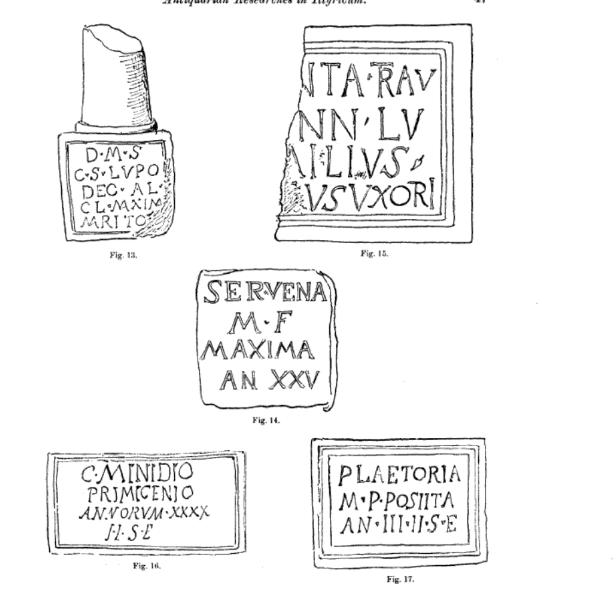
“The occurrence of this and other indigenous names on Risinian monuments taken in connexion with the abiding cult of the native Lar show that the Illyrian element continued to hold its own in the Roman city and I may observe that the modern Risanotes though at present entirely of Slavonic speech must ethnologically be classed with the Albanian descendants of these same Illyrians.
The finely modelled head the aquiline nose such as King Balleos displays on his Rhizonian coins the stricti artus minax vultus recall at once the Illyrian aborigines of ancient writers and the modern Skipetar. Meanwhile the Risanote tales about Queen Teuta or Czaritza Tiuda as they call her may be safely placed in the same category with the Ragusa Vecchian traditions of Dolabella and Cadmus “.
Albanian and Illyrian symtoms in Canalese, Brenese and Hercegovinian peasants
“Physical types, distinctively un-Slavonic and presenting marked Albanian affinities (an Illyrian symptom), are still to be detected among the modern Canalese Brenese and Herzegovinian peasants mingled with types as characteristically Slav. Their language however is at the present day a very pure Serbian dialect and taken by itself affords us no clue to the fact illustrated in this case by historical record by craniological observations and by the stray survival of local names that their forefathers were as much or more Illyro-Roman than Slavonic.”
Ragusa or Cavtat (Capětatě) and pre-Slavic elements
“Ragusa – the new Epitaurum – was in the time of Constantine Porphyrogenitus still a Roman city and though in the course of the succeeding centuries Ragusa became a Slav speaking community there are still interesting traces of her older Illyro-Roman speech to be found in the later dialect while the names of many of the surrounding villages clearly indicate a Neo Latin origin.
The name Cavtat in its earlier form Capětatě still applied by the present Slav speaking population of the neighbourhood to the town that occupies the Epitaurian site is as we have seen simply a Rouman Civitate to be compared with the Wallachian Cetate or Citat and the Albanian Giutet or Kiutet. Molonta Vitaljina and other Canalese villages still present us with non-Slavonic name forms and there is documentary evidence that as late as the fifteenth century the shepherds who pastured their herds on the mountains of Upper Canali were still Rouman or Wallachian”.
Dacian, Illyrian, pre-Slavic and Albanian elements of Canali, Mrcine, and Hajdeu
“Excavations made by Dr Felix von Luschan and myself in the mediæval cemeteries of Canali have supplied craniological proofs of the existence here in the thirteenth and fourteenth centuries of a non Slavonic race presenting apparently Illyrian and Albanian affinities. What is especially pertinent in this regard a large number of the skulls on which this generalisation is based were obtained from a medivval graveyard above the present village of Mrcine known from old Ragusan records to have been a Vlach or Rouman centre as late as the fifteenth century.
The name Mrcine itself written Marzine according to the Ragusan orthography appears to me to be of the highest interest. It is a characteristically Rouman word and is found with its derivatives in the present Rouman lands north of the Danube under the form Mrăcina or Măracină meaning the prickly thorn, of Eastern Europe Cratægus Oxyacantha, the Slav Drač, with which indeed the rocks of Mrcine are covered.
The Roumanian antiquary Hajdeu who notices its appearance as a Vlach surname in a chrysobull of the Serbian Emperor Dušan which contains many references to the still existing Rouman population in the old Serbian regions after pronouncing the word justly enough to be neither of Latin nor of Slavonic origin expresses his opinion that it is probably derived from the old Dacian tongue.
It would seem to be rather of Illyrian origin for the modern word for blackthorn among the Albanians the existing representatives of the Illyrian stock is Muris zi in the plural Muriza-te. The name Mrzine or Mrcine appears in this case to have been a Rouman equivalent for the old Slavonic name of the hilly district on whose borders it lies: Dračevica or the Thorny Country from drač drača the Serb equivalent of the Wallachian Mărăcina”
Source
Antiquarian Researches in Illyricum, Volume 1-2. Sir Arthur Evans. 1883 https://www.google.se/books/edition/Antiquarian_Researches_in_Illyricum/g34OAAAAQAAJ?hl=sv&gbpv=0

 Balkan Academia