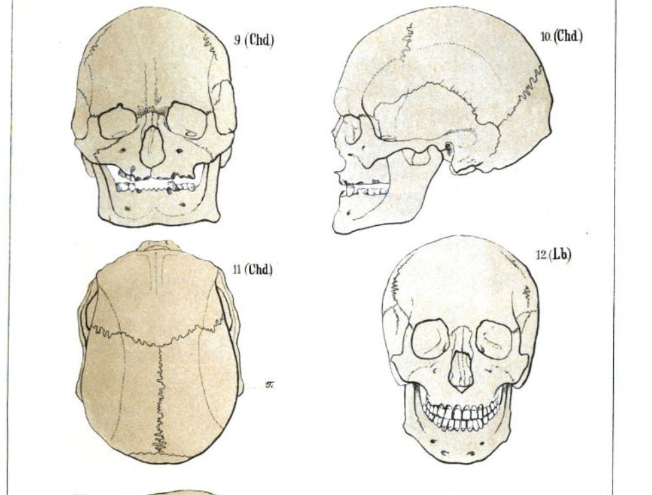

In the publication “Archiv für Anthropologie Zeitschrift für Naturgeschichte und Urgeschichte des Menschen”, Volume 14 from 1883, we can read of an inspection of Albanian skulls in 1877 by Virchow.
Cited:
“Skulls from Albania were described by Virchow in 1877 of which I describe here as accurately as possible using the author’s own words and figures. An Albanian, a leader, killed in the fighting in Montenegro in 1877, perhaps a classic specimen, exhibits the following characteristics in his skull: The bones are robust, seemingly very thick; the skull is exceptionally large, distinctly brachycephalic, of medium height, and strongly mesorrhinate, close to the border of the platyrrhine.
The temporal plane is smooth and high, becoming flatter anteriorly and inferiorly. In the norma verticalis, this feature is still prominent despite the width. The forehead is only slightly arched, the parietal tuberosities flat, and the parietal suture almost completely effaced. In the norma frontalis, the face appears gracile and not high in comparison to the broad skull.
I calculate a chame prosop facial index of 89.2. Despite the considerable distance between the zygomatic arches, the facial index increases, and the length of the face is assumed to reach this level (125 mm), although neither the height of the The difference in height of the upper jaw and the lower jaw is very considerable. 69 31 100.
Assuming a length of 20 mm for the missing teeth, the facial height would be 5 mm shorter, thus reducing the facial index to 85 7. If we consider the upper jaw index, the expression of chameprosopia becomes striking with 49 2. The orbital openings, broad and low, have an index of 79 2. The nose is short and broad, reaching to the platyrrhine. The margin of the nasal opening is sharp, the canine fossae moderately deep, the alveolar process low and not insignificantly prominent. The palate is very broad with an index of 95″.1
Sources

 Balkan Academia